1
Arc Length
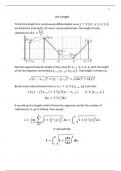
To find the length of a continuously differentiable curve 𝑦 = 𝑓 (𝑥 ); 𝑎 ≤ 𝑥 ≤ 𝑏,
we divide the interval [𝑎, 𝑏] into 𝑛 equal subintervals. The length of each
𝑏−𝑎
subinterval is ∆𝑥 = .
𝑛
𝑓(𝑥1 )
𝑓(𝑥0 ) 𝑓(𝑥4 )
𝑓(𝑥2 )
𝑓(𝑥3 )
𝑎 = 𝑥0 𝑥1 𝑥2 𝑥3 𝑥4 = 𝑏
We then approximate the length of the curve for 𝑥𝑖−1 ≤ 𝑥 ≤ 𝑥𝑖 with the length
of the line segment connecting (𝑥𝑖−1 , 𝑦𝑖−1 ), (𝑥𝑖 , 𝑦𝑖 ). That length is written as:
√(𝑥𝑖 − 𝑥𝑖−1 )2 + (𝑦𝑖 − 𝑦𝑖−1 )2 = √(∆𝑥 )2 + (∆𝑦)2
By the mean value theorem there is a 𝑐𝑖 = 𝑥𝑖∗ ∈ [𝑥𝑖−1 , 𝑥𝑖 ] such that:
𝑓(𝑥𝑖 ) − 𝑓(𝑥𝑖−1 ) = 𝑓 ′ (𝑥𝑖∗ )(𝑥𝑖 − 𝑥𝑖−1 ) ; 𝑥𝑖∗ ∈ [𝑥𝑖−1 , 𝑥𝑖 ]
∆𝑦𝑖 = 𝑓 ′ (𝑥𝑖∗ )∆𝑥
If we add up the lengths of all of these line segments and let the number of
subintervals, 𝑛, go to infinity, then we get:
𝑛 𝑏
2 2
𝐿 = lim ∑ √1 + (𝑓 ′ (𝑥𝑖∗ )) ∆𝑥 = ∫ √1 + (𝑓 ′ (𝑥 )) 𝑑𝑥
𝑛→∞ 𝑎
𝑖=1
or equivalently:
𝒃
𝒅𝒚 𝟐
𝑳 = ∫ √𝟏 + ( ) 𝒅𝒙.
𝒂 𝒅𝒙
, 2
3
2
Ex. Find the length of the curve given by 𝑦 = 𝑥 2 + 1 for 0 ≤ 𝑥 ≤ 3.
3
3
𝑑𝑦 2
𝐿 = ∫ √1 + ( ) 𝑑𝑥
0 𝑑𝑥
3
2
𝑦 = 𝑥2 + 1
3
1
𝑑𝑦
= 𝑥2
𝑑𝑥
𝑑𝑦 2
(𝑑𝑥) =𝑥
3 𝑥=3
2 3
𝐿 = ∫ √1 + 𝑥 𝑑𝑥 = (1 + 𝑥 )2 |
0 3 𝑥=0
3 3
2 2 3 3
= [(1 + 3)2 − (1 + 0) ] = 2 [42 −1 ]
2
3 3
2 14
= [ 8 − 1] = .
3 3
If a curve is given by 𝑥 = 𝑔(𝑦), 𝑐 ≤ 𝑦 ≤ 𝑑 where 𝑔′ (𝑦) is continuous, then a
similar argument to the case where 𝑦 = 𝑓 (𝑥 ) gives us:
𝒚=𝒅
𝟐
𝒚=𝒅
𝒅𝒙 𝟐
𝑳=∫ √𝟏 + (𝒈′ (𝒚)) 𝒅𝒚 = ∫ √𝟏 + ( ) 𝒅𝒚.
𝒚=𝒄 𝒚=𝒄 𝒅𝒚
Arc Length
To find the length of a continuously differentiable curve 𝑦 = 𝑓 (𝑥 ); 𝑎 ≤ 𝑥 ≤ 𝑏,
we divide the interval [𝑎, 𝑏] into 𝑛 equal subintervals. The length of each
𝑏−𝑎
subinterval is ∆𝑥 = .
𝑛
𝑓(𝑥1 )
𝑓(𝑥0 ) 𝑓(𝑥4 )
𝑓(𝑥2 )
𝑓(𝑥3 )
𝑎 = 𝑥0 𝑥1 𝑥2 𝑥3 𝑥4 = 𝑏
We then approximate the length of the curve for 𝑥𝑖−1 ≤ 𝑥 ≤ 𝑥𝑖 with the length
of the line segment connecting (𝑥𝑖−1 , 𝑦𝑖−1 ), (𝑥𝑖 , 𝑦𝑖 ). That length is written as:
√(𝑥𝑖 − 𝑥𝑖−1 )2 + (𝑦𝑖 − 𝑦𝑖−1 )2 = √(∆𝑥 )2 + (∆𝑦)2
By the mean value theorem there is a 𝑐𝑖 = 𝑥𝑖∗ ∈ [𝑥𝑖−1 , 𝑥𝑖 ] such that:
𝑓(𝑥𝑖 ) − 𝑓(𝑥𝑖−1 ) = 𝑓 ′ (𝑥𝑖∗ )(𝑥𝑖 − 𝑥𝑖−1 ) ; 𝑥𝑖∗ ∈ [𝑥𝑖−1 , 𝑥𝑖 ]
∆𝑦𝑖 = 𝑓 ′ (𝑥𝑖∗ )∆𝑥
If we add up the lengths of all of these line segments and let the number of
subintervals, 𝑛, go to infinity, then we get:
𝑛 𝑏
2 2
𝐿 = lim ∑ √1 + (𝑓 ′ (𝑥𝑖∗ )) ∆𝑥 = ∫ √1 + (𝑓 ′ (𝑥 )) 𝑑𝑥
𝑛→∞ 𝑎
𝑖=1
or equivalently:
𝒃
𝒅𝒚 𝟐
𝑳 = ∫ √𝟏 + ( ) 𝒅𝒙.
𝒂 𝒅𝒙
, 2
3
2
Ex. Find the length of the curve given by 𝑦 = 𝑥 2 + 1 for 0 ≤ 𝑥 ≤ 3.
3
3
𝑑𝑦 2
𝐿 = ∫ √1 + ( ) 𝑑𝑥
0 𝑑𝑥
3
2
𝑦 = 𝑥2 + 1
3
1
𝑑𝑦
= 𝑥2
𝑑𝑥
𝑑𝑦 2
(𝑑𝑥) =𝑥
3 𝑥=3
2 3
𝐿 = ∫ √1 + 𝑥 𝑑𝑥 = (1 + 𝑥 )2 |
0 3 𝑥=0
3 3
2 2 3 3
= [(1 + 3)2 − (1 + 0) ] = 2 [42 −1 ]
2
3 3
2 14
= [ 8 − 1] = .
3 3
If a curve is given by 𝑥 = 𝑔(𝑦), 𝑐 ≤ 𝑦 ≤ 𝑑 where 𝑔′ (𝑦) is continuous, then a
similar argument to the case where 𝑦 = 𝑓 (𝑥 ) gives us:
𝒚=𝒅
𝟐
𝒚=𝒅
𝒅𝒙 𝟐
𝑳=∫ √𝟏 + (𝒈′ (𝒚)) 𝒅𝒚 = ∫ √𝟏 + ( ) 𝒅𝒚.
𝒚=𝒄 𝒚=𝒄 𝒅𝒚