1
The Concept of a Limit
𝑫𝒊𝒔𝒑𝒍𝒂𝒄𝒆𝒎𝒆𝒏𝒕
Average Velocity= .
𝑻𝒊𝒎𝒆
Ex. A driver leaves city A and drives 150 miles to city B. If the driver leaves city A
at 2pm and arrives at city B at 5pm, find the average velocity.
150𝑚𝑖𝑙𝑒𝑠
Average Velocity= = 50𝑚𝑝ℎ
3ℎ𝑟𝑠
If the position of an object at time 𝑡 is given by 𝑆(𝑡), then the average velocity
for 𝑡1 ≤ 𝑡 ≤ 𝑡2 is given by:
𝑆(𝑡2 )−𝑆(𝑡1 )
𝑣𝑎𝑣𝑒 = .
𝑡2 −𝑡1
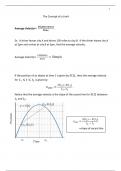
Notice that the average velocity is the slope of the secant line for 𝑆(𝑡) between
𝑡1 and 𝑡2 .
(𝑡2 , 𝑆(𝑡2 ))
𝑦 = 𝑆(𝑡)
𝑃𝑜𝑠𝑖𝑡𝑖𝑜𝑛
𝑆(𝑡2 ) − 𝑆(𝑡1 )
𝑣𝑎𝑣𝑒 =
𝑡2 − 𝑡1
(𝑡1 , 𝑆(𝑡1 ))
=slope of secant line
𝑡1 𝑡2
𝑇𝑖𝑚𝑒
, 2
Ex. A projectile is launched vertically upward at 128 𝑓𝑡⁄𝑠𝑒𝑐 . Neglecting air
resistance, the height of the projectile in feet above the ground after time
𝑡 ≥ 0 is given by 𝑆(𝑡) = −16𝑡 2 + 128𝑡, 0 ≤ 𝑡 ≤ 8 𝑠𝑒𝑐.
a. Find the average velocity between 𝑡 = 1 𝑠𝑒𝑐 and 𝑡 = 4 𝑠𝑒𝑐 .
b. Find the average velocity between 𝑡 = 1 𝑠𝑒𝑐 and 𝑡 = 2 𝑠𝑒𝑐 .
c. Find the average velocity between 𝑡 = 1 𝑠𝑒𝑐 and 𝑡 = 7 𝑠𝑒𝑐 .
(4, 256)
𝑆(4) − 𝑆(1)
𝑃𝑜𝑠𝑖𝑡𝑖𝑜𝑛
𝑣𝑎𝑣𝑒 =
4−1
(1, 112)
1 4
𝑇𝑖𝑚𝑒
𝑆(𝑡2 )−𝑆(𝑡1 ) 𝑆(4)−𝑆(1) 256−112
a. For 1 ≤ 𝑡 ≤ 4, 𝑣𝑎𝑣𝑒 = = =
𝑡2 −𝑡1 4−1 4−1
= 48 𝑓𝑡⁄𝑠𝑒𝑐 .
𝑆(𝑡2 )−𝑆(𝑡1 ) 𝑆(2)−𝑆(1) 192−112
b. For 1 ≤ 𝑡 ≤ 2, 𝑣𝑎𝑣𝑒 = = =
𝑡2 −𝑡1 2−1 1
= 80𝑓𝑡/𝑠𝑒𝑐.
𝑆(𝑡2 )−𝑆(𝑡1 ) 𝑆(7)−𝑆(1) 112−112
c. For 1 ≤ 𝑡 ≤ 7, 𝑣𝑎𝑣𝑒 = = =
𝑡2 −𝑡1 7−1 4
= 0 𝑓𝑡/𝑠𝑒𝑐.
The Concept of a Limit
𝑫𝒊𝒔𝒑𝒍𝒂𝒄𝒆𝒎𝒆𝒏𝒕
Average Velocity= .
𝑻𝒊𝒎𝒆
Ex. A driver leaves city A and drives 150 miles to city B. If the driver leaves city A
at 2pm and arrives at city B at 5pm, find the average velocity.
150𝑚𝑖𝑙𝑒𝑠
Average Velocity= = 50𝑚𝑝ℎ
3ℎ𝑟𝑠
If the position of an object at time 𝑡 is given by 𝑆(𝑡), then the average velocity
for 𝑡1 ≤ 𝑡 ≤ 𝑡2 is given by:
𝑆(𝑡2 )−𝑆(𝑡1 )
𝑣𝑎𝑣𝑒 = .
𝑡2 −𝑡1
Notice that the average velocity is the slope of the secant line for 𝑆(𝑡) between
𝑡1 and 𝑡2 .
(𝑡2 , 𝑆(𝑡2 ))
𝑦 = 𝑆(𝑡)
𝑃𝑜𝑠𝑖𝑡𝑖𝑜𝑛
𝑆(𝑡2 ) − 𝑆(𝑡1 )
𝑣𝑎𝑣𝑒 =
𝑡2 − 𝑡1
(𝑡1 , 𝑆(𝑡1 ))
=slope of secant line
𝑡1 𝑡2
𝑇𝑖𝑚𝑒
, 2
Ex. A projectile is launched vertically upward at 128 𝑓𝑡⁄𝑠𝑒𝑐 . Neglecting air
resistance, the height of the projectile in feet above the ground after time
𝑡 ≥ 0 is given by 𝑆(𝑡) = −16𝑡 2 + 128𝑡, 0 ≤ 𝑡 ≤ 8 𝑠𝑒𝑐.
a. Find the average velocity between 𝑡 = 1 𝑠𝑒𝑐 and 𝑡 = 4 𝑠𝑒𝑐 .
b. Find the average velocity between 𝑡 = 1 𝑠𝑒𝑐 and 𝑡 = 2 𝑠𝑒𝑐 .
c. Find the average velocity between 𝑡 = 1 𝑠𝑒𝑐 and 𝑡 = 7 𝑠𝑒𝑐 .
(4, 256)
𝑆(4) − 𝑆(1)
𝑃𝑜𝑠𝑖𝑡𝑖𝑜𝑛
𝑣𝑎𝑣𝑒 =
4−1
(1, 112)
1 4
𝑇𝑖𝑚𝑒
𝑆(𝑡2 )−𝑆(𝑡1 ) 𝑆(4)−𝑆(1) 256−112
a. For 1 ≤ 𝑡 ≤ 4, 𝑣𝑎𝑣𝑒 = = =
𝑡2 −𝑡1 4−1 4−1
= 48 𝑓𝑡⁄𝑠𝑒𝑐 .
𝑆(𝑡2 )−𝑆(𝑡1 ) 𝑆(2)−𝑆(1) 192−112
b. For 1 ≤ 𝑡 ≤ 2, 𝑣𝑎𝑣𝑒 = = =
𝑡2 −𝑡1 2−1 1
= 80𝑓𝑡/𝑠𝑒𝑐.
𝑆(𝑡2 )−𝑆(𝑡1 ) 𝑆(7)−𝑆(1) 112−112
c. For 1 ≤ 𝑡 ≤ 7, 𝑣𝑎𝑣𝑒 = = =
𝑡2 −𝑡1 7−1 4
= 0 𝑓𝑡/𝑠𝑒𝑐.