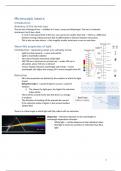
Microscopic basics
Introduction
Anatomy of the human eye
The eye has a biological lens -> shielded in 2 ways, cornea and diaphragm. The eye is a fantastic
instrument, but it has a limit.
- 0.1 mm is the typical limit of the eye, you cannot see smaller than that -> there is a difference
between seeing nothing and not able to differentiate a distance between two points.
- This is why we have lenses -> they magnify smaller structures so we can see them
Wave-like properties of light
Introduction: repeating what you already know
- Light has dual property -> wave and particle
- Light is essentially radiation
- Very minor fraction represents visible light
- 400-700 nm is what we can at least see -> under 400 nm is
ultraviolet, above 700 nm is infrared
- Inverse relation between wavelength and energy -> lower
wavelength, the higher the energy (UV is more energetic than IR)
Refraction
- All of the properties are defined by the medium in which the light
travels
- Refractive index n = speed of light in vacuum / speed in
medium
o The slower the light goes, the higher the refractive
index will be
- There will be a bend by the fact that there is a change
in medium
- The direction of bending will be towards the normal
if the refractive index is higher in the second medium
(dotted line)
There is a critical angle in which light will fully reflect with no refraction
Dispersion = refraction depends on the wavelength or
wavelength dependent refraction
- White light -> will be dispersed in the individual colors
- Red light is much less sensitive to refraction than blue
light
1
,Diffraction
= the process by which a beam of light or other system of
waves is spread out as a result of passing through a narrow
aperture or across an edge, typically accompanied by
interference between the wave forms produced.
- The smaller the opening, the stronger the light will
be bend
- You will get interference when you have 2 waves
which amplify and balance each other out -> constructive and deconstructive interference
Maxima are dependent on only a
few things: the angle, d or distance
between the slit or the size of the
slit and the wavelength.
Lens theory
All the light that will travel through the lens will come
together in the focal point. We consider this only with
perfect convect lenses.
There are a few rules:
- Rule 1: parallel rays converge at the focal point
- Rule 2: rays from the focal plane exit in parallel
- Rule 3: rays that pass through the center are unaffected
Know how to calculate the magnification
and distance of the image on the exam,
probably a mcq
2
,Calculating the
If the magnification is negative,
the object will be inverted
Real image: image is on the other
side of the object
Virtual image: image is on the same
side of the object
magnification
From the moment the object is 2f, there will be magnification
- D0 > 2f -> reduction in size
- D0 = 2f -> same size
- D0 < 2f -> magnification
- D0 = f -> no image, it lies at infinity
Optical train of compound microscope
The condenser focuses the light, the
objective will magnify and the ocular
also has an additional magnification.
What is a compound microscope? It is a
combination of 2 lenses basically ->
objective and ocular.
The first lens is the objective that really
matters in magnification. Object needs
to be closer than 2f, otherwise it will not
magnify -> relatively close to the
objective. The real image is than
captured by the ocular. The second lens
is the ocular -> will generate a virtual
image. This will be projected on the retina -> to get a virtual image, you
need to have the object closer than f to the lens -> lenses need to be
positioned very well together.
Finite vs. infinity optics
Infinity optics -> tend to use this in todays microscopes -> you have an
image at infinity, object is exact at the focus point -> you can put whatever
you want in between, so you can focus the light with a tube lens to make
the virtual image -> this requires an important alignment.
3
, The concept of conjugate planes
Conjugate planes = where the focus is the same, you see the same thing.
Where is the image in focus? On the object itself, but
also in the retina -> these 2 planes are what we call
conjugate planes.
Intermediate image planes -> objective focusses the
image (3rd conjugate plane), the ocular needs to generate
the virtual image. 4th conjugate plane -> lies before the
object, lies a bit above the collector lens -> important,
here we control how much of the field is illuminated
(typical place for a diaphragm)
4 conjugate planes in total in the image formation path.
Illumination path also exists -> lamp filament in focus,
you don’t want to see this. There can’t be a conjugate
plane at the position of the sample, the light should
move parallel.
The light should be focused in front of the focal plane of
the condenser -> in the focal point light will move in
parallel rays and will be the first conjugate plane (plane where lamp is focused).
Will be a 3rd at the back of the objective and a 4th on our lens (why on the lens?
Because it will the shine light homogenously on the retina).
Properties of optics
One of the main concepts of a microscope is what can it achieve in terms of resolution, how fine is
the structure we can see. The microscope has a resolution limit, you can’t go beyond that because of
diffraction -> you see a smudges version of the pattern, it is being blurred because of diffraction.
The smaller the distance between the patterns, the more light will get bend
and the larger your diffraction pattern will become. If you have a larger
pattern, then there is more of the maxima that you can detect -> important to
realize, if you can capture them all than you can regenerate the image back.
But if you lose some of these maxima (fall off) you can’t retain the image ->
why lose them? We have an objective that can capture only a part of the
image -> you start losing information and so you lose resolution.
The finer the pattern, the more spread out it will be and will be more difficult
to capture all of the maxima and to reconstruct the image.
Resolution limit = difficulty in spotting the 2 different maxima
Important formula for the diffraction -> distance between two
point that we can still discriminate in a microscope is limited
by the equation.
The smaller d becomes, the better the resolution (good
resolution = small d, bad resolution = large d).
4
Introduction
Anatomy of the human eye
The eye has a biological lens -> shielded in 2 ways, cornea and diaphragm. The eye is a fantastic
instrument, but it has a limit.
- 0.1 mm is the typical limit of the eye, you cannot see smaller than that -> there is a difference
between seeing nothing and not able to differentiate a distance between two points.
- This is why we have lenses -> they magnify smaller structures so we can see them
Wave-like properties of light
Introduction: repeating what you already know
- Light has dual property -> wave and particle
- Light is essentially radiation
- Very minor fraction represents visible light
- 400-700 nm is what we can at least see -> under 400 nm is
ultraviolet, above 700 nm is infrared
- Inverse relation between wavelength and energy -> lower
wavelength, the higher the energy (UV is more energetic than IR)
Refraction
- All of the properties are defined by the medium in which the light
travels
- Refractive index n = speed of light in vacuum / speed in
medium
o The slower the light goes, the higher the refractive
index will be
- There will be a bend by the fact that there is a change
in medium
- The direction of bending will be towards the normal
if the refractive index is higher in the second medium
(dotted line)
There is a critical angle in which light will fully reflect with no refraction
Dispersion = refraction depends on the wavelength or
wavelength dependent refraction
- White light -> will be dispersed in the individual colors
- Red light is much less sensitive to refraction than blue
light
1
,Diffraction
= the process by which a beam of light or other system of
waves is spread out as a result of passing through a narrow
aperture or across an edge, typically accompanied by
interference between the wave forms produced.
- The smaller the opening, the stronger the light will
be bend
- You will get interference when you have 2 waves
which amplify and balance each other out -> constructive and deconstructive interference
Maxima are dependent on only a
few things: the angle, d or distance
between the slit or the size of the
slit and the wavelength.
Lens theory
All the light that will travel through the lens will come
together in the focal point. We consider this only with
perfect convect lenses.
There are a few rules:
- Rule 1: parallel rays converge at the focal point
- Rule 2: rays from the focal plane exit in parallel
- Rule 3: rays that pass through the center are unaffected
Know how to calculate the magnification
and distance of the image on the exam,
probably a mcq
2
,Calculating the
If the magnification is negative,
the object will be inverted
Real image: image is on the other
side of the object
Virtual image: image is on the same
side of the object
magnification
From the moment the object is 2f, there will be magnification
- D0 > 2f -> reduction in size
- D0 = 2f -> same size
- D0 < 2f -> magnification
- D0 = f -> no image, it lies at infinity
Optical train of compound microscope
The condenser focuses the light, the
objective will magnify and the ocular
also has an additional magnification.
What is a compound microscope? It is a
combination of 2 lenses basically ->
objective and ocular.
The first lens is the objective that really
matters in magnification. Object needs
to be closer than 2f, otherwise it will not
magnify -> relatively close to the
objective. The real image is than
captured by the ocular. The second lens
is the ocular -> will generate a virtual
image. This will be projected on the retina -> to get a virtual image, you
need to have the object closer than f to the lens -> lenses need to be
positioned very well together.
Finite vs. infinity optics
Infinity optics -> tend to use this in todays microscopes -> you have an
image at infinity, object is exact at the focus point -> you can put whatever
you want in between, so you can focus the light with a tube lens to make
the virtual image -> this requires an important alignment.
3
, The concept of conjugate planes
Conjugate planes = where the focus is the same, you see the same thing.
Where is the image in focus? On the object itself, but
also in the retina -> these 2 planes are what we call
conjugate planes.
Intermediate image planes -> objective focusses the
image (3rd conjugate plane), the ocular needs to generate
the virtual image. 4th conjugate plane -> lies before the
object, lies a bit above the collector lens -> important,
here we control how much of the field is illuminated
(typical place for a diaphragm)
4 conjugate planes in total in the image formation path.
Illumination path also exists -> lamp filament in focus,
you don’t want to see this. There can’t be a conjugate
plane at the position of the sample, the light should
move parallel.
The light should be focused in front of the focal plane of
the condenser -> in the focal point light will move in
parallel rays and will be the first conjugate plane (plane where lamp is focused).
Will be a 3rd at the back of the objective and a 4th on our lens (why on the lens?
Because it will the shine light homogenously on the retina).
Properties of optics
One of the main concepts of a microscope is what can it achieve in terms of resolution, how fine is
the structure we can see. The microscope has a resolution limit, you can’t go beyond that because of
diffraction -> you see a smudges version of the pattern, it is being blurred because of diffraction.
The smaller the distance between the patterns, the more light will get bend
and the larger your diffraction pattern will become. If you have a larger
pattern, then there is more of the maxima that you can detect -> important to
realize, if you can capture them all than you can regenerate the image back.
But if you lose some of these maxima (fall off) you can’t retain the image ->
why lose them? We have an objective that can capture only a part of the
image -> you start losing information and so you lose resolution.
The finer the pattern, the more spread out it will be and will be more difficult
to capture all of the maxima and to reconstruct the image.
Resolution limit = difficulty in spotting the 2 different maxima
Important formula for the diffraction -> distance between two
point that we can still discriminate in a microscope is limited
by the equation.
The smaller d becomes, the better the resolution (good
resolution = small d, bad resolution = large d).
4