
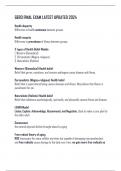
GERO FINAL EXAM LATEST UPDATED 2024
Health disparity
Difference in health outcomes between groups
Health inequity
Difference in prevalence of illness between groups
3 types of Health Belief Models
1. Western (Biomedical)
2. Personalistic (Magico-religious)
3. Naturalistic (Holistic)
Western (Biomedical) Health belief
Belief that germs, mutations, and invasive pathogens cause disease and illness.
Personalistic (Magico-religious) Health belief
Belief that a supernatural being causes diseases and illness. May believe that illness is
punishment for sin.
Naturalistic (Holistic) Health belief
Belief that imbalance psychologically, spiritually, and physically causes illness and disease
LEARN Model
Listen, Explain, Acknowledge, Recommend, and Negotiate. Used to make a care plan for
the older adult
Senescence
the natural physical decline brought about by aging
Free radical theory of aging
ROS (necessary for some cellular activities but capable of damaging macromolecules)
and free radicals cause damage to the body over time. we gain more free radicals as
,our number of ROS increase. These all weaken the body, making us susceptible to disease
processes as we age.
ROS (Damage of cells) causes (Internal and External)
E: Pollution and Cigarette smoke
I: Inflammation
Inflamm-aging theory of aging
The immune system decreases in function as we age which increases our risk for developing
disease processes.
CNS Changes in geriatrics
-Brain size and weight decrease
-Subtle change in cognitive and motor function
-Mild memory impairments
-Takes longer to complete tasks
PNS changes in geriatrics
-Decreased senses (tactile=touch, kinesthetic=body movements, and vibratory=perception
of vibrations)
-Reaction time delayed
"Old" is based on what 4 factors?
- Functional (ADL performance)
- Social (Based on life events, ex. Retirement)
- Biological ( Function of body)
- Chronological (Age in years)
Certified Nursing Facilities
Commonly called Nursing homes
Most stays are 1 week - 3 months
Life Expectancy
Varies based on race and ethnicity; White males have the lowest and Hispanic males and
females have the highest.
, Super-centenarians
110+
Centenarians
100-109
Those in-between
Born between 1920-1945
Baby boomers
Born between 1946-1964
7 Ethnoracial groups in the US
1. Black
2. Asian American
3. Native Hawaiian/Pacific Islander
4. American Indian/Alaskan Native
5. White
6. Multiracial
7. Hispanic/Latino
Skin changes in geriatrics
Epidermis: Thins, decreased melanocytes, fragile. Increase in healing time because of an
increase in the amount of time it takes for cells to heal.
Dermis: thins and becomes pallor, decrease cold tolerance, decreased collagen formation
(tears easily)
Hypodermis: atrophy, decreased sebum production, decreased Vit D production ability
Hair and nail changes in geriatrics
- Nails: thicken, harden, get dull and brittle. have vertical ridges and slow in growth. Prone to
fungal infections
- Hair: thins, decreased on extremities but increased in ears, nose, and brows. loss of
pigmentation.
Musculoskeletal changes in geriatrics
Health disparity
Difference in health outcomes between groups
Health inequity
Difference in prevalence of illness between groups
3 types of Health Belief Models
1. Western (Biomedical)
2. Personalistic (Magico-religious)
3. Naturalistic (Holistic)
Western (Biomedical) Health belief
Belief that germs, mutations, and invasive pathogens cause disease and illness.
Personalistic (Magico-religious) Health belief
Belief that a supernatural being causes diseases and illness. May believe that illness is
punishment for sin.
Naturalistic (Holistic) Health belief
Belief that imbalance psychologically, spiritually, and physically causes illness and disease
LEARN Model
Listen, Explain, Acknowledge, Recommend, and Negotiate. Used to make a care plan for
the older adult
Senescence
the natural physical decline brought about by aging
Free radical theory of aging
ROS (necessary for some cellular activities but capable of damaging macromolecules)
and free radicals cause damage to the body over time. we gain more free radicals as
,our number of ROS increase. These all weaken the body, making us susceptible to disease
processes as we age.
ROS (Damage of cells) causes (Internal and External)
E: Pollution and Cigarette smoke
I: Inflammation
Inflamm-aging theory of aging
The immune system decreases in function as we age which increases our risk for developing
disease processes.
CNS Changes in geriatrics
-Brain size and weight decrease
-Subtle change in cognitive and motor function
-Mild memory impairments
-Takes longer to complete tasks
PNS changes in geriatrics
-Decreased senses (tactile=touch, kinesthetic=body movements, and vibratory=perception
of vibrations)
-Reaction time delayed
"Old" is based on what 4 factors?
- Functional (ADL performance)
- Social (Based on life events, ex. Retirement)
- Biological ( Function of body)
- Chronological (Age in years)
Certified Nursing Facilities
Commonly called Nursing homes
Most stays are 1 week - 3 months
Life Expectancy
Varies based on race and ethnicity; White males have the lowest and Hispanic males and
females have the highest.
, Super-centenarians
110+
Centenarians
100-109
Those in-between
Born between 1920-1945
Baby boomers
Born between 1946-1964
7 Ethnoracial groups in the US
1. Black
2. Asian American
3. Native Hawaiian/Pacific Islander
4. American Indian/Alaskan Native
5. White
6. Multiracial
7. Hispanic/Latino
Skin changes in geriatrics
Epidermis: Thins, decreased melanocytes, fragile. Increase in healing time because of an
increase in the amount of time it takes for cells to heal.
Dermis: thins and becomes pallor, decrease cold tolerance, decreased collagen formation
(tears easily)
Hypodermis: atrophy, decreased sebum production, decreased Vit D production ability
Hair and nail changes in geriatrics
- Nails: thicken, harden, get dull and brittle. have vertical ridges and slow in growth. Prone to
fungal infections
- Hair: thins, decreased on extremities but increased in ears, nose, and brows. loss of
pigmentation.
Musculoskeletal changes in geriatrics


