

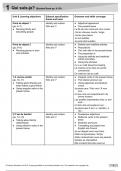
1 Qui suis-je? (Student Book pp. 6–29)
Unit & Learning objectives Edexcel specification Grammar and skills coverage
theme and topic
Point de départ 1 Identity and culture: ● Adjectival agreement
(pp. 6–7) Who am I? ● The present tense
● Revising family and Le fils de mon oncle est mon cousin.
describing people J’ai les cheveux courts / longs.
J’ai les yeux bleus.
Je suis petit(e).
Je porte des lunettes.
Point de départ 2 Identity and culture: ● Definite and indefinite articles
(pp. 8–9) Who am I? ● Prepositions
● Revising places in town ● The verb aller in the present tense
and activities ● The preposition à
● Using the definite and indefinite
article accurately
● Using time phrases
Il y a un café devant le bowling.
Le cinéma est en face du centre
commercial.
Ce matin je vais au café.
1 A comme amitié Identity and culture: ● Irregular verbs in the present tense
(pp. 10–11) Who am I? ● The relative pronoun qui
● Talking about friends and ● Using adjectives and abstract
what makes a good friend nouns
● Using irregular verbs in the Je pense que / Pour moi / À mon
present tense avis…
Un bon ami est compréhensif / de
bonne humeur.
Les qualités importantes chez un ami
sont…
Un bon ami est quelqu’un qui…
Je pense que X est / a / semble / a
l’air…
2 C’est de famille! Identity and culture: ● Possessive adjectives
(pp. 12–13) Who am I? ● Reflexive verbs in the present
● Talking about family tense
relationships ● Emphatic pronouns
● Using reflexive verbs in the ● Translating accurately from
present tense English into French
Je me dispute avec mon frère.
Il/elle est dynamique / fort(e).
Il/elle s’entend bien avec ses parents.
Ils/elles se chamaillent.
Elle s’entend très bien avec lui.
© Pearson Education Ltd 2016. Copying permitted for purchasing institution only. This material is not copyright free. 1
, Qui suis-je? – MODULE 1
Unit & Learning objectives Edexcel specification Grammar and skills coverage
theme and topic
3 On va voir un spectacle? Identity and culture: ● The near future tense
(pp. 14–15) Who am I? ● Using different pronouns and
● Making arrangements to go giving opinions
out Je vais / tu vas / on va aller au match.
● Using the near future tense Tu veux / peux venir?
On se retrouve quand / où?
À quelle heure?
D’accord / À plus tard.
4 Quelle soirée! Identity and culture: ● The perfect tense
(pp. 16–17) Who am I? ● Getting the perfect tense correct
● Describing a night out with Hier soir / d’abord / après
friends J’ai / il/elle a / nous avons vu un
● Using the perfect tense match.
Je suis / il/elle est / nous sommes
sorti(e)(s).
C’était…
5 Il était une fois… Identity and culture: ● The imperfect tense
(pp. 18–19) Who am I? ● Translating from French into
● Talking about your life English
when you were younger Quand j’étais plus jeune…
● Using the imperfect tense J’habitais / allais / avais…
6 La personne que j’admire Identity and culture: ● Using the present, perfect and
(pp. 20–21) Who am I? imperfect tenses
● Discussing role models ● Using a variety of tenses
● Using the present, perfect ● Using questions to structure your
and imperfect tenses writing
Moi, j’admire…
Mon modèle s’appelle…
Il/elle m’impressionne / a travaillé /
avait…
Contrôle de lecture et Identity and culture: Reading and listening exam skills
d’écoute Who am I?
(pp. 22–23)
Exam reading and listening
practice
Contrôle oral Identity and culture: Speaking exam skills
(pp. 24–25) Who am I?
Exam speaking practice
Contrôle écrit Identity and culture: Writing exam skills
(pp. 26–27) Who am I?
Exam writing practice
À toi Identity and Culture:
(p. 198) Who am I?
Self-access reading and
writing activities
© Pearson Education Ltd 2016. Copying permitted for purchasing institution only. This material is not copyright free. 2
,Point de départ 1 Qui suis-je? – MODULE 1
Student Book pages Key language Resources
6–7 Ma belle-sœur est… Audio files:
J’ai Track 1
Learning objectives
les cheveux courts / longs / mi- Track 2
● Revising family and
longs / raides / bouclés / frisés /
describing people Front-of-Class (ActiveTeach):
noirs / bruns / châtains / blonds /
roux / gris / blancs p.007 Grammar presentation
Edexcel specification theme
and topic les yeux bleus / verts / gris / Grammar and Translation
marron Workbook:
Identity and culture:
des boutons / une barbe / une pp.010–011
Who am I?
moustache. pp.040–041
Grammar and skills Je suis
coverage
petit(e) / grand(e) / de taille
● Adjectival agreement moyenne / mince / gros(se)
● The present tense beau (belle) / joli(e) / laid(e) /
moche
timide / bavard(e) / intelligent(e) /
sensible / aimable.
Je porte des lunettes.
1 Lisez et choisissez le bon mot pour 3 Écoutez. Bruno décrit sa famille.
compléter chaque phrase. (Reading) Identifiez le membre de la famille sur la
Read and choose the correct word(s) to complete photo et notez les adjectifs utilisés.
each sentence. (1–7) (Listening)
Answers Listen. Bruno describes his family. Identify each
1 mon grand-père 2 ma tante family member in the photo and note down the
adjectives used.
3 mon cousin 4 ma demi-sœur
5 ma grand-mère 6 mon beau-père
Audioscript Track 1
7 mon petit-fils 8 ma belle-fille
1
2 Écrivez les adjectifs en deux listes: – Voici ma mère. Maman est timide, mais elle
adjectifs positifs et adjectifs négatifs. est très intelligente.
(Writing) 2
Write out the adjectives and put them into two lists: – Je m’appelle Bruno. J’ai 15 ans. Je suis
positive and negative. travailleur et têtu: quand je veux quelque
Answers chose, je fais tout pour l’obtenir.
POSITIF: drôle sage sympa sensible aimable 3
intelligent charmant poli travailleur sérieux
– Ça, c’est mon beau-père. Mon père n’habite
généreux gentil cool fidèle amusant fort pas avec nous. Mon beau-père, Jean-Paul,
NÉGATIF: égoïste paresseux méchant est sérieux et très généreux.
arrogant jaloux triste vilain agaçant têtu 4
impatient
NB: timide and bavard can be either positive or – J’habite aussi avec mon grand-père. Il est
gentil et vraiment drôle.
negative
© Pearson Education Ltd 2016. Copying permitted for purchasing institution only. This material is not copyright free. 3
, Point de départ 1 | Qui suis-je? – MODULE 1
5 6 Regardez les images. Copiez les
– Ma demi-sœur s’appelle Lucie. Elle a quatre descriptions mais corrigez les erreurs.
ans. Elle est souvent agaçante, mais elle (Reading)
sait être aimable. Look at the pictures. Copy the descriptions but
6 correct the mistakes.
– Ça, c’est mon petit frère. Je partage ma Answers
chambre avec mon frère et c’est difficile car 1 J’ai les cheveux bruns et longs, et les yeux
il est arrogant et égoïste. bleus. Je suis petit et gros. Je suis beau.
7 2 Je suis grande et mince. J’ai les cheveux
bouclés et noirs et les yeux marron. Je porte
– Ma grand-mère habite dans la ville voisine
des lunettes. Je suis jolie.
mais la voilà sur la photo! J’adore ma grand-
mère: elle est sympa avec tout le monde, 3 J’ai les yeux verts. Je suis grande et mince et
même si elle est un peu bavarde! j’ai des boutons. J’ai les cheveux courts, blonds
et frisés.
Answers
4 J’ai les cheveux gris, courts et raides, et une
1 e – timide, intelligente
barbe grise. Je suis de taille moyenne et assez
2 f – travailleur, têtu
mince.
3 c – sérieux, généreux
4 a – gentil, drôle
5 d – agaçante, aimable Grammaire
6 b – arrogant, égoïste The Grammaire box explains how the present
7 g – sympa, bavarde tense of -er verbs is formed. It lists all forms of
the verb. It also covers the most useful irregular
4 Écrivez trois adjectifs corrects pour verbs, avoir (to have) and être (to be).
compléter chaque phrase. (Writing) More information and exercises can be found in
the Student Book grammar section on pages
Write down three correct adjectives to complete
206–207 for regular verbs and pages 208–209
each sentence.
for irregular verbs. Students can also turn to the
Grammar and Translation Workbook for more
5 À deux. Choisissez trois adjectifs practice on this grammar point.
pour décrire la personnalité des
membres de votre famille. (Speaking)
7 Copiez et complétez chaque phrase
In pairs, choose three adjectives to describe the
avec j’ai, je suis ou je porte. (Reading)
personality of members of your family.
Copy and complete each phrase with j'ai, je suis or
Grammaire je porte.
The Grammaire box explains how to make
adjectives agree with the nouns that they Answers
describe by adding different endings depending 1 je suis 2 je suis
on whether the noun is masculine or feminine, 3 j’ai 4 je suis
singular or plural. Some adjectives follow a 5 j’ai 6 je porte (or j’ai)
different pattern (e.g. travailleur, gentil) and 7 j’ai 8 j’ai
some adjectives never change. 9 je suis 10 j’ai
More information and exercises can be found in
the Student Book grammar section on pages 8 Vous aidez la police après un
224–225. Students can also turn to the incident. Écoutez les descriptions des
Grammar and Translation Workbook for more suspects et notez les détails en
practice on this grammar point. anglais. (1–6) (Listening)
You are helping the police after an incident. Listen
to the descriptions of the suspects and note down
the details in English.
© Pearson Education Ltd 2016. Copying permitted for purchasing institution only. This material is not copyright free. 4
, Point de départ 1 | Qui suis-je? – MODULE 1
Audioscript Track 2 9 À deux. Vous êtes un de ces
suspects. Décrivez-vous. Imaginez
Bon, nous avons six suspects pour le crime. aussi votre personnalité. (Speaking)
Écoutez bien et notez les détails parce que vous
allez peut-être les voir dans la rue. Work in pairs. You are one of the suspects.
Describe yourself. Imagine what your personality
1
is like too.
Le suspect numéro 1 est un homme. Il est grand et
gros. Il a les cheveux courts et bruns.
2
Le suspect numéro deux a comme surnom «la
Rousse». Elle a les cheveux mi-longs et roux. Elle
a les yeux bleus et elle est très belle.
3
Le troisième suspect, c’est-à-dire le suspect
numéro 3, est une personne très dangereuse. Il
est petit et laid. Il a une petite barbe brune et il
porte des lunettes. Il a les cheveux courts et bruns.
4
Notre suspect numéro quatre, c’est une femme
très méchante. Elle est grande et grosse, et très
cruelle. Elle souffre d’acné et elle a des boutons
sur le visage. Elle porte toujours un jogging rose,
je répète, elle porte un jogging rose.
5
Le suspect numéro 5 a comme surnom «Super
Mario». Il est très petit: il mesure 1,45 mètre. Il a
les cheveux noirs, une moustache et les yeux
bleus.
6
Et finalement, notre suspect numéro six. Elle est
de taille moyenne, avec des cheveux frisés et gris.
Elle porte des lunettes de soleil tout le temps,
même quand il pleut. Ne l’approchez pas: elle est
très dangereuse.
Answers
1 male – tall, fat, short brown hair.
2 female – nickname ‘la Rousse’. Shoulder-
length red hair, blue eyes, very beautiful.
3 male – very dangerous. Small and ugly. Little
brown beard and wears glasses. Short brown
hair.
4 female – very mean. Tall, fat and very cruel.
Spots. Always wears pink tracksuit.
5 male – nickname ‘Super Mario’. Very small
(1m45). Black hair, moustache, blue eyes.
6 female – average height, curly / frizzy grey
hair. Wears sunglasses all the time (even when
it’s raining), don’t approach her, she’s very
dangerous.
© Pearson Education Ltd 2016. Copying permitted for purchasing institution only. This material is not copyright free. 5
,Point de départ 2 Qui suis-je? – MODULE 1
Student Book pages Key language Resources
8–9 aujourd’hui Audio files:
demain Track 3
Learning objectives
après-demain Track 4
● Revising places in town and
activities ce matin Front-of-Class (ActiveTeach):
cet après-midi p.008 Grammar presentation 1
Edexcel specification theme
and topic ce soir p.008 Grammar presentation 2
Identity and culture: p.009 Grid
Who am I? p.009 Grammar presentation
Grammar and Translation
Grammar and skills Workbook:
coverage
pp. 006–007
● Definite and indefinite articles
pp. 088–089
● Prepositions
● The verb aller in the present
tense
● The preposition à
● Using the definite and
indefinite article accurately
● Using time phrases
1 Regardez le plan du centre-ville.
Audioscript Track 3
Reliez les images et les mots.
(Reading) – Le week-end, je vais souvent en ville. Dans
ma ville, il y a un bowling et aussi un
Look at the map of the city centre. Match the
théâtre. Je ne vais jamais au théâtre mais je
pictures and the words.
vais souvent au cinéma. Il y a un grand
Answers cinéma multiplexe avec neuf écrans. Quand
1f 2b 3a 4d 5c je vais en ville, je fais les magasins avec
6g 7j 8e 9i 10 h mes copines. Il y a beaucoup de bons
magasins et aussi un grand centre
commercial. Il y a un bon café dans le
Grammaire centre-ville, une piscine et une boîte de nuit
où ma sœur va le soir. Parfois, le dimanche,
The Grammaire box gives the definite and
je vais à la piscine. Nous avons aussi une
indefinite articles for masculine, feminine and nouvelle patinoire. Mais ce que j’aime le
plural nouns. It also explains that if a noun plus, quand il fait beau, c’est aller à la plage.
begins with a vowel or h, le or la shortens to l’.
Students can turn to the Grammar and
Answers
Translation Workbook for more practice on the
4, 8, 3, 7, 5, 2, 1, 10, 9, 6
grammar points covered in this unit. See the
summary box above for page references.
3 Lisez les phrases et regardez le plan
2 Écoutez et mettez les images de de l’exercice 1. Écrivez V (vrai) ou F
l’exercice 1 dans le bon ordre. (faux) pour chaque phrase. (Reading)
(Listening) Read the sentences and look at the map in
exercise 1. Write V (true) or F (false) for each
Listen and put the pictures from exercise 1 in the sentence.
correct order.
Answers
1F 2V 3F 4V 5F 6V 7V
© Pearson Education Ltd 2016. Copying permitted for purchasing institution only. This material is not copyright free. 6
, Point de départ 2 | Qui suis-je? – MODULE 1
Grammaire 5
The Grammaire box lists some useful – Bonsoir, je t’appelle parce qu’on va à la
prepositions of place. It also explains that when plage avec Marc demain après-midi. On va
a preposition containing the word de is used with y être vers seize heures, d’accord?
a masculine or plural noun, de changes 6
accordingly:
– Bonjour, un message rapide … On va à la
de + le> du, e.g. en face du cinema
piscine ce matin, tu veux venir? Appelle-moi!
de + les > des, e.g. près des magasins On y va à dix heures moins le quart.
Answers
4 À deux. Posez des questions et
où? quand? heure?
utilisez le plan de l’exercice 1 pour
donner des réponses. (Speaking) 1 au cinéma ce soir 20h
2 au bowling demain 9h30
Work in pairs. Ask your partner questions and use
matin
the map in exercise 1 to answer their questions.
3 au centre aujourd’hui 12h30
5 Traduisez ces phrases en français. commercial
4 en boîte de après- 21h30
(Writing) nuit demain
Translate these sentences into French. 5 à la plage demain 16h
après-midi
Answers 6 à la piscine ce matin 9h45
1 Il y a un café en face des magasins.
2 La piscine est près du bowling.
3 Il y a un centre commercial en face du cinéma. Grammaire
4 La plage est derrière le centre commercial. The Grammaire box lists the present tense of
5 Le théâtre est à côté des magasins. the irregular verb aller (to go).
6 Il y a une patinoire entre le théâtre et la boîte
More information and exercises can be found in
de nuit. the Student Book grammar section on pages
208–209.
6 Écoutez. Copiez et complétez le
tableau en français. (1–6) (Listening)
7 Lisez le texte et traduisez-le en
Listen. Copy and complete the table in French. anglais. (Reading)
Audioscript Track 4 Read the text and translate it into English.
Answers
1
Today it is my birthday. This morning I am going
– Salut, c’est moi. On va au cinéma ce soir à to the bowling alley with my brother. This
vingt heures, d’accord? afternoon, I am going to the café at 4 p.m. with
2 my grandmother. The café is in the shopping
centre. Tonight I am going to the ice rink at
– Bonsoir, c’est moi. Demain matin, on va au
bowling à neuf heures trente, OK? 7 p.m. and then I am going to the cinema with
my parents. The cinema is opposite the theatre,
3
near the swimming pool.
– Bonjour, tu n’es pas là? Je vais au centre
commercial aujourd’hui à midi et demi. Tu
viens?
4
– Salut, toi! Après-demain, on va en boîte
avec les copains. On y va tard, à vingt-et-
une heures trente. Tu peux venir?
© Pearson Education Ltd 2016. Copying permitted for purchasing institution only. This material is not copyright free. 7
, Point de départ 2 | Qui suis-je? – MODULE 1
Grammaire
The Grammaire box looks at the preposition à,
which means ‘at’ or ‘to’. It explains how the
preposition changes when it is used with
different definite articles:
à + le > au, e.g. au cinéma (at/to the cinema)
à + la > à la
à + l’ > à l’
à + les > aux, e.g. aux magasins (at/to the
shops)
à 8 heures/20 heures (at 8 p.m.)
8 À deux. Parlez de vos activités pour
aujourd’hui. Utilisez les notes.
(Speaking)
Work in pairs. Talk about the activities you have
planned for today. Use your notes.
© Pearson Education Ltd 2016. Copying permitted for purchasing institution only. This material is not copyright free. 8
,1 A comme amitié Qui suis-je? – MODULE 1
très / assez / extrêmement /
Student Book pages Key language
vraiment / plutôt
10–11 Je pense que
agaçant(e) / fort(e) / puissant(e) /
Pour moi, maigre.
Learning objectives
À mon avis, est maigre comme un clou / léger
● Talking about friends and
what makes a good friend les qualités importantes chez un (légère) comme une plume / laide
ami sont le sens de l’humour / comme un pou.
● Using irregular verbs in the
la patience / la générosité / a des yeux qui inspirent
present tense
la fidélité / la gentillesse / confiance / les mêmes centres
Edexcel specification theme la modestie / l’honnêteté / d’intérêt que moi.
and topic l’optimisme.
Un bon ami est compréhensif / Resources
Identity and culture:
de bonne humeur / énergique / Audio files:
Who am I? équilibré / fidèle / gentil / Track 5
généreux / honnête / indépendant
Grammar and skills Track 6
/ modeste / patient / sûr de lui /
coverage
sensible. Homework (ActiveLearn):
● Irregular verbs in the present
Un bon ami n’est pas de Listening activity
tense
mauvaise humeur / déprimé / Reading activity
● The relative pronoun qui impatient / jaloux / prétentieux /
raciste / sexiste / vaniteux. Vocabulary activity
● Using adjectives and abstract
nouns Un bon ami (est quel qu’un qui) Grammar and Translation
croit en moi / dit toujours la vérité Workbook:
/ me fait rire / prend soin de moi / pp.032–033
voit le bon côté de choses. pp.042–043
X est / semble / a l’air
Starter 1 Lisez le forum et identifiez le(s)
trait(s) de personnalité le(s) plus
Aim important(s) pour chaque personne.
To brainstorm common personality traits (Reading)
Discuss the concept of abstract nouns with the Read the forum posts and name the personality
trait(s) that each person finds most important in a
class. Ask students to brainstorm at least five
friend.
English abstract nouns that describe personality
traits (e.g. modesty, patience) in groups of three Answers
or four without looking at page 10 of the Student Louloute66: la gentillesse, la modestie
Book. Make it clear to students that they are JeSuisBill: la générosité
brainstorming the noun rather than the adjective Sushi101: la patience, la fidélité
(e.g. generosity, not generous). An@nas: le sens de l’humour
Mayleen: l’honnêteté
Students then use an online dictionary to look up Legeek: l’optimisme
the French translation for these abstract nouns,
including their gender. Award 1 point for each 2 Écoutez. Identifiez le trait de
correct noun in French and 2 points for each personnalité le plus important pour
correct noun which also appears in exercise 1 chaque personne. (1–8) (Listening)
on page 10 of the Student Book. Listen. Name the most important personality trait
for each person.
la patience / le sens de l’humour / l’honnêteté
l’optimisme / la générosité / la fidélité
la gentillesse / la modestie
© Pearson Education Ltd 2016. Copying permitted for purchasing institution only. This material is not copyright free. 9
, A comme amitié | Qui suis-je? – MODULE 1
Audioscript Track 5 7 la modestie
8 la gentillesse
1
– Pour moi, un ami doit être généreux. Ce 3 À deux. Discutez des qualités les
n’est pas une question d’argent, c’est être
plus importantes chez un(e) ami(e).
généreux de son temps.
(Speaking)
2
Work in pairs. Discuss the qualities you find most
– Je m’entends bien avec mes amis quand on important in a friend.
rit ensemble. Un bon copain est drôle et me
fait rire. Pour moi, c’est extrêmement
important. Grammaire
3 The Grammaire box highlights some useful
French irregular verbs such as prendre, faire,
– Un ami doit être patient. Il doit avoir du dire and sortir.
temps pour moi quand j’ai des problèmes. More information and exercises can be found in
C’est difficile d’avoir un ami qui est toujours
impatient. the Student Book grammar section on pages
208–209. Students can also turn to the
4
Grammar and Translation Workbook for more
– Un bon ami est quelqu’un qui est fidèle. Il practice on this grammar point.
garde tes secrets et il ne te critique pas
devant les autres.
4 Écrivez votre réponse pour le forum
5 «C’est quoi un bon ami, pour toi?».
– Un ami peut te dire la vérité. Il faut être (Writing)
honnête avec ses amis. Un ami qui ne peut Write your response to the forum topic "What do
pas être honnête avec toi est un faux ami. you think makes a good friend?"
6
– Pour moi, un bon ami ne doit pas être 5 Lisez et trouvez les expressions dans
pessimiste et de mauvaise humeur tout le les textes. (Reading)
temps. Bien sûr, nous pouvons tous être
déprimés de temps en temps mais moi, je Read the passages and find these phrases.
veux un ami optimiste. Answers
7 a il mesure 1,80 mètre
b maigre comme un clou
– Je n’aime pas les gens vaniteux ou
c elle semble timide
prétentieux. D’accord, on doit être sûr de
soi, mais pas trop: pour moi, un bon ami doit d la plupart du temps
être équilibré et modeste. e elle a un joli sourire
f il a l’air cool
8
g elle rit beaucoup
– C’est clair pour moi qu’un bon ami doit être
h elle porte un appareil dentaire
gentil et sympa. Pour moi, les gens racistes
ou sexistes ne peuvent jamais être de bons i je m’entends bien avec elle
amis. Si on veut être un bon ami, il faut être j on a les mêmes centres d’intérêt
compréhensif et sensible.
Grammaire
Answers The Grammaire box explains the relative
1 la générosité pronoun qui, which means ‘who’, ‘which’ or
2 le sens de l’humour ‘that’, and is used to refer to the subject of a
3 la patience sentence. It is very useful for creating longer,
4 la fidélité more complex sentences. In English, we can
5 l’honnêteté miss out the relative pronoun if we want to:
6 l’optimisme ‘the book we read yesterday’ or ‘the book that
© Pearson Education Ltd 2016. Copying permitted for purchasing institution only. This material is not copyright free. 10
Unit & Learning objectives Edexcel specification Grammar and skills coverage
theme and topic
Point de départ 1 Identity and culture: ● Adjectival agreement
(pp. 6–7) Who am I? ● The present tense
● Revising family and Le fils de mon oncle est mon cousin.
describing people J’ai les cheveux courts / longs.
J’ai les yeux bleus.
Je suis petit(e).
Je porte des lunettes.
Point de départ 2 Identity and culture: ● Definite and indefinite articles
(pp. 8–9) Who am I? ● Prepositions
● Revising places in town ● The verb aller in the present tense
and activities ● The preposition à
● Using the definite and indefinite
article accurately
● Using time phrases
Il y a un café devant le bowling.
Le cinéma est en face du centre
commercial.
Ce matin je vais au café.
1 A comme amitié Identity and culture: ● Irregular verbs in the present tense
(pp. 10–11) Who am I? ● The relative pronoun qui
● Talking about friends and ● Using adjectives and abstract
what makes a good friend nouns
● Using irregular verbs in the Je pense que / Pour moi / À mon
present tense avis…
Un bon ami est compréhensif / de
bonne humeur.
Les qualités importantes chez un ami
sont…
Un bon ami est quelqu’un qui…
Je pense que X est / a / semble / a
l’air…
2 C’est de famille! Identity and culture: ● Possessive adjectives
(pp. 12–13) Who am I? ● Reflexive verbs in the present
● Talking about family tense
relationships ● Emphatic pronouns
● Using reflexive verbs in the ● Translating accurately from
present tense English into French
Je me dispute avec mon frère.
Il/elle est dynamique / fort(e).
Il/elle s’entend bien avec ses parents.
Ils/elles se chamaillent.
Elle s’entend très bien avec lui.
© Pearson Education Ltd 2016. Copying permitted for purchasing institution only. This material is not copyright free. 1
, Qui suis-je? – MODULE 1
Unit & Learning objectives Edexcel specification Grammar and skills coverage
theme and topic
3 On va voir un spectacle? Identity and culture: ● The near future tense
(pp. 14–15) Who am I? ● Using different pronouns and
● Making arrangements to go giving opinions
out Je vais / tu vas / on va aller au match.
● Using the near future tense Tu veux / peux venir?
On se retrouve quand / où?
À quelle heure?
D’accord / À plus tard.
4 Quelle soirée! Identity and culture: ● The perfect tense
(pp. 16–17) Who am I? ● Getting the perfect tense correct
● Describing a night out with Hier soir / d’abord / après
friends J’ai / il/elle a / nous avons vu un
● Using the perfect tense match.
Je suis / il/elle est / nous sommes
sorti(e)(s).
C’était…
5 Il était une fois… Identity and culture: ● The imperfect tense
(pp. 18–19) Who am I? ● Translating from French into
● Talking about your life English
when you were younger Quand j’étais plus jeune…
● Using the imperfect tense J’habitais / allais / avais…
6 La personne que j’admire Identity and culture: ● Using the present, perfect and
(pp. 20–21) Who am I? imperfect tenses
● Discussing role models ● Using a variety of tenses
● Using the present, perfect ● Using questions to structure your
and imperfect tenses writing
Moi, j’admire…
Mon modèle s’appelle…
Il/elle m’impressionne / a travaillé /
avait…
Contrôle de lecture et Identity and culture: Reading and listening exam skills
d’écoute Who am I?
(pp. 22–23)
Exam reading and listening
practice
Contrôle oral Identity and culture: Speaking exam skills
(pp. 24–25) Who am I?
Exam speaking practice
Contrôle écrit Identity and culture: Writing exam skills
(pp. 26–27) Who am I?
Exam writing practice
À toi Identity and Culture:
(p. 198) Who am I?
Self-access reading and
writing activities
© Pearson Education Ltd 2016. Copying permitted for purchasing institution only. This material is not copyright free. 2
,Point de départ 1 Qui suis-je? – MODULE 1
Student Book pages Key language Resources
6–7 Ma belle-sœur est… Audio files:
J’ai Track 1
Learning objectives
les cheveux courts / longs / mi- Track 2
● Revising family and
longs / raides / bouclés / frisés /
describing people Front-of-Class (ActiveTeach):
noirs / bruns / châtains / blonds /
roux / gris / blancs p.007 Grammar presentation
Edexcel specification theme
and topic les yeux bleus / verts / gris / Grammar and Translation
marron Workbook:
Identity and culture:
des boutons / une barbe / une pp.010–011
Who am I?
moustache. pp.040–041
Grammar and skills Je suis
coverage
petit(e) / grand(e) / de taille
● Adjectival agreement moyenne / mince / gros(se)
● The present tense beau (belle) / joli(e) / laid(e) /
moche
timide / bavard(e) / intelligent(e) /
sensible / aimable.
Je porte des lunettes.
1 Lisez et choisissez le bon mot pour 3 Écoutez. Bruno décrit sa famille.
compléter chaque phrase. (Reading) Identifiez le membre de la famille sur la
Read and choose the correct word(s) to complete photo et notez les adjectifs utilisés.
each sentence. (1–7) (Listening)
Answers Listen. Bruno describes his family. Identify each
1 mon grand-père 2 ma tante family member in the photo and note down the
adjectives used.
3 mon cousin 4 ma demi-sœur
5 ma grand-mère 6 mon beau-père
Audioscript Track 1
7 mon petit-fils 8 ma belle-fille
1
2 Écrivez les adjectifs en deux listes: – Voici ma mère. Maman est timide, mais elle
adjectifs positifs et adjectifs négatifs. est très intelligente.
(Writing) 2
Write out the adjectives and put them into two lists: – Je m’appelle Bruno. J’ai 15 ans. Je suis
positive and negative. travailleur et têtu: quand je veux quelque
Answers chose, je fais tout pour l’obtenir.
POSITIF: drôle sage sympa sensible aimable 3
intelligent charmant poli travailleur sérieux
– Ça, c’est mon beau-père. Mon père n’habite
généreux gentil cool fidèle amusant fort pas avec nous. Mon beau-père, Jean-Paul,
NÉGATIF: égoïste paresseux méchant est sérieux et très généreux.
arrogant jaloux triste vilain agaçant têtu 4
impatient
NB: timide and bavard can be either positive or – J’habite aussi avec mon grand-père. Il est
gentil et vraiment drôle.
negative
© Pearson Education Ltd 2016. Copying permitted for purchasing institution only. This material is not copyright free. 3
, Point de départ 1 | Qui suis-je? – MODULE 1
5 6 Regardez les images. Copiez les
– Ma demi-sœur s’appelle Lucie. Elle a quatre descriptions mais corrigez les erreurs.
ans. Elle est souvent agaçante, mais elle (Reading)
sait être aimable. Look at the pictures. Copy the descriptions but
6 correct the mistakes.
– Ça, c’est mon petit frère. Je partage ma Answers
chambre avec mon frère et c’est difficile car 1 J’ai les cheveux bruns et longs, et les yeux
il est arrogant et égoïste. bleus. Je suis petit et gros. Je suis beau.
7 2 Je suis grande et mince. J’ai les cheveux
bouclés et noirs et les yeux marron. Je porte
– Ma grand-mère habite dans la ville voisine
des lunettes. Je suis jolie.
mais la voilà sur la photo! J’adore ma grand-
mère: elle est sympa avec tout le monde, 3 J’ai les yeux verts. Je suis grande et mince et
même si elle est un peu bavarde! j’ai des boutons. J’ai les cheveux courts, blonds
et frisés.
Answers
4 J’ai les cheveux gris, courts et raides, et une
1 e – timide, intelligente
barbe grise. Je suis de taille moyenne et assez
2 f – travailleur, têtu
mince.
3 c – sérieux, généreux
4 a – gentil, drôle
5 d – agaçante, aimable Grammaire
6 b – arrogant, égoïste The Grammaire box explains how the present
7 g – sympa, bavarde tense of -er verbs is formed. It lists all forms of
the verb. It also covers the most useful irregular
4 Écrivez trois adjectifs corrects pour verbs, avoir (to have) and être (to be).
compléter chaque phrase. (Writing) More information and exercises can be found in
the Student Book grammar section on pages
Write down three correct adjectives to complete
206–207 for regular verbs and pages 208–209
each sentence.
for irregular verbs. Students can also turn to the
Grammar and Translation Workbook for more
5 À deux. Choisissez trois adjectifs practice on this grammar point.
pour décrire la personnalité des
membres de votre famille. (Speaking)
7 Copiez et complétez chaque phrase
In pairs, choose three adjectives to describe the
avec j’ai, je suis ou je porte. (Reading)
personality of members of your family.
Copy and complete each phrase with j'ai, je suis or
Grammaire je porte.
The Grammaire box explains how to make
adjectives agree with the nouns that they Answers
describe by adding different endings depending 1 je suis 2 je suis
on whether the noun is masculine or feminine, 3 j’ai 4 je suis
singular or plural. Some adjectives follow a 5 j’ai 6 je porte (or j’ai)
different pattern (e.g. travailleur, gentil) and 7 j’ai 8 j’ai
some adjectives never change. 9 je suis 10 j’ai
More information and exercises can be found in
the Student Book grammar section on pages 8 Vous aidez la police après un
224–225. Students can also turn to the incident. Écoutez les descriptions des
Grammar and Translation Workbook for more suspects et notez les détails en
practice on this grammar point. anglais. (1–6) (Listening)
You are helping the police after an incident. Listen
to the descriptions of the suspects and note down
the details in English.
© Pearson Education Ltd 2016. Copying permitted for purchasing institution only. This material is not copyright free. 4
, Point de départ 1 | Qui suis-je? – MODULE 1
Audioscript Track 2 9 À deux. Vous êtes un de ces
suspects. Décrivez-vous. Imaginez
Bon, nous avons six suspects pour le crime. aussi votre personnalité. (Speaking)
Écoutez bien et notez les détails parce que vous
allez peut-être les voir dans la rue. Work in pairs. You are one of the suspects.
Describe yourself. Imagine what your personality
1
is like too.
Le suspect numéro 1 est un homme. Il est grand et
gros. Il a les cheveux courts et bruns.
2
Le suspect numéro deux a comme surnom «la
Rousse». Elle a les cheveux mi-longs et roux. Elle
a les yeux bleus et elle est très belle.
3
Le troisième suspect, c’est-à-dire le suspect
numéro 3, est une personne très dangereuse. Il
est petit et laid. Il a une petite barbe brune et il
porte des lunettes. Il a les cheveux courts et bruns.
4
Notre suspect numéro quatre, c’est une femme
très méchante. Elle est grande et grosse, et très
cruelle. Elle souffre d’acné et elle a des boutons
sur le visage. Elle porte toujours un jogging rose,
je répète, elle porte un jogging rose.
5
Le suspect numéro 5 a comme surnom «Super
Mario». Il est très petit: il mesure 1,45 mètre. Il a
les cheveux noirs, une moustache et les yeux
bleus.
6
Et finalement, notre suspect numéro six. Elle est
de taille moyenne, avec des cheveux frisés et gris.
Elle porte des lunettes de soleil tout le temps,
même quand il pleut. Ne l’approchez pas: elle est
très dangereuse.
Answers
1 male – tall, fat, short brown hair.
2 female – nickname ‘la Rousse’. Shoulder-
length red hair, blue eyes, very beautiful.
3 male – very dangerous. Small and ugly. Little
brown beard and wears glasses. Short brown
hair.
4 female – very mean. Tall, fat and very cruel.
Spots. Always wears pink tracksuit.
5 male – nickname ‘Super Mario’. Very small
(1m45). Black hair, moustache, blue eyes.
6 female – average height, curly / frizzy grey
hair. Wears sunglasses all the time (even when
it’s raining), don’t approach her, she’s very
dangerous.
© Pearson Education Ltd 2016. Copying permitted for purchasing institution only. This material is not copyright free. 5
,Point de départ 2 Qui suis-je? – MODULE 1
Student Book pages Key language Resources
8–9 aujourd’hui Audio files:
demain Track 3
Learning objectives
après-demain Track 4
● Revising places in town and
activities ce matin Front-of-Class (ActiveTeach):
cet après-midi p.008 Grammar presentation 1
Edexcel specification theme
and topic ce soir p.008 Grammar presentation 2
Identity and culture: p.009 Grid
Who am I? p.009 Grammar presentation
Grammar and Translation
Grammar and skills Workbook:
coverage
pp. 006–007
● Definite and indefinite articles
pp. 088–089
● Prepositions
● The verb aller in the present
tense
● The preposition à
● Using the definite and
indefinite article accurately
● Using time phrases
1 Regardez le plan du centre-ville.
Audioscript Track 3
Reliez les images et les mots.
(Reading) – Le week-end, je vais souvent en ville. Dans
ma ville, il y a un bowling et aussi un
Look at the map of the city centre. Match the
théâtre. Je ne vais jamais au théâtre mais je
pictures and the words.
vais souvent au cinéma. Il y a un grand
Answers cinéma multiplexe avec neuf écrans. Quand
1f 2b 3a 4d 5c je vais en ville, je fais les magasins avec
6g 7j 8e 9i 10 h mes copines. Il y a beaucoup de bons
magasins et aussi un grand centre
commercial. Il y a un bon café dans le
Grammaire centre-ville, une piscine et une boîte de nuit
où ma sœur va le soir. Parfois, le dimanche,
The Grammaire box gives the definite and
je vais à la piscine. Nous avons aussi une
indefinite articles for masculine, feminine and nouvelle patinoire. Mais ce que j’aime le
plural nouns. It also explains that if a noun plus, quand il fait beau, c’est aller à la plage.
begins with a vowel or h, le or la shortens to l’.
Students can turn to the Grammar and
Answers
Translation Workbook for more practice on the
4, 8, 3, 7, 5, 2, 1, 10, 9, 6
grammar points covered in this unit. See the
summary box above for page references.
3 Lisez les phrases et regardez le plan
2 Écoutez et mettez les images de de l’exercice 1. Écrivez V (vrai) ou F
l’exercice 1 dans le bon ordre. (faux) pour chaque phrase. (Reading)
(Listening) Read the sentences and look at the map in
exercise 1. Write V (true) or F (false) for each
Listen and put the pictures from exercise 1 in the sentence.
correct order.
Answers
1F 2V 3F 4V 5F 6V 7V
© Pearson Education Ltd 2016. Copying permitted for purchasing institution only. This material is not copyright free. 6
, Point de départ 2 | Qui suis-je? – MODULE 1
Grammaire 5
The Grammaire box lists some useful – Bonsoir, je t’appelle parce qu’on va à la
prepositions of place. It also explains that when plage avec Marc demain après-midi. On va
a preposition containing the word de is used with y être vers seize heures, d’accord?
a masculine or plural noun, de changes 6
accordingly:
– Bonjour, un message rapide … On va à la
de + le> du, e.g. en face du cinema
piscine ce matin, tu veux venir? Appelle-moi!
de + les > des, e.g. près des magasins On y va à dix heures moins le quart.
Answers
4 À deux. Posez des questions et
où? quand? heure?
utilisez le plan de l’exercice 1 pour
donner des réponses. (Speaking) 1 au cinéma ce soir 20h
2 au bowling demain 9h30
Work in pairs. Ask your partner questions and use
matin
the map in exercise 1 to answer their questions.
3 au centre aujourd’hui 12h30
5 Traduisez ces phrases en français. commercial
4 en boîte de après- 21h30
(Writing) nuit demain
Translate these sentences into French. 5 à la plage demain 16h
après-midi
Answers 6 à la piscine ce matin 9h45
1 Il y a un café en face des magasins.
2 La piscine est près du bowling.
3 Il y a un centre commercial en face du cinéma. Grammaire
4 La plage est derrière le centre commercial. The Grammaire box lists the present tense of
5 Le théâtre est à côté des magasins. the irregular verb aller (to go).
6 Il y a une patinoire entre le théâtre et la boîte
More information and exercises can be found in
de nuit. the Student Book grammar section on pages
208–209.
6 Écoutez. Copiez et complétez le
tableau en français. (1–6) (Listening)
7 Lisez le texte et traduisez-le en
Listen. Copy and complete the table in French. anglais. (Reading)
Audioscript Track 4 Read the text and translate it into English.
Answers
1
Today it is my birthday. This morning I am going
– Salut, c’est moi. On va au cinéma ce soir à to the bowling alley with my brother. This
vingt heures, d’accord? afternoon, I am going to the café at 4 p.m. with
2 my grandmother. The café is in the shopping
centre. Tonight I am going to the ice rink at
– Bonsoir, c’est moi. Demain matin, on va au
bowling à neuf heures trente, OK? 7 p.m. and then I am going to the cinema with
my parents. The cinema is opposite the theatre,
3
near the swimming pool.
– Bonjour, tu n’es pas là? Je vais au centre
commercial aujourd’hui à midi et demi. Tu
viens?
4
– Salut, toi! Après-demain, on va en boîte
avec les copains. On y va tard, à vingt-et-
une heures trente. Tu peux venir?
© Pearson Education Ltd 2016. Copying permitted for purchasing institution only. This material is not copyright free. 7
, Point de départ 2 | Qui suis-je? – MODULE 1
Grammaire
The Grammaire box looks at the preposition à,
which means ‘at’ or ‘to’. It explains how the
preposition changes when it is used with
different definite articles:
à + le > au, e.g. au cinéma (at/to the cinema)
à + la > à la
à + l’ > à l’
à + les > aux, e.g. aux magasins (at/to the
shops)
à 8 heures/20 heures (at 8 p.m.)
8 À deux. Parlez de vos activités pour
aujourd’hui. Utilisez les notes.
(Speaking)
Work in pairs. Talk about the activities you have
planned for today. Use your notes.
© Pearson Education Ltd 2016. Copying permitted for purchasing institution only. This material is not copyright free. 8
,1 A comme amitié Qui suis-je? – MODULE 1
très / assez / extrêmement /
Student Book pages Key language
vraiment / plutôt
10–11 Je pense que
agaçant(e) / fort(e) / puissant(e) /
Pour moi, maigre.
Learning objectives
À mon avis, est maigre comme un clou / léger
● Talking about friends and
what makes a good friend les qualités importantes chez un (légère) comme une plume / laide
ami sont le sens de l’humour / comme un pou.
● Using irregular verbs in the
la patience / la générosité / a des yeux qui inspirent
present tense
la fidélité / la gentillesse / confiance / les mêmes centres
Edexcel specification theme la modestie / l’honnêteté / d’intérêt que moi.
and topic l’optimisme.
Un bon ami est compréhensif / Resources
Identity and culture:
de bonne humeur / énergique / Audio files:
Who am I? équilibré / fidèle / gentil / Track 5
généreux / honnête / indépendant
Grammar and skills Track 6
/ modeste / patient / sûr de lui /
coverage
sensible. Homework (ActiveLearn):
● Irregular verbs in the present
Un bon ami n’est pas de Listening activity
tense
mauvaise humeur / déprimé / Reading activity
● The relative pronoun qui impatient / jaloux / prétentieux /
raciste / sexiste / vaniteux. Vocabulary activity
● Using adjectives and abstract
nouns Un bon ami (est quel qu’un qui) Grammar and Translation
croit en moi / dit toujours la vérité Workbook:
/ me fait rire / prend soin de moi / pp.032–033
voit le bon côté de choses. pp.042–043
X est / semble / a l’air
Starter 1 Lisez le forum et identifiez le(s)
trait(s) de personnalité le(s) plus
Aim important(s) pour chaque personne.
To brainstorm common personality traits (Reading)
Discuss the concept of abstract nouns with the Read the forum posts and name the personality
trait(s) that each person finds most important in a
class. Ask students to brainstorm at least five
friend.
English abstract nouns that describe personality
traits (e.g. modesty, patience) in groups of three Answers
or four without looking at page 10 of the Student Louloute66: la gentillesse, la modestie
Book. Make it clear to students that they are JeSuisBill: la générosité
brainstorming the noun rather than the adjective Sushi101: la patience, la fidélité
(e.g. generosity, not generous). An@nas: le sens de l’humour
Mayleen: l’honnêteté
Students then use an online dictionary to look up Legeek: l’optimisme
the French translation for these abstract nouns,
including their gender. Award 1 point for each 2 Écoutez. Identifiez le trait de
correct noun in French and 2 points for each personnalité le plus important pour
correct noun which also appears in exercise 1 chaque personne. (1–8) (Listening)
on page 10 of the Student Book. Listen. Name the most important personality trait
for each person.
la patience / le sens de l’humour / l’honnêteté
l’optimisme / la générosité / la fidélité
la gentillesse / la modestie
© Pearson Education Ltd 2016. Copying permitted for purchasing institution only. This material is not copyright free. 9
, A comme amitié | Qui suis-je? – MODULE 1
Audioscript Track 5 7 la modestie
8 la gentillesse
1
– Pour moi, un ami doit être généreux. Ce 3 À deux. Discutez des qualités les
n’est pas une question d’argent, c’est être
plus importantes chez un(e) ami(e).
généreux de son temps.
(Speaking)
2
Work in pairs. Discuss the qualities you find most
– Je m’entends bien avec mes amis quand on important in a friend.
rit ensemble. Un bon copain est drôle et me
fait rire. Pour moi, c’est extrêmement
important. Grammaire
3 The Grammaire box highlights some useful
French irregular verbs such as prendre, faire,
– Un ami doit être patient. Il doit avoir du dire and sortir.
temps pour moi quand j’ai des problèmes. More information and exercises can be found in
C’est difficile d’avoir un ami qui est toujours
impatient. the Student Book grammar section on pages
208–209. Students can also turn to the
4
Grammar and Translation Workbook for more
– Un bon ami est quelqu’un qui est fidèle. Il practice on this grammar point.
garde tes secrets et il ne te critique pas
devant les autres.
4 Écrivez votre réponse pour le forum
5 «C’est quoi un bon ami, pour toi?».
– Un ami peut te dire la vérité. Il faut être (Writing)
honnête avec ses amis. Un ami qui ne peut Write your response to the forum topic "What do
pas être honnête avec toi est un faux ami. you think makes a good friend?"
6
– Pour moi, un bon ami ne doit pas être 5 Lisez et trouvez les expressions dans
pessimiste et de mauvaise humeur tout le les textes. (Reading)
temps. Bien sûr, nous pouvons tous être
déprimés de temps en temps mais moi, je Read the passages and find these phrases.
veux un ami optimiste. Answers
7 a il mesure 1,80 mètre
b maigre comme un clou
– Je n’aime pas les gens vaniteux ou
c elle semble timide
prétentieux. D’accord, on doit être sûr de
soi, mais pas trop: pour moi, un bon ami doit d la plupart du temps
être équilibré et modeste. e elle a un joli sourire
f il a l’air cool
8
g elle rit beaucoup
– C’est clair pour moi qu’un bon ami doit être
h elle porte un appareil dentaire
gentil et sympa. Pour moi, les gens racistes
ou sexistes ne peuvent jamais être de bons i je m’entends bien avec elle
amis. Si on veut être un bon ami, il faut être j on a les mêmes centres d’intérêt
compréhensif et sensible.
Grammaire
Answers The Grammaire box explains the relative
1 la générosité pronoun qui, which means ‘who’, ‘which’ or
2 le sens de l’humour ‘that’, and is used to refer to the subject of a
3 la patience sentence. It is very useful for creating longer,
4 la fidélité more complex sentences. In English, we can
5 l’honnêteté miss out the relative pronoun if we want to:
6 l’optimisme ‘the book we read yesterday’ or ‘the book that
© Pearson Education Ltd 2016. Copying permitted for purchasing institution only. This material is not copyright free. 10


