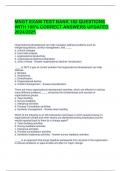
MNGT EXAM TEST BANK 182 QUESTIONS
WITH 100% CORRECT ANSWERS UPDATED
2024/2025
Organizational development can help managers address problems such as
merger/acquisitions, conflict management, and ____.
a. cultural changes
b. force field analysis
c. organizational productivity
d. organizational decline/revitalization
e. none of these - Answer-organizational decline/ revitalization
____ is NOT a type of current problem that organizational development can help
address.
a. Mergers
b. Acquisitions
c. Diversification
d. Organizational decline
e. Conflict management - Answer-diversification
There are many organizational development activities, which are effective in solving
many different problems. ____ enhances the cohesiveness and success of
organizational groups.
a. Team building
b. Survey feedback
c. Intergroup activities
d. Process-Consultation activities
e. Symbolic management - Answer-team building
Which of the following is an OD intervention technique in which questionnaires on
organizational climate and other factors are distributed among employees and the
results reported back to them by a change agent?
a. Team building activities
b. Survey feedback activities
c. Intergroup activities
d. Process-consolidation activities
e. Symbiotic leadership activities - Answer-survey feedback activities
____ is an approach that brings together participants from all parts of the organization
to discuss problems or opportunities and plan for major change.
,a. virtual-group intervention
b. Traditional organization development
c. Multi-unit intervention
d. Strategic planning committee
e. Large-group intervention - Answer-large-group intervention
Which of the following is the intervention stage of organization development in which
individuals experiment with new workplace behavior?
a. Refreezing
b. Restating
c. Unfreezing
d. Changing
e. Jumping - Answer-changing
Which of the following is the reinforcement stage of organization development in which
individuals acquire a desired new skill or attitude and are rewarded for it by the
organization?
a. Refreezing
b. Restating
c. Unfreezing
d. Changing
e. Jumping - Answer-refreezing
A step in the diagnosis stage of organizational development in which participants are
made aware of problems is referred to as
a. change agent.
b. changing.
c. refreezing.
d. unfreezing.
e. exercising. - Answer-unfreezing
Organizational development specialists identify three distinct steps for achieving
behavioral and attitudinal changes. These are
a. freezing, changing, and intervention.
b. unfreezing, change agent, and freezing.
c. unfreezing, changing, and refreezing.
d. intervention, refreezing, and change agent.
e. none of these. - Answer-unfreezing, changing, and refreezing
At which stage of the change process do managers evaluate problems and
opportunities?
a. Monitor forces for change
b. Need for change
c. Initiate change
d. Implement change
e. Internal forces - Answer-need for change
, ____ indicates a disparity between existing and desired performance levels.
a. Environmental opportunity
b. Need for change
c. Behavioral occurrence
d. Critical incident
e. Organizational structural imbalance - Answer-need for change
Kyle is seeing, on a regular basis, a difference between current and expected
performance levels. She should begin
a. to gather more data.
b. to implement change.
c. to perceive a need for change.
d. to change the reward system.
e. all of these. - Answer-to perceive a need for change
Recently, a high level manager at Trophy Trinkets noted a rise in customer satisfaction
complaints. This rise is inconsistent with Trophy's goals in this area. This manager has
identified
a. a need for change.
b. a critical incident.
c. a behavioral occurrence.
d. an environmental opportunity.
e. a SWOT analysis. - Answer-a need for change
Cyrus' Resort has proposed some major structural changes within their organization.
Some of the employees fear that they will lose power with the changes. They begin
voicing resistance to the changes. What barrier to change are they exhibiting?
a. Disagreements about the benefits
b. Self interests
c. A lack of understanding and trust
d. Uncertainty
e. Goals and rewards - Answer-self interests
After every quarterly board meeting, Bernice's Bracelets, Inc. announces big changes.
They usually do not follow through on these changes. What is causing this lack of
enthusiasm?
a. Disagreements about the benefits
b. Self interests
c. A lack of trust
d. Goals and assessments
e. Competitors - Answer-a lack of trust
According to Spotlight on Skills in Chapter 8, the eight-step plan for implementing
change in an organization includes all of the following EXCEPT:
a. establish a sense of urgency
, b. form a powerful coalition of managers
c. communicate the vision
d. empower others to act on the vision
e. all of these are steps in the plan - Answer-all of these are steps in the plan
You are the production manager for Connor's Construction, Inc. You decide to change
the production procedure to increase efficiency. One of your long-time foremen is
resisting the change, insisting that the idea won't work. He is exhibiting what obstacle to
change?
a. Different assessment and goals
b. Uncertainty about the future
c. A lack of trust
d. All of these
e. Uncertainty about the future and a lack of trust only - Answer-different assessment
and goals
Which of the following refers to the deployment of organizational resources to achieve
strategic goals?
a. Planning
b. Controlling
c. Organizing
d. Leading
e. Strategic management - Answer-Organizing
2. Strategy defines ____ to do (it) while organizing defines ____ to do (it).
a. how; what
b. how; why
c. what; how
d. what; why
e. when; what - Answer-what:how
3. Organizational structure includes which of these?
a. The set of formal tasks assigned to individuals
b. The set of formal tasks assigned to departments
c. The design of systems to ensure effective coordination of employees across
departments
d. Formal reporting relationships
e. All of these are part of organizational structure. - Answer-All of these are part of
organizational structure
4. Organization structure is defined as the
a. visual representation of the organization.
b. framework in which the organization defined how tasks are divided, resources are
deployed, and departments are coordinated.
c. division of labor.
d. unbroken line of authority that links all individuals in the organization.
WITH 100% CORRECT ANSWERS UPDATED
2024/2025
Organizational development can help managers address problems such as
merger/acquisitions, conflict management, and ____.
a. cultural changes
b. force field analysis
c. organizational productivity
d. organizational decline/revitalization
e. none of these - Answer-organizational decline/ revitalization
____ is NOT a type of current problem that organizational development can help
address.
a. Mergers
b. Acquisitions
c. Diversification
d. Organizational decline
e. Conflict management - Answer-diversification
There are many organizational development activities, which are effective in solving
many different problems. ____ enhances the cohesiveness and success of
organizational groups.
a. Team building
b. Survey feedback
c. Intergroup activities
d. Process-Consultation activities
e. Symbolic management - Answer-team building
Which of the following is an OD intervention technique in which questionnaires on
organizational climate and other factors are distributed among employees and the
results reported back to them by a change agent?
a. Team building activities
b. Survey feedback activities
c. Intergroup activities
d. Process-consolidation activities
e. Symbiotic leadership activities - Answer-survey feedback activities
____ is an approach that brings together participants from all parts of the organization
to discuss problems or opportunities and plan for major change.
,a. virtual-group intervention
b. Traditional organization development
c. Multi-unit intervention
d. Strategic planning committee
e. Large-group intervention - Answer-large-group intervention
Which of the following is the intervention stage of organization development in which
individuals experiment with new workplace behavior?
a. Refreezing
b. Restating
c. Unfreezing
d. Changing
e. Jumping - Answer-changing
Which of the following is the reinforcement stage of organization development in which
individuals acquire a desired new skill or attitude and are rewarded for it by the
organization?
a. Refreezing
b. Restating
c. Unfreezing
d. Changing
e. Jumping - Answer-refreezing
A step in the diagnosis stage of organizational development in which participants are
made aware of problems is referred to as
a. change agent.
b. changing.
c. refreezing.
d. unfreezing.
e. exercising. - Answer-unfreezing
Organizational development specialists identify three distinct steps for achieving
behavioral and attitudinal changes. These are
a. freezing, changing, and intervention.
b. unfreezing, change agent, and freezing.
c. unfreezing, changing, and refreezing.
d. intervention, refreezing, and change agent.
e. none of these. - Answer-unfreezing, changing, and refreezing
At which stage of the change process do managers evaluate problems and
opportunities?
a. Monitor forces for change
b. Need for change
c. Initiate change
d. Implement change
e. Internal forces - Answer-need for change
, ____ indicates a disparity between existing and desired performance levels.
a. Environmental opportunity
b. Need for change
c. Behavioral occurrence
d. Critical incident
e. Organizational structural imbalance - Answer-need for change
Kyle is seeing, on a regular basis, a difference between current and expected
performance levels. She should begin
a. to gather more data.
b. to implement change.
c. to perceive a need for change.
d. to change the reward system.
e. all of these. - Answer-to perceive a need for change
Recently, a high level manager at Trophy Trinkets noted a rise in customer satisfaction
complaints. This rise is inconsistent with Trophy's goals in this area. This manager has
identified
a. a need for change.
b. a critical incident.
c. a behavioral occurrence.
d. an environmental opportunity.
e. a SWOT analysis. - Answer-a need for change
Cyrus' Resort has proposed some major structural changes within their organization.
Some of the employees fear that they will lose power with the changes. They begin
voicing resistance to the changes. What barrier to change are they exhibiting?
a. Disagreements about the benefits
b. Self interests
c. A lack of understanding and trust
d. Uncertainty
e. Goals and rewards - Answer-self interests
After every quarterly board meeting, Bernice's Bracelets, Inc. announces big changes.
They usually do not follow through on these changes. What is causing this lack of
enthusiasm?
a. Disagreements about the benefits
b. Self interests
c. A lack of trust
d. Goals and assessments
e. Competitors - Answer-a lack of trust
According to Spotlight on Skills in Chapter 8, the eight-step plan for implementing
change in an organization includes all of the following EXCEPT:
a. establish a sense of urgency
, b. form a powerful coalition of managers
c. communicate the vision
d. empower others to act on the vision
e. all of these are steps in the plan - Answer-all of these are steps in the plan
You are the production manager for Connor's Construction, Inc. You decide to change
the production procedure to increase efficiency. One of your long-time foremen is
resisting the change, insisting that the idea won't work. He is exhibiting what obstacle to
change?
a. Different assessment and goals
b. Uncertainty about the future
c. A lack of trust
d. All of these
e. Uncertainty about the future and a lack of trust only - Answer-different assessment
and goals
Which of the following refers to the deployment of organizational resources to achieve
strategic goals?
a. Planning
b. Controlling
c. Organizing
d. Leading
e. Strategic management - Answer-Organizing
2. Strategy defines ____ to do (it) while organizing defines ____ to do (it).
a. how; what
b. how; why
c. what; how
d. what; why
e. when; what - Answer-what:how
3. Organizational structure includes which of these?
a. The set of formal tasks assigned to individuals
b. The set of formal tasks assigned to departments
c. The design of systems to ensure effective coordination of employees across
departments
d. Formal reporting relationships
e. All of these are part of organizational structure. - Answer-All of these are part of
organizational structure
4. Organization structure is defined as the
a. visual representation of the organization.
b. framework in which the organization defined how tasks are divided, resources are
deployed, and departments are coordinated.
c. division of labor.
d. unbroken line of authority that links all individuals in the organization.