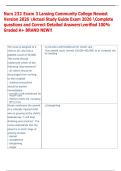
NRNP 6531 Week 8
Graded A+ Guaranteed
Pass
Nrnp week8 knowledge check gastrointestinal genitourinary
endocrine and hematologic conditions fall
Question 1
1 out of 1 points
Which of the following patients most warrants screening for hypothyroidism?
Selected d.
Answer: An elderly female with recent onset of mental dysfunction.
Answers: a.
A young adult female with postpartum depression lasting 2
weeks.
b.
A patient taking thyroid replacement preparation.
c.
A 40 year old male with unexplained tremors.
d.
An elderly female with recent onset of mental dysfunction.
Question 2
, 1 out of 1 points
The nurse practitioner diagnoses epididymitis in a 24 year old sexually active male patient. The drug
of choice for treatment of this patient is:
Selected b.
Answer: Oral doxycycline (Virbamycin) plus intramuscular ceftriaxone
Answers: a.
Oral ciprofloxacin (Cipro)
b.
Oral doxycycline (Virbamycin) plus intramuscular ceftriaxone
c.
Oral trimethoprim-sulfamethoxazole (Bactrim DS)
d.
Intramuscular penicillin
Question 3
1 out of 1 points
The most commonly recommended method for prostate cancer screening in a 55 year old
male is:
Selected a.
Answer: Digital rectal examination (DRE) plus prostate specific antigen (PSA)
Answers: a.
Digital rectal examination (DRE) plus prostate specific antigen (PSA)
b.
Prostate specific antigen (PSA) alone
c.
Transrectal ultrasound (TRUS) alone
d.
Prostate specific antigen (PSA) and transrectal ultrasound
(TRUS)
Question 4
1 out of 1 points
John, age 33, has a total cholesterol level of 188 mg/dL. How often should he be screened for
hypercholesterolemia?
, Selected a.
Answer: Every 5 years
Answers: a.
Every 5 years
b.
Every 2 years
c.
Every year
d.
Whenever blood work is done
Question 5
1 out of 1 points
The National Cholesterol Education Program’s Adult Treatment Panel III recommends that the
goal for low density lipoproteins in high risk patients be less than:
Selected c.
Answer: 100
mg/dL
Answers: a.
160
mg/dL
b.
130
mg/dL
c.
100
mg/dL
d.
70
mg/dL
Question 6
1 out of 1 points
A patient presents with classic symptoms of gastroesophageal reflux disease (GERD). He is instructed
on life style modifications and drug therapy for 8 weeks. Three months later he returns, reporting that
he was “fine” as long as he took the medication. The most appropriate next step is:
Graded A+ Guaranteed
Pass
Nrnp week8 knowledge check gastrointestinal genitourinary
endocrine and hematologic conditions fall
Question 1
1 out of 1 points
Which of the following patients most warrants screening for hypothyroidism?
Selected d.
Answer: An elderly female with recent onset of mental dysfunction.
Answers: a.
A young adult female with postpartum depression lasting 2
weeks.
b.
A patient taking thyroid replacement preparation.
c.
A 40 year old male with unexplained tremors.
d.
An elderly female with recent onset of mental dysfunction.
Question 2
, 1 out of 1 points
The nurse practitioner diagnoses epididymitis in a 24 year old sexually active male patient. The drug
of choice for treatment of this patient is:
Selected b.
Answer: Oral doxycycline (Virbamycin) plus intramuscular ceftriaxone
Answers: a.
Oral ciprofloxacin (Cipro)
b.
Oral doxycycline (Virbamycin) plus intramuscular ceftriaxone
c.
Oral trimethoprim-sulfamethoxazole (Bactrim DS)
d.
Intramuscular penicillin
Question 3
1 out of 1 points
The most commonly recommended method for prostate cancer screening in a 55 year old
male is:
Selected a.
Answer: Digital rectal examination (DRE) plus prostate specific antigen (PSA)
Answers: a.
Digital rectal examination (DRE) plus prostate specific antigen (PSA)
b.
Prostate specific antigen (PSA) alone
c.
Transrectal ultrasound (TRUS) alone
d.
Prostate specific antigen (PSA) and transrectal ultrasound
(TRUS)
Question 4
1 out of 1 points
John, age 33, has a total cholesterol level of 188 mg/dL. How often should he be screened for
hypercholesterolemia?
, Selected a.
Answer: Every 5 years
Answers: a.
Every 5 years
b.
Every 2 years
c.
Every year
d.
Whenever blood work is done
Question 5
1 out of 1 points
The National Cholesterol Education Program’s Adult Treatment Panel III recommends that the
goal for low density lipoproteins in high risk patients be less than:
Selected c.
Answer: 100
mg/dL
Answers: a.
160
mg/dL
b.
130
mg/dL
c.
100
mg/dL
d.
70
mg/dL
Question 6
1 out of 1 points
A patient presents with classic symptoms of gastroesophageal reflux disease (GERD). He is instructed
on life style modifications and drug therapy for 8 weeks. Three months later he returns, reporting that
he was “fine” as long as he took the medication. The most appropriate next step is: