IMM4: Antibodies
Humoral immune response
When B cells encounter an antigen, they trigger the humoral immune response. Upon activation,
the B cell receptor (BCR) gains effector functions, leading to the secretion of antibodies. This process
involves multiple phases of B cell development and activation, ultimately resulting in the production
of antibodies that help neutralize or eliminate the antigen. The humoral immune response plays a
crucial role in defending the body against pathogens.
Part I: antibody structure and function
Antibodies
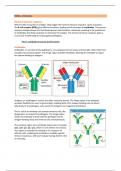
Antibodies, or secreted immunoglobulins, are composed of two heavy and two light chains that form
variable and constant regions. The hinge region provides flexibility, allowing the antibody to adjust
for optimal binding to antigens.
Antigens on a pathogen's surface are often unevenly spaced. The hinge region of an antibody
provides flexibility (as seen in IgG and IgA), enabling both of its antigen-binding sites to attach
effectively to the pathogen, even when the antigens are irregularly distributed.
The Fc-tail of an antibody can activate immune cells, like
phagocytes, to respond to pathogens. The hinge region
allows the antibody to bind both the pathogen (via its
antigen-binding sites) and immune cells simultaneously.
The constant region of an antibody determines its isotype
(IgG, IgM, IgD, IgE, IgA), which in turn defines its function.
This region is essential for binding to Fc receptors on
effector cells, enabling the antibody to mediate specific
immune responses, with each isotype having distinct roles
in immunity.
, Functions of antibodies
The three primary functions of antibodies are:
1. Neutralization: Antibodies bind to pathogens or toxins, blocking their ability to infect host
cells or cause harm.
2. Opsonization: Antibodies coat pathogens, marking them for recognition and ingestion by
phagocytic immune cells such as macrophages and neutrophils.
3. Complement Activation: Antibodies activate the complement system, a group of proteins
that enhance immune responses.
Antigen Specificity and Epitope Recognition by Antibodies
The variable region of an antibody determines its antigen specificity.
The antigen-binding site is formed by the combination of the
variable regions of the heavy and light chains, enabling precise
binding to a specific antigen. Each B cell receptor (BCR) or antibody
has a unique variable region, ensuring that different B cells can
recognize a wide variety of antigens.
Antibodies can bind both continuous and discontinuous epitopes on
an intact antigen. An antigen can contain multiple epitopes, making
it multivalent, with either different or repeated epitopes.
Epitopes can be classified as linear, consisting of successive amino
acids, or discontinuous, where separate amino acids align due to the
folding of the antigen.
The ability of an antibody to bind to an antigen depends on the 3D
structure of the intact antigen, which allows for the correct
alignment of the epitope with the antibody’s binding site.
Humoral immune response
When B cells encounter an antigen, they trigger the humoral immune response. Upon activation,
the B cell receptor (BCR) gains effector functions, leading to the secretion of antibodies. This process
involves multiple phases of B cell development and activation, ultimately resulting in the production
of antibodies that help neutralize or eliminate the antigen. The humoral immune response plays a
crucial role in defending the body against pathogens.
Part I: antibody structure and function
Antibodies
Antibodies, or secreted immunoglobulins, are composed of two heavy and two light chains that form
variable and constant regions. The hinge region provides flexibility, allowing the antibody to adjust
for optimal binding to antigens.
Antigens on a pathogen's surface are often unevenly spaced. The hinge region of an antibody
provides flexibility (as seen in IgG and IgA), enabling both of its antigen-binding sites to attach
effectively to the pathogen, even when the antigens are irregularly distributed.
The Fc-tail of an antibody can activate immune cells, like
phagocytes, to respond to pathogens. The hinge region
allows the antibody to bind both the pathogen (via its
antigen-binding sites) and immune cells simultaneously.
The constant region of an antibody determines its isotype
(IgG, IgM, IgD, IgE, IgA), which in turn defines its function.
This region is essential for binding to Fc receptors on
effector cells, enabling the antibody to mediate specific
immune responses, with each isotype having distinct roles
in immunity.
, Functions of antibodies
The three primary functions of antibodies are:
1. Neutralization: Antibodies bind to pathogens or toxins, blocking their ability to infect host
cells or cause harm.
2. Opsonization: Antibodies coat pathogens, marking them for recognition and ingestion by
phagocytic immune cells such as macrophages and neutrophils.
3. Complement Activation: Antibodies activate the complement system, a group of proteins
that enhance immune responses.
Antigen Specificity and Epitope Recognition by Antibodies
The variable region of an antibody determines its antigen specificity.
The antigen-binding site is formed by the combination of the
variable regions of the heavy and light chains, enabling precise
binding to a specific antigen. Each B cell receptor (BCR) or antibody
has a unique variable region, ensuring that different B cells can
recognize a wide variety of antigens.
Antibodies can bind both continuous and discontinuous epitopes on
an intact antigen. An antigen can contain multiple epitopes, making
it multivalent, with either different or repeated epitopes.
Epitopes can be classified as linear, consisting of successive amino
acids, or discontinuous, where separate amino acids align due to the
folding of the antigen.
The ability of an antibody to bind to an antigen depends on the 3D
structure of the intact antigen, which allows for the correct
alignment of the epitope with the antibody’s binding site.