
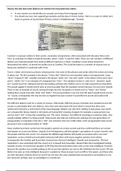
Discuss the idea that some dialects are viewed less favourably than others.
In your answer you should discuss concepts and issues from language study.
You should use your own supporting examples and the data in Text A, below. Text A is a copy of a letter sent
home to parents at Sacred Heart Primary School in Middlesbrough, Teesside.
A person’s or group’s dialect is their accent, vocabulary and grammar, often associated with the place they come
from- an example of a dialect would be Geordie, where “netty” is used for toilet. There are vast numbers of different
dialects and naturally people have built up different opinions on them, resulting in some being viewed less
favourably than others, as proven by studies such as ComRes. This could be down to a number of reasons such as
being non-standard or associated with crime.
Text A, a letter sent home to primary school parents, lists some of the phrases and words which the school are trying
to phase out. The first example is the phrase “I done that” which has non-standard subject verb agreement, using
“done” instead of “did”. Another example is the phrase “gizzit ‘ere”, the verb “gizzit” is the elision of the word “give”
and it”, whilst “ere” is an example of h dropping from “here”. The standard version is “give me it”. However “gizzit
ere” sounds much for colloquial and less demanding, perhaps why children use it, to make requests less imperative.
This would suggest it should not be seen as less favourably than the standard version because it is just more relaxed.
There is also an example of accent coming through into the vocabulary on words such as “letter” and “butter”
making them sound more like “letta” and “butta”. This pronunciation is very far from RP which would clearly say the
“er” sound, consequently this may be seen as negative because it doesn’t sound like the accent associated with
power and education.
The different dialects exist for a variety of reasons. Historically, different groups of people were isolated around the
country so developed their own dialects, since they only interacted with each other it meant that they were
reinforced to become a central part of the areas language. Dialects can also form relating to age group, new words
are consequently being created or old words are having their meaning changed, for example a young person may
use the word “sick” to describe something cool. This word, however, has different meanings to someone older, who
would probably define it as being unwell. Slang words also fade out and become unknown by new generations of
young people, for example in the 60s a “fink” was someone who was a tittle tattle, most young people today would
presume it was a mispronunciation of “think”.
Many studies have been carried out into people’s opinion on certain accents and thus confirmed there are certain
stereotypes on accent and dialect. Linguist Chris Montgomery said that people’s perceptions of a place transfer onto
the people and then the accent. For example the Hillsborough disaster left people in Liverpool with a very bad
reputation, scenes of theft and animalistic behaviour left them with many negative opinions from others.
Consequently the ComRes poll found that Liverpool was the least intelligent, friendly and trustworthy. This bad
reputation is now associated with the accent so it is viewed less favourably. Howard Giles also investigated feelings
towards accents. He found that speakers of RP (Received Pronunciation) were seen as the most intelligent. However
because the speaker was actually putting on the accent the opinions are not on the individual but the accent. RP was
likely to be seen as most intelligent because it is spoken by those in power such as MPs or the queen, and those who
are well educated. Dialects which are not RP do not have the same sophisticated and powerful connotations so are
less favoured, perhaps seen as unintelligent or uncultured.
In your answer you should discuss concepts and issues from language study.
You should use your own supporting examples and the data in Text A, below. Text A is a copy of a letter sent
home to parents at Sacred Heart Primary School in Middlesbrough, Teesside.
A person’s or group’s dialect is their accent, vocabulary and grammar, often associated with the place they come
from- an example of a dialect would be Geordie, where “netty” is used for toilet. There are vast numbers of different
dialects and naturally people have built up different opinions on them, resulting in some being viewed less
favourably than others, as proven by studies such as ComRes. This could be down to a number of reasons such as
being non-standard or associated with crime.
Text A, a letter sent home to primary school parents, lists some of the phrases and words which the school are trying
to phase out. The first example is the phrase “I done that” which has non-standard subject verb agreement, using
“done” instead of “did”. Another example is the phrase “gizzit ‘ere”, the verb “gizzit” is the elision of the word “give”
and it”, whilst “ere” is an example of h dropping from “here”. The standard version is “give me it”. However “gizzit
ere” sounds much for colloquial and less demanding, perhaps why children use it, to make requests less imperative.
This would suggest it should not be seen as less favourably than the standard version because it is just more relaxed.
There is also an example of accent coming through into the vocabulary on words such as “letter” and “butter”
making them sound more like “letta” and “butta”. This pronunciation is very far from RP which would clearly say the
“er” sound, consequently this may be seen as negative because it doesn’t sound like the accent associated with
power and education.
The different dialects exist for a variety of reasons. Historically, different groups of people were isolated around the
country so developed their own dialects, since they only interacted with each other it meant that they were
reinforced to become a central part of the areas language. Dialects can also form relating to age group, new words
are consequently being created or old words are having their meaning changed, for example a young person may
use the word “sick” to describe something cool. This word, however, has different meanings to someone older, who
would probably define it as being unwell. Slang words also fade out and become unknown by new generations of
young people, for example in the 60s a “fink” was someone who was a tittle tattle, most young people today would
presume it was a mispronunciation of “think”.
Many studies have been carried out into people’s opinion on certain accents and thus confirmed there are certain
stereotypes on accent and dialect. Linguist Chris Montgomery said that people’s perceptions of a place transfer onto
the people and then the accent. For example the Hillsborough disaster left people in Liverpool with a very bad
reputation, scenes of theft and animalistic behaviour left them with many negative opinions from others.
Consequently the ComRes poll found that Liverpool was the least intelligent, friendly and trustworthy. This bad
reputation is now associated with the accent so it is viewed less favourably. Howard Giles also investigated feelings
towards accents. He found that speakers of RP (Received Pronunciation) were seen as the most intelligent. However
because the speaker was actually putting on the accent the opinions are not on the individual but the accent. RP was
likely to be seen as most intelligent because it is spoken by those in power such as MPs or the queen, and those who
are well educated. Dialects which are not RP do not have the same sophisticated and powerful connotations so are
less favoured, perhaps seen as unintelligent or uncultured.



