
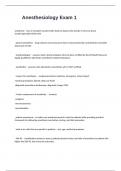
Anesthesiology Exam 1
anesthesia - loss of sensation to part/entire body to depress the activity of nervous tissue
locally/regionally/within CNS
general anesthesia - drug induced unconsciousness that is characterized by controlled but reversible
depression of CNS
anesthesiologist - a person with a doctoral degree who has been certified by the ACVAA/ECVAA and
legally qualified to administer anesthetics/related techniques
anesthetist - a person who administers anesthetics who is NOT certified
reasons for anesthesia - -surgical procedures (elective, emergency, minor/major)
-medical procedures (dental, deep ear flush)
-diagnostic procedures (endoscopy, diagnostic image, FNA)
4 main components of anesthesia - -amnesia
-analgesia
-unconsciousness
-myorelaxation
patient assessment - to make sure anesthesia period is safe for patients while providing practical
framework for delivering anesthesia care before, during, and after procedure
what is are risks that are specific to patients - size, age, medical procedures
ASA-PS - classification system to asses a patients physical status and risks of anesthesia to patient (the
higher the ASA-PS, the worse the outcome)
, ASA class 1 - normal healthy patient
ASA class 2 - patient with mild systemic disease
ASA class 3 - patient with severe systemic disease
ASA class 4 - patient with severe systemic disease that is constant threat to life
ASA class 5 - moribund patient not expected to survive with out emergent procedure
what are other things to be kept in mind with patient assessment - -disease related risks
-monitoring physiological parameters/provision of physiologic support
-resource of staffs, equipment, drug availability
-history and PE (within 12-24 hours of anesthesia)
-time of day
what are the components of the anesthesia machine - -F: flowmeter
-R: regulator
-O: oxygen/other medial gases
-G: gas (vaporizer)
-S: scavenger
purpose of the flowmeter - to precisely control the delivery of a specific amount of medical gas
(usually oxygen) through the vaporizer to the patient
what does the color green mean - oxygen
what does the color yellow mean - medical air
, what does the color blue mean - N2O
what is flow rate determined by - observing the bob/float in the flowmeter (read middle of ball or top
of float)
purpose of regulator - reduces the high pressure from the medical gas to a working pressure, reduces
risk of patients airway/machine damage and provides constant flow
what are the three different pressure of a regulator - -high pressure system (1900-2200 PSI)
-intermediate pressure system (45-50 PSI)
-low pressure system (16 PSI)
purpose of hanger yoke (cylinder yoke) - allows portable tank to be connected to machine
what does the safety system for oxygen do - prevents accidental connection/wrong gas
PISS system - pin index safety system
DISS system - diameter index safety system
Type E tank - -small tank
-N2O: 1590 L, 745 PSI
-O2: 660 L, 1900 PSI
-medical air: 625 L, 1900 PSI
type H tank - -large tank
-N2O: 15800 L, 745 PSI
-O2: 6900 L, 2200 PSI
, -medical air: 6550 L, 2200 PSI
oxygen flushing valve - allows high volume of O2 to bypass the vaporizer and common gas outlet to
breathing circuit when activated--used to dilute aesthetic agent during anesthesia emergency
when should you never use the oxygen flushing valve? - when the patient is connected (barotrauma)
what is the normal oxygen flow rate - 35-75 L/min at 58 PSI
what is the purpose of the scavenger - used to minimize pollution to working environment
passive scavenging system - active charcoal canister that absorbs halogenated hydrocarbon
anesthetics (high resistance to waste gas flow->ineffective at eliminated N2O)
when should you replace your passive scavenging system canister - when the canister is 50g heavier
than the initial weight
active scavenging system - effective at removing waste gas (vacuum pump needed), competitively
vacuum the fresh gas supply and affect patients ventilation/oxygenation
what should halogenated anesthetics not exceed - 2 ppm when used alone
RVOLTS - R: resistance: high vs low
V: vaporization: flow over vs injection
O: output method: variable bypass vs measured
L: location: VIC vs VOC
T: temp. compensation: mechanical vs compound
S: agent specificity: iso, sevo, desflurane
anesthesia - loss of sensation to part/entire body to depress the activity of nervous tissue
locally/regionally/within CNS
general anesthesia - drug induced unconsciousness that is characterized by controlled but reversible
depression of CNS
anesthesiologist - a person with a doctoral degree who has been certified by the ACVAA/ECVAA and
legally qualified to administer anesthetics/related techniques
anesthetist - a person who administers anesthetics who is NOT certified
reasons for anesthesia - -surgical procedures (elective, emergency, minor/major)
-medical procedures (dental, deep ear flush)
-diagnostic procedures (endoscopy, diagnostic image, FNA)
4 main components of anesthesia - -amnesia
-analgesia
-unconsciousness
-myorelaxation
patient assessment - to make sure anesthesia period is safe for patients while providing practical
framework for delivering anesthesia care before, during, and after procedure
what is are risks that are specific to patients - size, age, medical procedures
ASA-PS - classification system to asses a patients physical status and risks of anesthesia to patient (the
higher the ASA-PS, the worse the outcome)
, ASA class 1 - normal healthy patient
ASA class 2 - patient with mild systemic disease
ASA class 3 - patient with severe systemic disease
ASA class 4 - patient with severe systemic disease that is constant threat to life
ASA class 5 - moribund patient not expected to survive with out emergent procedure
what are other things to be kept in mind with patient assessment - -disease related risks
-monitoring physiological parameters/provision of physiologic support
-resource of staffs, equipment, drug availability
-history and PE (within 12-24 hours of anesthesia)
-time of day
what are the components of the anesthesia machine - -F: flowmeter
-R: regulator
-O: oxygen/other medial gases
-G: gas (vaporizer)
-S: scavenger
purpose of the flowmeter - to precisely control the delivery of a specific amount of medical gas
(usually oxygen) through the vaporizer to the patient
what does the color green mean - oxygen
what does the color yellow mean - medical air
, what does the color blue mean - N2O
what is flow rate determined by - observing the bob/float in the flowmeter (read middle of ball or top
of float)
purpose of regulator - reduces the high pressure from the medical gas to a working pressure, reduces
risk of patients airway/machine damage and provides constant flow
what are the three different pressure of a regulator - -high pressure system (1900-2200 PSI)
-intermediate pressure system (45-50 PSI)
-low pressure system (16 PSI)
purpose of hanger yoke (cylinder yoke) - allows portable tank to be connected to machine
what does the safety system for oxygen do - prevents accidental connection/wrong gas
PISS system - pin index safety system
DISS system - diameter index safety system
Type E tank - -small tank
-N2O: 1590 L, 745 PSI
-O2: 660 L, 1900 PSI
-medical air: 625 L, 1900 PSI
type H tank - -large tank
-N2O: 15800 L, 745 PSI
-O2: 6900 L, 2200 PSI
, -medical air: 6550 L, 2200 PSI
oxygen flushing valve - allows high volume of O2 to bypass the vaporizer and common gas outlet to
breathing circuit when activated--used to dilute aesthetic agent during anesthesia emergency
when should you never use the oxygen flushing valve? - when the patient is connected (barotrauma)
what is the normal oxygen flow rate - 35-75 L/min at 58 PSI
what is the purpose of the scavenger - used to minimize pollution to working environment
passive scavenging system - active charcoal canister that absorbs halogenated hydrocarbon
anesthetics (high resistance to waste gas flow->ineffective at eliminated N2O)
when should you replace your passive scavenging system canister - when the canister is 50g heavier
than the initial weight
active scavenging system - effective at removing waste gas (vacuum pump needed), competitively
vacuum the fresh gas supply and affect patients ventilation/oxygenation
what should halogenated anesthetics not exceed - 2 ppm when used alone
RVOLTS - R: resistance: high vs low
V: vaporization: flow over vs injection
O: output method: variable bypass vs measured
L: location: VIC vs VOC
T: temp. compensation: mechanical vs compound
S: agent specificity: iso, sevo, desflurane


