

Written by students who passed Immediately available after payment Read online or as PDF Wrong document? Swap it for free 4.6 TrustPilot
logo-home
Document preview thumbnail
Preview 2 out of 11 pages
Exam (elaborations)

Psychology - Exam 1 - Study Guide Questions Exam With Correct Verified Answers A+ Score.

Document preview thumbnail
Preview 2 out of 11 pages

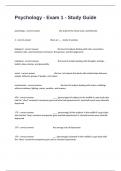
psychology - correct answer the study of the mind, brain, and behavior 4 - correct answer there are ___ levels of analysis biological - correct answer the level of analysis dealing with cells, connections between cells, neurochemicals, hormones, the genome, and the epigenome individual - correct answer the level of analysis dealing with thoughts, feelings, beliefs, ideas, desires, and personality social - correct answer the leve l of analysis that deals with relationships between people, influence groups of people, and culture environment - correct answer the level of analysis dealing with nature, buildings without windows, lighting, noises, weather, and seasons 43% - correct answer ____ (percentage) of subjects in the moffitt & caspi study who had the "short" serotonin transporter gene and who had experienced 4+ stressfull events were clinically depressed 17% - correct answer ____ (percentage) of the subjects in the moffitt & caspi study who had the "long" serotonin transporter gene and had experienced 4+ stressful events were clinically depressed 17% - correct answer the average rate of depression 17% - correct answer ___ (percentage) of people in the moffitt & caspi study with the "short" serotonin transporter gene and no stressful experiences operational definition - correct answer specifying what you will measure descriptive - correct answer aka naturalistic observation: see patterns in real world through simple observation as they are. there isn't any researcher influence on the participant's behavior - correct answer strengths of descriptive studies you can't determine causality - correct answer weaknesses of descriptive studies correlational - correct answer studies where relationships between two or more variables are measured but not manipulated can study variables that can't or don't need to be manipulated - correct answer strengths of correlational studies you can't determine causality - correct answer weaknesses of correlational studies experimental - correct answer studies that involve the random assignment of both experimental and control groups ability to determine causality - correct answer strengths of experimental studies you can't always manipulate a variable (ethically, realistically, etc.) - correct answer weaknesses of experimental studies confound - correct answer a third, unaccounted for variable that could also explain the link between two other studied variables correlation - correct answer an apparent link between two variables being studied; not cause and effect necessarily +1 - correct answer the numerical value for a strong/positive correlation -1 - correct answer the numerical value for a strong/negative correlation 0 - correct answer the numerical value for no correlation independent variable - correct answer the variable that is intentionally changed while another variable is measured. This is the treatment or the condition dependent variable - correct answer the variable that is measured while another variable is changed. This is the outcome drug x - correct answer "Drug x impairs short-term memory in a word-recall task." Which is the independent variable? short-term memory - correct answer "Drug x impairs short-term memory in a word-recall task." Which is the dependent variable? visualization - correct answer "athletic performance is improved by visualization." Which is the independent variable? athletic performance - correct answer "athletic performance is improved by visualization." Which is the dependent variable? reliability - correct answer if we can replicate the results of a study, it has ______ validity - correct answer if we are measuring what we set out to measure, the study has _____ response bias - correct answer the tendency of participants to respond in a particular way, generally aiming to please sampling bias - correct answer what happens when participants aren't chosen at random cohort effects - correct answer a bias that comes as a result of different generations and their respective experiences experimenter expectancy effect - correct answer a term that's used for a researcher unknowingly cueing the participant in a study to respond a certain way double blind design - correct answer the "cure" for the experimenter expectancy effect; researches don't know which participant is control and which is experimental true - correct answer socioeconomic status and education level are examples of biases, too neuron - correct answer a cell in the nervous system specialized to receive, process, and/or transmit information to other cells dendrite - correct answer the part of the neuron that receives incoming messages resting potential - correct answer the stage of neuron firing that involves a negative charge inside the neuron, relative to the outside stimulation - correct answer ___________ causes neurons to move away from their resting potential action potential - correct answer when neurons move away from their resting potential, they move into their ______ positive - correct answer during the action potential, particles with a ______ charge enter the neuron depolarized - correct answer during action potential, after the new particles enter the neuron, the neuron becomes __________ some positively charged particles leave - correct answer how does a neuron return to its resting potential? 3 - correct answer how many different classes of neurons are there? sensory - correct answer a class of neurons that receives information from the world and sends it to the brain via the spinal cord afferent - correct answer another name for the sensory neuron motor - correct answer the class of neurons that carries signals from the spinal cord to the muscles and glands efferent - correct answer another name for the motor neuron interneurons - correct answer the class of neurons that connect all three types of neurons, and account for most of the neurons in the brain acetylcholine - correct answer the neurotransmitter that enables muscle contraction and memory alzheimer's - correct answer the result of a malfunction in acetylcholine in the body

Content preview

Psychology - Exam 1 - Study Guide

psychology - correct answer the study of the mind, brain, and behavior


4 - correct answer there are ___ levels of analysis


biological - correct answer the level of analysis dealing with cells, connections
between cells, neurochemicals, hormones, the genome, and the epigenome


individual - correct answer the level of analysis dealing with thoughts, feelings,
beliefs, ideas, desires, and personality


social - correct answer the leve l of analysis that deals with relationships between
people, influence groups of people, and culture


environment - correct answer the level of analysis dealing with nature, buildings
without windows, lighting, noises, weather, and seasons


43% - correct answer ____ (percentage) of subjects in the moffitt & caspi study who
had the "short" serotonin transporter gene and who had experienced 4+ stressfull events were clinically
depressed


17% - correct answer ____ (percentage) of the subjects in the moffitt & caspi study
who had the "long" serotonin transporter gene and had experienced 4+ stressful events were clinically
depressed


17% - correct answer the average rate of depression


17% - correct answer ___ (percentage) of people in the moffitt & caspi study with
the "short" serotonin transporter gene and no stressful experiences

, operational definition - correct answer specifying what you will measure


descriptive - correct answer aka naturalistic observation: see patterns in real world
through simple observation as they are.


there isn't any researcher influence on the participant's behavior - correct answer
strengths of descriptive studies


you can't determine causality - correct answer weaknesses of descriptive studies


correlational - correct answer studies where relationships between two or more
variables are measured but not manipulated


can study variables that can't or don't need to be manipulated - correct answer
strengths of correlational studies


you can't determine causality - correct answer weaknesses of correlational studies


experimental - correct answer studies that involve the random assignment of both
experimental and control groups


ability to determine causality - correct answer strengths of experimental studies


you can't always manipulate a variable (ethically, realistically, etc.) - correct answer
weaknesses of experimental studies


confound - correct answer a third, unaccounted for variable that could also explain
the link between two other studied variables


correlation - correct answer an apparent link between two variables being studied;
not cause and effect necessarily


Document information

Uploaded on
December 10, 2024
Number of pages
11
Written in
2024/2025
Type
Exam (elaborations)
Contains
Questions & answers
$14.49

Wrong document? Swap it for free Within 14 days of purchase and before downloading, you can choose a different document. You can simply spend the amount again.
Written by students who passed
Immediately available after payment
Read online or as PDF

Seller avatar
Reputation scores are based on the amount of documents a seller has sold for a fee and the reviews they have received for those documents. There are three levels: Bronze, Silver and Gold. The better the reputation, the more your can rely on the quality of the sellers work.
RealGrades
4.0
(26)
Sold
197
Followers
52
Items
12331
Last sold
3 weeks ago


Why students choose Stuvia

Created by fellow students, verified by reviews

Quality you can trust: written by students who passed their tests and reviewed by others who've used these notes.

Didn't get what you expected? Choose another document

No worries! You can instantly pick a different document that better fits what you're looking for.

Pay as you like, start learning right away

No subscription, no commitments. Pay the way you're used to via credit card and download your PDF document instantly.

Student with book image

“Bought, downloaded, and aced it. It really can be that simple.”

Alisha Student

Working on your references?

Create accurate citations in APA, MLA and Harvard with our free citation generator.

Working on your references?

Frequently asked questions
