

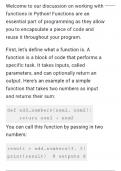
Welcome to our discussion on working with
functions in Python! Functions are an
essential part of programming as they allow
you to encapsulate a piece of code and
reuse it throughout your program.
First, let's define what a function is. A
function is a block of code that performs a
specific task. It takes inputs, called
parameters, and can optionally return an
output. Here's an example of a simple
function that takes two numbers as input
and returns their sum:
def add_numbers (num1, num2 ) :
return num1 + num2
Youcan call this function by passing in two
numbers:
result = add_numbers(3, 5)
print (result) # outputs 8
, One of the most important things to keep in
mind when working with functions is that
they should be concise and do one thing
well. This principle is known asthe Single
Responsibility Principle. By following this
principle, you make your code easier to
read, test, and maintain.
Another best practice when working with
functions is to use descriptive parameter
names. This makes your code more
readable and self-explanatory. For example,
instead of using num1 and num2 as
parameter names in the add_numbers
function, you could use first_number
and second_number ,respectively.
,
When it comes to debugging functions, a
useful technique is to use step-by-step
calculation. This involves executing your
code line by line and checking the value of
each variable after each step. This is
especially useful when your function is not
producing the expected output.
functions in Python! Functions are an
essential part of programming as they allow
you to encapsulate a piece of code and
reuse it throughout your program.
First, let's define what a function is. A
function is a block of code that performs a
specific task. It takes inputs, called
parameters, and can optionally return an
output. Here's an example of a simple
function that takes two numbers as input
and returns their sum:
def add_numbers (num1, num2 ) :
return num1 + num2
Youcan call this function by passing in two
numbers:
result = add_numbers(3, 5)
print (result) # outputs 8
, One of the most important things to keep in
mind when working with functions is that
they should be concise and do one thing
well. This principle is known asthe Single
Responsibility Principle. By following this
principle, you make your code easier to
read, test, and maintain.
Another best practice when working with
functions is to use descriptive parameter
names. This makes your code more
readable and self-explanatory. For example,
instead of using num1 and num2 as
parameter names in the add_numbers
function, you could use first_number
and second_number ,respectively.
,
When it comes to debugging functions, a
useful technique is to use step-by-step
calculation. This involves executing your
code line by line and checking the value of
each variable after each step. This is
especially useful when your function is not
producing the expected output.


