SLPA Certification Exam
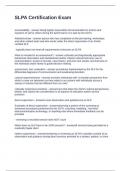
accountability - answer being legally responsible and answerable for actions and
inactions of self or others during the performance of a task by the SLPA
Aide/technician - answer person who has completed on-the-job training, workshops,
and other related tasks and who works under the direct supervision of an ASHA-
certified SLP
- typically does not meet all requirements to become an SLPA
What is included in an assessment? - answer culturally and linguistically appropriate
behavioral observation and standardized and/or criterion-referenced tools; use of
instrumentation; review of records, case history, and prior test results; and interview of
the individual and/or family to guide decision making
assessment, test, evaluation - answer procedures implemented by the SLP for the
differential diagnosis of communication and swallowing disorders
cultural responsiveness - answer provides individuals with "a broader perspective from
which to view our behaviors as they relate to our actions with individuals across a
variety of cultures that are different from our own"
culturally responsive practices - answerCare that takes the client's cultural perspectives,
beliefs, and values into consideration in all aspects of education and/or service
provision
direct supervision - answerin-view observation and guidance by an SLP
Examples of direct supervision - answerobserving a portion of the screening or
treatment procedures performed by the SLPA, coaching, modeling, "real-time"
telecommunication technology, or anything else where immediate feedback can be
provided
- reviewing a recorded session does NOT count
When does an SLP have to be 100% present? - answerall services being provided to a
medically fragile client
indirect supervision - answermonitoring or reviewing an SLPA's activities outside of an
observation and guidance during direct services provided to a student, patient, or client
, examples of indirect supervision - answerdemonstration, records review, review and
evaluation of audio or video recorded sessions, interactive conferences that may be
conducted by telecommunication (email, phone, etc.)
interpretation - answersummarizing, integrating, and using of data for the purpose of
clinical decision making, which may only be done by SLPs
medically fragile - answeran individual who is acutely ill and in an unstable health
condition
plan of care - answerwritten service plan developed and monitored by the supervising
SLP to meet the needs of an individual student, patient, or client. Addresses the needs
for screening, observation, monitoring, assessment, treatment, and other services
Examples of plan of care - answerIndividualized Education Plans (IEPs), Individualized
Family Service Plans (IFSPs), and rehabilitation services plans
progress monitoring - answercollecting, graphing, and reviewing data on an individual's
target skills to assess their response to treatment and then comparing their growth to a
target trend line or goal to determine whether sufficient progress is being made
screening - answera pass-fail procedure to identify, without interpretation, students,
patients, or clients who may require further assessment following specified screening
protocols developed by and/or approved by the supervising SLP
social determinants of health - answerThe conditions in which people are born, grow,
live, work, and age, shaped by the distribution of money, power, and resources at
global, national, and local levels
speech-language pathology assistant - answerperson who has completed coursework,
clinical practicum, and credentials and can perform tasks prescribed, directed, and
supervised by ASHA-certified SLPs
supervising SLP - answerSLP who holds a Certificate of Clinical Competence in
Speech-Language Pathology (CCC-SLP) from ASHA and/or a state licensure, has
active interest and desire to collaborate with support personnel, has a minimum of 9
months experience after being awarded ASHA certification, and has completed the 2
hour supervision requirement
what are examples of support personnel? - answerSLPAs & SLP aides/technicians
telepractice - answerapplying telecommunications technology to the delivery of
professional services at a distance by linking clinician to client for an assessment,
intervention, and/or consultation
accountability - answer being legally responsible and answerable for actions and
inactions of self or others during the performance of a task by the SLPA
Aide/technician - answer person who has completed on-the-job training, workshops,
and other related tasks and who works under the direct supervision of an ASHA-
certified SLP
- typically does not meet all requirements to become an SLPA
What is included in an assessment? - answer culturally and linguistically appropriate
behavioral observation and standardized and/or criterion-referenced tools; use of
instrumentation; review of records, case history, and prior test results; and interview of
the individual and/or family to guide decision making
assessment, test, evaluation - answer procedures implemented by the SLP for the
differential diagnosis of communication and swallowing disorders
cultural responsiveness - answer provides individuals with "a broader perspective from
which to view our behaviors as they relate to our actions with individuals across a
variety of cultures that are different from our own"
culturally responsive practices - answerCare that takes the client's cultural perspectives,
beliefs, and values into consideration in all aspects of education and/or service
provision
direct supervision - answerin-view observation and guidance by an SLP
Examples of direct supervision - answerobserving a portion of the screening or
treatment procedures performed by the SLPA, coaching, modeling, "real-time"
telecommunication technology, or anything else where immediate feedback can be
provided
- reviewing a recorded session does NOT count
When does an SLP have to be 100% present? - answerall services being provided to a
medically fragile client
indirect supervision - answermonitoring or reviewing an SLPA's activities outside of an
observation and guidance during direct services provided to a student, patient, or client
, examples of indirect supervision - answerdemonstration, records review, review and
evaluation of audio or video recorded sessions, interactive conferences that may be
conducted by telecommunication (email, phone, etc.)
interpretation - answersummarizing, integrating, and using of data for the purpose of
clinical decision making, which may only be done by SLPs
medically fragile - answeran individual who is acutely ill and in an unstable health
condition
plan of care - answerwritten service plan developed and monitored by the supervising
SLP to meet the needs of an individual student, patient, or client. Addresses the needs
for screening, observation, monitoring, assessment, treatment, and other services
Examples of plan of care - answerIndividualized Education Plans (IEPs), Individualized
Family Service Plans (IFSPs), and rehabilitation services plans
progress monitoring - answercollecting, graphing, and reviewing data on an individual's
target skills to assess their response to treatment and then comparing their growth to a
target trend line or goal to determine whether sufficient progress is being made
screening - answera pass-fail procedure to identify, without interpretation, students,
patients, or clients who may require further assessment following specified screening
protocols developed by and/or approved by the supervising SLP
social determinants of health - answerThe conditions in which people are born, grow,
live, work, and age, shaped by the distribution of money, power, and resources at
global, national, and local levels
speech-language pathology assistant - answerperson who has completed coursework,
clinical practicum, and credentials and can perform tasks prescribed, directed, and
supervised by ASHA-certified SLPs
supervising SLP - answerSLP who holds a Certificate of Clinical Competence in
Speech-Language Pathology (CCC-SLP) from ASHA and/or a state licensure, has
active interest and desire to collaborate with support personnel, has a minimum of 9
months experience after being awarded ASHA certification, and has completed the 2
hour supervision requirement
what are examples of support personnel? - answerSLPAs & SLP aides/technicians
telepractice - answerapplying telecommunications technology to the delivery of
professional services at a distance by linking clinician to client for an assessment,
intervention, and/or consultation