

PERSUASIVE COMMUNICATION
week 1
micro lectures
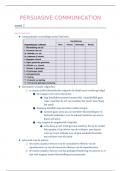
★ communicatie-overredings matrix McGuire:
★ alternatieve causale volgorden:
○ er is geen strikt hiërarchische volgorde die altijd moet worden gevolgd:
■ sla stappen over neem shortcuts:
● laag betrokken mensen kunnen bijv. onmiddellijk gaan
vaan ‘waardeer de ad’ via waardeer het merk’ naar ‘koop
het merk’.
■ doorloop dezelfde stap meerdere malen (loops):
● mensen gaan soms pas na meerdere blootstellingen en
herhaald nadenken over de inhoud, besluiten om iets te
kopen (of niet).
■ volg stappen in omgekeerde volgorde:
● soms koop je een merk gewoon omdat je het in de winkel
hebt gezien, of op advies van de verkoper. pas daarna
vorm je er een attitude over of gaat aandacht besteden
aan reclame voor dit merk.
★ relevantie van de matrix:
○ de matrix maakt je bewust van de cumulatieve effecten van de
inputfactoren en van de interactie-effecten van de inputfactoren.
○ de matrix maakt je bewust van dat gedragsverandering een proces is. er
zijn veel stappen tussen blootstelling en permanente
, gedragsverandering. de inputfactoren kunnen op elke outputstap een
ander effect hebben (positief, negatief of geen).
○ de matrix stelt je in staat om een systematisch overzicht te maken van
de wetenschappelijke kennis over de effecten over elke inputfactor op
de outputfactoren.
○ de matrix helpt je om de zwakke plekken van bepaalde inputfactoren te
zien, waarbij andere inputfactoren kunnen helpen dit op te lossen.
○ bij ontwerp van eigen campagne.
★ misvattingen en principes:
1. afnemende effecten misvatting (attenuated effects fallacy)
■ succesvol beïnvloeden van elke outputstap is afhankelijk van de
mate van positief effect van de voorgaande stappen
2. meting-op-afstand misvatting (distant measure fallacy)
■ als je doel is om te verkopen, evalueer dan niet aan de hand van
blootstelling (bereik)
■ koppel campagnedoel en evaluatie: als je doelstelling is om meer
te verkopen, meer dan de extra verkopen die kunnen worden
toegeschreven aan de campagne blootstelling
3. verwaarloosde-mediator misvatting (neglected-mediator fallacy)
■ een input element kan je succes vergroten bij de ene output stap,
maar deze verkleinen bij een andere stap
■ je moet rekening houden met deze negatieve effecten, want
negatieve effecten verkleinen het totale effect van de campagne.
het gaat om de combinatie van alle effecten op alle
opeenvolgende output stappen (conform de afnemende effecten
misvatting)
■ dus, hou rekening met alle output stappen
4. compensatie principe (compensatory principle)
■ dit is omgekeerde van de verwaarloosde mediator misvatting. als
een input element een negatief effect heeft op bepaalde output
stap, kan dit worden gecompenseerd met een sterker positief
effect op een andere stap
5. gulden middenweg principe (golden-mean principle)
■ meer is niet altijd beter; kies de gulden middenweg (d.w.z., pas
input elementen toe op een gemiddeld niveau)
6. situatie afhankelijk principe (situation-weighting principle)
■ de mate van effect dat een input element kan hebben is
afhankelijk van andere input elementen
■ de totale situatie/context moet in ogenschouw worden genomen
★ who says what in which channel to whom, with what effect?
, 1. who
2. what
3. which channel
4. to whom
5. what effect
★ yale model of persuasion (Carl Hovland, 1950s):
○ content (what)
○ source (who)
○ recipient (whom)
1. attention to message
2. understanding the message
3. acceptance of message (attitude)
4. retention of attitude → behaviour
literatuur
★ the input factors in a public communication campaign are the independent
variables and persuasive message options that can be manipulated, the
components for constructing the persuasive communication.
★ source factors (source variables): refer to characteristics of the perceived
communicator to whom the message is attributed, not of the person who
actually produced the message.
★ message factors: provides the richest sublist of input variables for persuasive
communications, including delivery style, types of appeals, inclusions and
omissions, organisation of the material included, and quantitative aspects
such as length and repetition.
★ channel factors: media through which persuasive messages are transmitted
include variables such as audio vs. visual vs. both, written vs. spoken words.
verbal vs. nonverbal messages, vocalic vs. visual nonverbal cues, immediate
vs. mediated, in various contexts.
★ receiver factors: campaigns should be designed with regard for audience
characteristics, including capacity variables such as age, education, and
intelligence; demographic variables such as gender and ethnicity; and
personality, life-style, and psychographics variables.
★ destination factors: includes variables having to do with the type of target
behaviour at which the communication is aimed. such as immediate vs. long-
term change. change on a specific issue vs. across a whole ideological system,
or change in an existing belief vs. conferring resistance against subsequent
attacks.
, ★ to advertise = to ‘call attention to’, or ‘to notify or warn’ people of something,
often by means of an announcement in a public medium.
★ advertising: stems from the latin ad vertere which means ‘to turn towards/to
change’.
★ while we might not recall many of the messages we see, we do often recognise
them.
★ Aristotle’s view: persuasion is determined by characteristics of the source of
the information (the persuader), its recipient and its content. he also showed
that it is important to consider the public your are addressing and, above all,
to concentrate on those aspects that your audience finds important and is
sensitive to.
★ Laswell’s view: the effectiveness of information is best understood by aksing
ourselves ‘who says what in which channel to whom, with what effect?’; it is
important to look at the characteristics of the person issuing the message
(who), the content of the information being communicated (what), the media
used to transmit it (which channel), the characteristics of the intended
recipient (to whom) and the extent to which their opinions or preferences are
influenced as a result (what effect).
★ attitude: describes an evaluative response - positive or negative - to a person, a
situation, a product, an idea or an organisation.
★ Hovland and his colleagues soon realised that the direct impact of a message
often differs from its indirect or delayed effect.
★ four-step process model of persuasion:
1. people must pay attention to the information contained in a message.
2. the message bust be presented in such a way that it is understood.
3. the recipient can accept it and modify their attitude accordingly.
4. for that change to influence their behaviour permanently, the recipient
must also retain their new attitude.
★ the content of a message should relate to things that people consider
important; information they regard as inconsequential will not be processed
effectively, if at all, and so have less impact.
★ the nature of the source may also give the recipient greater or lesser reason to
pay attention to particular information and to use it in shaping their attitude.
★ the yale model of persuasion:
week 1
micro lectures
★ communicatie-overredings matrix McGuire:
★ alternatieve causale volgorden:
○ er is geen strikt hiërarchische volgorde die altijd moet worden gevolgd:
■ sla stappen over neem shortcuts:
● laag betrokken mensen kunnen bijv. onmiddellijk gaan
vaan ‘waardeer de ad’ via waardeer het merk’ naar ‘koop
het merk’.
■ doorloop dezelfde stap meerdere malen (loops):
● mensen gaan soms pas na meerdere blootstellingen en
herhaald nadenken over de inhoud, besluiten om iets te
kopen (of niet).
■ volg stappen in omgekeerde volgorde:
● soms koop je een merk gewoon omdat je het in de winkel
hebt gezien, of op advies van de verkoper. pas daarna
vorm je er een attitude over of gaat aandacht besteden
aan reclame voor dit merk.
★ relevantie van de matrix:
○ de matrix maakt je bewust van de cumulatieve effecten van de
inputfactoren en van de interactie-effecten van de inputfactoren.
○ de matrix maakt je bewust van dat gedragsverandering een proces is. er
zijn veel stappen tussen blootstelling en permanente
, gedragsverandering. de inputfactoren kunnen op elke outputstap een
ander effect hebben (positief, negatief of geen).
○ de matrix stelt je in staat om een systematisch overzicht te maken van
de wetenschappelijke kennis over de effecten over elke inputfactor op
de outputfactoren.
○ de matrix helpt je om de zwakke plekken van bepaalde inputfactoren te
zien, waarbij andere inputfactoren kunnen helpen dit op te lossen.
○ bij ontwerp van eigen campagne.
★ misvattingen en principes:
1. afnemende effecten misvatting (attenuated effects fallacy)
■ succesvol beïnvloeden van elke outputstap is afhankelijk van de
mate van positief effect van de voorgaande stappen
2. meting-op-afstand misvatting (distant measure fallacy)
■ als je doel is om te verkopen, evalueer dan niet aan de hand van
blootstelling (bereik)
■ koppel campagnedoel en evaluatie: als je doelstelling is om meer
te verkopen, meer dan de extra verkopen die kunnen worden
toegeschreven aan de campagne blootstelling
3. verwaarloosde-mediator misvatting (neglected-mediator fallacy)
■ een input element kan je succes vergroten bij de ene output stap,
maar deze verkleinen bij een andere stap
■ je moet rekening houden met deze negatieve effecten, want
negatieve effecten verkleinen het totale effect van de campagne.
het gaat om de combinatie van alle effecten op alle
opeenvolgende output stappen (conform de afnemende effecten
misvatting)
■ dus, hou rekening met alle output stappen
4. compensatie principe (compensatory principle)
■ dit is omgekeerde van de verwaarloosde mediator misvatting. als
een input element een negatief effect heeft op bepaalde output
stap, kan dit worden gecompenseerd met een sterker positief
effect op een andere stap
5. gulden middenweg principe (golden-mean principle)
■ meer is niet altijd beter; kies de gulden middenweg (d.w.z., pas
input elementen toe op een gemiddeld niveau)
6. situatie afhankelijk principe (situation-weighting principle)
■ de mate van effect dat een input element kan hebben is
afhankelijk van andere input elementen
■ de totale situatie/context moet in ogenschouw worden genomen
★ who says what in which channel to whom, with what effect?
, 1. who
2. what
3. which channel
4. to whom
5. what effect
★ yale model of persuasion (Carl Hovland, 1950s):
○ content (what)
○ source (who)
○ recipient (whom)
1. attention to message
2. understanding the message
3. acceptance of message (attitude)
4. retention of attitude → behaviour
literatuur
★ the input factors in a public communication campaign are the independent
variables and persuasive message options that can be manipulated, the
components for constructing the persuasive communication.
★ source factors (source variables): refer to characteristics of the perceived
communicator to whom the message is attributed, not of the person who
actually produced the message.
★ message factors: provides the richest sublist of input variables for persuasive
communications, including delivery style, types of appeals, inclusions and
omissions, organisation of the material included, and quantitative aspects
such as length and repetition.
★ channel factors: media through which persuasive messages are transmitted
include variables such as audio vs. visual vs. both, written vs. spoken words.
verbal vs. nonverbal messages, vocalic vs. visual nonverbal cues, immediate
vs. mediated, in various contexts.
★ receiver factors: campaigns should be designed with regard for audience
characteristics, including capacity variables such as age, education, and
intelligence; demographic variables such as gender and ethnicity; and
personality, life-style, and psychographics variables.
★ destination factors: includes variables having to do with the type of target
behaviour at which the communication is aimed. such as immediate vs. long-
term change. change on a specific issue vs. across a whole ideological system,
or change in an existing belief vs. conferring resistance against subsequent
attacks.
, ★ to advertise = to ‘call attention to’, or ‘to notify or warn’ people of something,
often by means of an announcement in a public medium.
★ advertising: stems from the latin ad vertere which means ‘to turn towards/to
change’.
★ while we might not recall many of the messages we see, we do often recognise
them.
★ Aristotle’s view: persuasion is determined by characteristics of the source of
the information (the persuader), its recipient and its content. he also showed
that it is important to consider the public your are addressing and, above all,
to concentrate on those aspects that your audience finds important and is
sensitive to.
★ Laswell’s view: the effectiveness of information is best understood by aksing
ourselves ‘who says what in which channel to whom, with what effect?’; it is
important to look at the characteristics of the person issuing the message
(who), the content of the information being communicated (what), the media
used to transmit it (which channel), the characteristics of the intended
recipient (to whom) and the extent to which their opinions or preferences are
influenced as a result (what effect).
★ attitude: describes an evaluative response - positive or negative - to a person, a
situation, a product, an idea or an organisation.
★ Hovland and his colleagues soon realised that the direct impact of a message
often differs from its indirect or delayed effect.
★ four-step process model of persuasion:
1. people must pay attention to the information contained in a message.
2. the message bust be presented in such a way that it is understood.
3. the recipient can accept it and modify their attitude accordingly.
4. for that change to influence their behaviour permanently, the recipient
must also retain their new attitude.
★ the content of a message should relate to things that people consider
important; information they regard as inconsequential will not be processed
effectively, if at all, and so have less impact.
★ the nature of the source may also give the recipient greater or lesser reason to
pay attention to particular information and to use it in shaping their attitude.
★ the yale model of persuasion:


