

Midlatitude
Cyclones
General Characteristics
o Mid-latitude cyclones are cells of low pressure.
o Mid-latitude cyclones bring cold, windy and wet weather.
o The general characteristics of mid-latitude cyclones are due to pressure, wind patterns
and the air masses involved in their formation.
Effect of pressure and wind pattern on mid-latitude cyclones
o Pressure is low at the centre and increases outwards
o Pressure lower than 1000 hPa is regarded as low pressure.
o Winds don’t blow straight along pressure gradient due to Coriolis force.
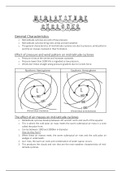
Northern Hemisphere Southern Hemisphere
Winds blow clockwise Winds blow anticlockwise
The effect of air masses on mid-latitude cyclones
o Midlatitude cyclones develop between 40° and 60° north and south of the equator.
o This is where the cold polar air mass meets the warm subtropical air mass in a zone
called the polar front.
o Can be between 1000 and 3000km in diameter
How do they form?
1. When these air masses meet, the warm subtropical air rises and the cold polar air
wedges in underneath.
2. As it rises, the warm air cools and condensation of water vapour occurs.
3. This produces the clouds and rain that are the main weather characteristics of mid-
latitude cyclones.
, Areas where mid-latitude cyclones form
World distribution of mid-latitude cyclones
o They move from west to east
o Occur mainly over the oceans and coastal areas
o Affect areas between 35° and 70° north and south of the equator.
Mid-latitude cyclones in South Africa
o The southern tip of South Africa is 37° S, so the cold fronts only cross the southern Cape
o The warm fronts are bent southwards away from South Africa.
o The cold fronts only reach South Africa in winter when all the pressure belts and wind
systems move slightly north.
o This is why the southwestern Cape receives winter rainfall.
o This will bring a week of cold, cloudy, wet weather.
Cyclones
General Characteristics
o Mid-latitude cyclones are cells of low pressure.
o Mid-latitude cyclones bring cold, windy and wet weather.
o The general characteristics of mid-latitude cyclones are due to pressure, wind patterns
and the air masses involved in their formation.
Effect of pressure and wind pattern on mid-latitude cyclones
o Pressure is low at the centre and increases outwards
o Pressure lower than 1000 hPa is regarded as low pressure.
o Winds don’t blow straight along pressure gradient due to Coriolis force.
Northern Hemisphere Southern Hemisphere
Winds blow clockwise Winds blow anticlockwise
The effect of air masses on mid-latitude cyclones
o Midlatitude cyclones develop between 40° and 60° north and south of the equator.
o This is where the cold polar air mass meets the warm subtropical air mass in a zone
called the polar front.
o Can be between 1000 and 3000km in diameter
How do they form?
1. When these air masses meet, the warm subtropical air rises and the cold polar air
wedges in underneath.
2. As it rises, the warm air cools and condensation of water vapour occurs.
3. This produces the clouds and rain that are the main weather characteristics of mid-
latitude cyclones.
, Areas where mid-latitude cyclones form
World distribution of mid-latitude cyclones
o They move from west to east
o Occur mainly over the oceans and coastal areas
o Affect areas between 35° and 70° north and south of the equator.
Mid-latitude cyclones in South Africa
o The southern tip of South Africa is 37° S, so the cold fronts only cross the southern Cape
o The warm fronts are bent southwards away from South Africa.
o The cold fronts only reach South Africa in winter when all the pressure belts and wind
systems move slightly north.
o This is why the southwestern Cape receives winter rainfall.
o This will bring a week of cold, cloudy, wet weather.


