
Lucy Kerr Question: The data showed that heart rate decreases as the mass of a mammal
1084899
increases. Does this scaling relationship apply as a rule to humans?
Heart Rate Analysis
Although the general trend is that a
Physics 1080 Lab #2 mammal's heart rate drops with
increasing bulk, this scaling relationship
does not hold true for humans. In
Young Module
addition to body mass, other variables
lo = 8 2 cm
.
that affect human heart rates include,
0 082m
age, physical fitness, heredity, and
= .
elastic = 13 .
18mm) (0 79mm) .
environmental circumstances. For
2 5122mm
example, cardiac function cause heart
= .
6m2
-
= 2 51 .
x 10
rates to typically drop with age. Another
Slope 0 277 Nicm
example is when a person is fit, their
=
.
= 27 7 N/m
resting heart rate typically decreases. As
.
lo
(YA)1 =Y
A
Slope
a result, although the scaling rule may
.
F= -YA D Slope D y= A
=
(27 . 7 Nm) /0 082m) .
be generally applicable to mammals,
6
this relationship is less clear-cut in
-
2 51 .
x 10
humans due to the complexity of the
?
=
904940 NIM
: 10
= 0 . 905 MP a
factors influencing heartbeats.
Tree Analysis
& Deciduous Tree
② Coniferous Tree
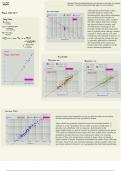
Public School Analysis
Question: Provide a brief explanation as to why you think the number of Tim Hortons
increases with population size in the way shown by the data.
More schools are generally required to meet the increasing number of
students as a city's population rises in order to ensure enough space to
provide every child/teen with an education. Sub-linearity in the
graph implies there is a slower increase in schools as population size grows.
This could be explained because larger cities may require fewer schools per
population because they have more students per school. For example,
because of their size and resources, schools in larger cities can handle a
higher number of pupils. Population distriubution is another factor affecting
this trent, larger towns can centralize education, whereas smaller cities may
need more scattered schools to serve geographically distributed populations.


