

Medical Genomics – Lecture 7 – Model organism
Human are most related to mouse and
rats.
Coding percentage is small in mammals.
Non-coding DNA is useless (introns,
regulatory sequences, centromeres,
telomeres)
In model organism could be the same
mutation as in humans.
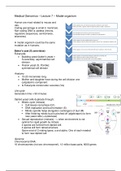
Baker’s yeat (S.cerevisiae)
Eukaryote;
• Budding yeast (baker’s yeast =
S.cerevisia); asymmetrical cell
division
• Fission yeast (S. Pombe);
symmetrical cell division
Anatomy
• 15-20 micrometer long.
• Mother and daughter have during the cell division one
cytoplasmic component.
• Is Eukaryote consist also vacuoles (Va)
Life cycle
Generation time = 90 minutes
Diploid yeast cells duplicate through;
• Mitotic cycle (mitosis)
▪ Cell leaves rest phase (G1)
▪ DNA replication and bud formation (S)
▪ Mitotic spindle helps elongation (verlengen) of bud (M)
▪ After finishing mitotic bud is pinched off (afgeknepen) to form
new yeast cells (=cytokinese)
• Sexual reproduction (meiosis) --> when environment is not
optimal for rapid growth by mitosis
4 spores are formed from diploid cell.
4 spores will form tetrad-structure.
Spore exist of 2 mating types; a and alpha. One of each needed
to form new diploid cell
Genome
Chromosomal DNA;
16 chromosomes (not sex chromosome!), 12 million base pairs, 6000 genes
, Mating type of yeast spores NOT determined by the absence or presence of specific
sex chromosomes, but is determined by a single locus on chromosome 3 termed the
MAT locus.
Yeast is eukaryote, so can remove introns by splicing. Introns are rare the cell
consist mostly of one exon.
Mitochondrial and plasmid DNA;
Propagation (voortplanting) of plasmids in yeast culture requires 2 elements;
• ARS (autonomously replicating sequence)
• CEN (centromere)
• Third compound for positive selection
When telomer sequences are added to the ends of the linear plasmids the linear
DNA is replicated. These linear DNA elements are
called Yeast Artificial Chromosome (YAS). --
>cloning large chunk of DNA
Gene replacement;
Gene replacement vector is prepared in the form of a plasmid, that
contains flanking regions of the gene (sides) and a positive
selection marker (URA3). Homologous recombination (occurs very
efficiently) in the flanking regions will replace the yeast gene
(white) with the artificial sequence (black)
Forward genetics
Yeast cell can divide fast, so suitable for forward genetics (select phenotype --> find
the gene)
Use of temperature-sensitive mutations (can be applied to all organisms)
Yeast cell grow optimal by 30 degrees.
• Inactive at 37 degrees; mutations lead to
phenotype (non-permissive or restricted) (cell cycle
will arrest)
• Active at 25 degrees; mutation not lead to a defect
(permissive)
Temperature sensitive mutations offer an opportunity to
study cell-essential mechanisms.
Genetic interactions
2 yeast genes have function in the same pathway? Test genetic interaction, they
have this if they collaborate in the production of the same phenotype.
To test; yeast strain that carries mutation in one gene is mated with yeast strain
mutation in the other gene. Combination lead to changes in phenotype there is
genetic interaction.
Combination 2 mutation lethal = synthetic lethality. To found this use Synthetic
Genetic array analysis
Human are most related to mouse and
rats.
Coding percentage is small in mammals.
Non-coding DNA is useless (introns,
regulatory sequences, centromeres,
telomeres)
In model organism could be the same
mutation as in humans.
Baker’s yeat (S.cerevisiae)
Eukaryote;
• Budding yeast (baker’s yeast =
S.cerevisia); asymmetrical cell
division
• Fission yeast (S. Pombe);
symmetrical cell division
Anatomy
• 15-20 micrometer long.
• Mother and daughter have during the cell division one
cytoplasmic component.
• Is Eukaryote consist also vacuoles (Va)
Life cycle
Generation time = 90 minutes
Diploid yeast cells duplicate through;
• Mitotic cycle (mitosis)
▪ Cell leaves rest phase (G1)
▪ DNA replication and bud formation (S)
▪ Mitotic spindle helps elongation (verlengen) of bud (M)
▪ After finishing mitotic bud is pinched off (afgeknepen) to form
new yeast cells (=cytokinese)
• Sexual reproduction (meiosis) --> when environment is not
optimal for rapid growth by mitosis
4 spores are formed from diploid cell.
4 spores will form tetrad-structure.
Spore exist of 2 mating types; a and alpha. One of each needed
to form new diploid cell
Genome
Chromosomal DNA;
16 chromosomes (not sex chromosome!), 12 million base pairs, 6000 genes
, Mating type of yeast spores NOT determined by the absence or presence of specific
sex chromosomes, but is determined by a single locus on chromosome 3 termed the
MAT locus.
Yeast is eukaryote, so can remove introns by splicing. Introns are rare the cell
consist mostly of one exon.
Mitochondrial and plasmid DNA;
Propagation (voortplanting) of plasmids in yeast culture requires 2 elements;
• ARS (autonomously replicating sequence)
• CEN (centromere)
• Third compound for positive selection
When telomer sequences are added to the ends of the linear plasmids the linear
DNA is replicated. These linear DNA elements are
called Yeast Artificial Chromosome (YAS). --
>cloning large chunk of DNA
Gene replacement;
Gene replacement vector is prepared in the form of a plasmid, that
contains flanking regions of the gene (sides) and a positive
selection marker (URA3). Homologous recombination (occurs very
efficiently) in the flanking regions will replace the yeast gene
(white) with the artificial sequence (black)
Forward genetics
Yeast cell can divide fast, so suitable for forward genetics (select phenotype --> find
the gene)
Use of temperature-sensitive mutations (can be applied to all organisms)
Yeast cell grow optimal by 30 degrees.
• Inactive at 37 degrees; mutations lead to
phenotype (non-permissive or restricted) (cell cycle
will arrest)
• Active at 25 degrees; mutation not lead to a defect
(permissive)
Temperature sensitive mutations offer an opportunity to
study cell-essential mechanisms.
Genetic interactions
2 yeast genes have function in the same pathway? Test genetic interaction, they
have this if they collaborate in the production of the same phenotype.
To test; yeast strain that carries mutation in one gene is mated with yeast strain
mutation in the other gene. Combination lead to changes in phenotype there is
genetic interaction.
Combination 2 mutation lethal = synthetic lethality. To found this use Synthetic
Genetic array analysis


