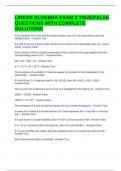
LINEAR ALGEBRA EXAM 2 TRUE/FALSE
QUESTIONS WITH COMPLETE
SOLUTIONS
If the equation Ax=0 has only the trivial solution, then A is row equivalent to the nxn
identity matrix. - Answer-True
If A and B are 2x2 matrices with columns a1,a2 and b1,b2 respectively, then ab = [a1b1
a2b2] - Answer-False
Each column of AB is a linear combination of the columns of B using weights from the
corresponding column of A. - Answer-False
AB + AC = A(B + C) - Answer-True
A^T + B^T = (A + B)^T - Answer-True
The transpose of a product of matrices equals the product of their transposes in the
same order. - Answer-False
if A and B are 3 x 3 matrices and B = [b1 b2 b3], then AB = [Ab1 + Ab2 + Ab3] -
Answer-False
The second row of AB is the second row of A multiplied on the right by B. - Answer-True
(AB)C = (AC)B - Answer-False
(AB)^T = A^T B^T - Answer-False
The transpose of a sum of matrices equals the sum of their transposes. - Answer-True
In order for a matrix B to be the inverse of A, both equations AB = I and BA = I must be
true. - Answer-True
If A and B are n x n and invertible, then A^-1B^-1 is the inverse of AB - Answer-False
If A = [a b; c d] and ad does not equal bc, then A is not invertible. - Answer-False
If A is an invertible nxn matrix, then the equation Ax=b is consistent for each b in Rn -
Answer-True
Each elementary matrix is invertible - Answer-True
, A product of invertible nxn matrices is invertible, and the inverse of the product is the
product of their inverses in the same order - Answer-False
If A is invertible, then the inverse of A^-1 is A itself - Answer-True
If A = [a b; c d] and ad = bc, then A is not invertible. - Answer-True
If A can be row reduced to the identity matrix, then A must be invertible - Answer-True
If A is invertible, then elementary row operations that reduce A to the identity In also
reduce A^-1 to In - Answer-True
If the columns of A span Rn, then the columns are linearly independent - Answer-True
If A is an nxn matrix then the equation Ax=b has least one solution for each b in Rn -
Answer-False
If the equation Ax=0 has a nontrivial solution, then A has fewer than n pivot positions -
Answer-True
If A^T is not invertible, then A is not invertible - Answer-True
If there is an nxn matrix D such that AD = I, then there is also an nxn matrix C such that
CA = I - Answer-True
If the columns of A are linearly independent, then the columns of A span Rn - Answer-
True
If the equation Ax=b has at least one solution for each b in Rn, then the solution is
unique for each b - Answer-True
If the linear transformation x->Ax maps Rn into Rn then the row reduced echelon form
of A is I - Answer-False
If there is a b in Rn such that the equation Ax=b is inconsistent, then the transformation
x -> Ax is not one-to-one. - Answer-True
A subspace of Rn is any set H such that the zero vector is in H, (u, v and u+v) are in H
and c is a scalar and cu is in H - Answer-True
If v1,...,vp are in Rn, then Span {v1,....,vp} is the same as the column space of the
matrix [v1 ... vp] - Answer-True
The set of all solutions of a system of m homogeneous equations in n unknowns is a
subspace of Rm - Answer-False
QUESTIONS WITH COMPLETE
SOLUTIONS
If the equation Ax=0 has only the trivial solution, then A is row equivalent to the nxn
identity matrix. - Answer-True
If A and B are 2x2 matrices with columns a1,a2 and b1,b2 respectively, then ab = [a1b1
a2b2] - Answer-False
Each column of AB is a linear combination of the columns of B using weights from the
corresponding column of A. - Answer-False
AB + AC = A(B + C) - Answer-True
A^T + B^T = (A + B)^T - Answer-True
The transpose of a product of matrices equals the product of their transposes in the
same order. - Answer-False
if A and B are 3 x 3 matrices and B = [b1 b2 b3], then AB = [Ab1 + Ab2 + Ab3] -
Answer-False
The second row of AB is the second row of A multiplied on the right by B. - Answer-True
(AB)C = (AC)B - Answer-False
(AB)^T = A^T B^T - Answer-False
The transpose of a sum of matrices equals the sum of their transposes. - Answer-True
In order for a matrix B to be the inverse of A, both equations AB = I and BA = I must be
true. - Answer-True
If A and B are n x n and invertible, then A^-1B^-1 is the inverse of AB - Answer-False
If A = [a b; c d] and ad does not equal bc, then A is not invertible. - Answer-False
If A is an invertible nxn matrix, then the equation Ax=b is consistent for each b in Rn -
Answer-True
Each elementary matrix is invertible - Answer-True
, A product of invertible nxn matrices is invertible, and the inverse of the product is the
product of their inverses in the same order - Answer-False
If A is invertible, then the inverse of A^-1 is A itself - Answer-True
If A = [a b; c d] and ad = bc, then A is not invertible. - Answer-True
If A can be row reduced to the identity matrix, then A must be invertible - Answer-True
If A is invertible, then elementary row operations that reduce A to the identity In also
reduce A^-1 to In - Answer-True
If the columns of A span Rn, then the columns are linearly independent - Answer-True
If A is an nxn matrix then the equation Ax=b has least one solution for each b in Rn -
Answer-False
If the equation Ax=0 has a nontrivial solution, then A has fewer than n pivot positions -
Answer-True
If A^T is not invertible, then A is not invertible - Answer-True
If there is an nxn matrix D such that AD = I, then there is also an nxn matrix C such that
CA = I - Answer-True
If the columns of A are linearly independent, then the columns of A span Rn - Answer-
True
If the equation Ax=b has at least one solution for each b in Rn, then the solution is
unique for each b - Answer-True
If the linear transformation x->Ax maps Rn into Rn then the row reduced echelon form
of A is I - Answer-False
If there is a b in Rn such that the equation Ax=b is inconsistent, then the transformation
x -> Ax is not one-to-one. - Answer-True
A subspace of Rn is any set H such that the zero vector is in H, (u, v and u+v) are in H
and c is a scalar and cu is in H - Answer-True
If v1,...,vp are in Rn, then Span {v1,....,vp} is the same as the column space of the
matrix [v1 ... vp] - Answer-True
The set of all solutions of a system of m homogeneous equations in n unknowns is a
subspace of Rm - Answer-False