

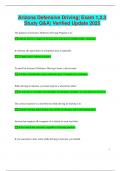
Arizona Defensive Driving| Exam 1,2,3
Study Q&A| Verified Update 2025
The purpose of Arizona’s Defensive Driving Program is to:
Educate drivers to improve driving skills and dismiss eligible traffic violations.
In Arizona, the speed limit in residential areas is typically:
25 mph, unless otherwise posted.
To enroll in Arizona’s Defensive Driving Course, a driver must:
Not have attended the course within the past 12 months for a violation.
When driving in Arizona, you must stop for a school bus when:
Its stop arm is extended, and red lights are flashing, regardless of your direction of travel.
The correct response to a tire blowout while driving in Arizona is to:
Grip the steering wheel firmly, ease off the accelerator, and avoid braking hard.
Arizona law requires all occupants of a vehicle to wear seat belts:
If the vehicle has seat belts, regardless of seating position.
If you encounter a dust storm while driving in Arizona, you should:
1
, Pull off the road, turn off your lights, and wait until the storm passes.
The legal Blood Alcohol Concentration (BAC) limit for drivers in Arizona is:
0.08% for drivers over 21, and zero tolerance for drivers under 21.
When driving at night in Arizona, you should:
Use high beams in poorly lit areas but dim them when approaching other vehicles.
In Arizona, a defensive driving strategy for approaching an intersection includes:
Slowing down, scanning for hazards, and preparing to stop if needed.
If a driver is caught speeding in a construction zone in Arizona, penalties include:
Heavier fines, as construction zones are strictly enforced.
Arizona law prohibits drivers from using handheld devices:
In all cities with local ordinances, including Phoenix and Tucson, unless hands-free.
The proper following distance in good conditions on Arizona roads is:
At least three seconds behind the vehicle in front of you.
When approaching a roundabout in Arizona, the rule is to:
Yield to traffic already in the roundabout and pedestrians.
2
Study Q&A| Verified Update 2025
The purpose of Arizona’s Defensive Driving Program is to:
Educate drivers to improve driving skills and dismiss eligible traffic violations.
In Arizona, the speed limit in residential areas is typically:
25 mph, unless otherwise posted.
To enroll in Arizona’s Defensive Driving Course, a driver must:
Not have attended the course within the past 12 months for a violation.
When driving in Arizona, you must stop for a school bus when:
Its stop arm is extended, and red lights are flashing, regardless of your direction of travel.
The correct response to a tire blowout while driving in Arizona is to:
Grip the steering wheel firmly, ease off the accelerator, and avoid braking hard.
Arizona law requires all occupants of a vehicle to wear seat belts:
If the vehicle has seat belts, regardless of seating position.
If you encounter a dust storm while driving in Arizona, you should:
1
, Pull off the road, turn off your lights, and wait until the storm passes.
The legal Blood Alcohol Concentration (BAC) limit for drivers in Arizona is:
0.08% for drivers over 21, and zero tolerance for drivers under 21.
When driving at night in Arizona, you should:
Use high beams in poorly lit areas but dim them when approaching other vehicles.
In Arizona, a defensive driving strategy for approaching an intersection includes:
Slowing down, scanning for hazards, and preparing to stop if needed.
If a driver is caught speeding in a construction zone in Arizona, penalties include:
Heavier fines, as construction zones are strictly enforced.
Arizona law prohibits drivers from using handheld devices:
In all cities with local ordinances, including Phoenix and Tucson, unless hands-free.
The proper following distance in good conditions on Arizona roads is:
At least three seconds behind the vehicle in front of you.
When approaching a roundabout in Arizona, the rule is to:
Yield to traffic already in the roundabout and pedestrians.
2


