

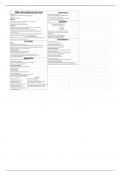
DNA: Deoxyribonucleic Acid Chromosomes:
Found in: -Long, thin, thread-like structures
-Nucleus, forms part of chromatin network (Chromosomes ) -Composed of: DNA wrapped around histones ( Proteins )
-Mitochondria -Gene = Short segment of DNA molecule
-Chloroplast, in plant cells =Carries code for the synthesis of a particular protein
Structure: -Proteins determine characterics of organism
-Giant molecule ( Polymere ), two strands twisted to form double helix Nucleotides:
-Unwound DNA strands look like a ladder Three parts: Sugar molecule ( Deoxyribose/ D )
-Polymere consists of monomers ( Nucleotides ) Phosphate froup ( Phosphoros/ P )
Formation: Nitrogenous base : Adenine ( A )
-Deoxyribose of one nucleotide bonds with phosphate group of another nucleotide Guanine ( G )
-2 long strands formed, resemble sides of a ladder Cytosine ( C )
-Ladder sides = Alternating deoxyribose molecules & phosphate groups Thymine ( T )
-Each DNA ladder rung formed by linking two nitrogenous bases, purine & pyrimidine - Adeinine & Guanine = Large molecules ( Purine bases )
-2 bases = Base pairs - Cytosine & Thymine = Smaller molecules ( Pyrimidine )
-Nitrogenous bases bonded with weak hydrogen bonds, easily broken by enzyme action Formation:
-Nitrogenous bases bond as follow: A-T ( Two hydrogen bonds formed ) -Deoxyribose combines with Phosphate group
G-C ( Three hydrogen bonds formed ) -Nitrogenous base combines with Deoxyribose
-Sequence of bases provides code ( Genetic code ) that gives instructions for protein synthesis -4 Different nucleotide within a DNA molecule
-One DNA strand = Complement of other strand DNA Replication:
Role of DNA: -Forms two identical copies
Genes: -Occurs during interphase of cell cycle
-Carries genetic code for protein synthesis -Proteins ( Histones ) also duplicate
-Short segment of DNA with specific nitrogenous base sequence, code for particular protein -Chromatids ( Two identical threads ) formed
-Determines sequence/ type of amino acid formed ( Combine to create particular protein ) -Two sister chromatids joined by centromere
-DNA able to replicate, to ensure accurately transfers Process of replication:
Non-coding DNA: -Double helix unwinds, shows two strands ( Shape of a ladder )
-Coding DNA = Approximately 2% DNA in living cells -Weak hydrogen bonds break
-Does not carry information to produce proteins -Free-floating nucleotides, in nucleoplasm, build complementary
-Functions: Important role in regulating/ control of expression in genes DNA strands onto each orginal DNA strand
-Protects genes from mutations/ Controls copying process during transcription -Enzymes control joining of strands
-Used in fingerprint identification -Each DNA strand serves as a template
DNA Profiling: -Two identical copies formed
-DNA prepared/ processed to create barcode pattern -Double-stranded structure of DNA makes replication possible
-Barcode pattern = DNA profile Importance of DNA replication:
-Mainly non-coding DNA that differs and is used in DNA profiling -During mitotic division, mother cells divides into two identical daughter cells
-Identical twins have the same DNA profile -To ensure each daughter cell has the same genetic information as mother cell
Uses of DNA profiling:
-To identify crime suspects in forensic investigations
-To identify dead bodies
-To identify relatives
-As proof of paternity
-To determind probability/ cause of genetic defects
-To trace missing persons
-To establish compatibility of tissue typs for organ transplants
Views for against/ for DNA profiling:
For: Against:
-Proof of paternity -Inacurracy leads to errors
-Tracing lost/ seperated relatives -Human error in interpretation
-Identifying missing people -Data used to descriminate against an ill person
-Identifying remains of victims -Cost may exclude poor communities
-Determine probability of genetics defects -Forensics labs do not conform to uniform standards
-Treatment of genetic defects -DNA samples may be planted at a crime scene
-Solving criminal cases in forensics -Small smaples may be identical in crime scenes
-Identifying orgin of products of threatened
species in illegal trading
, RNA: Ribonucleic Acid Nucleotides:
Location: -4 different ones
-Nucleus & cytoplasm Three parts: Sugar molecule ( Ribose/ R )
-Forms part of ribsomes Phosphate froup ( Phosphoros/ P )
Structure: Nitrogenous base : Adenine ( A )
-Single strand Guanine ( G )
-Polymere with nucleotide ( Monomers ) Cytosine ( C )
Formation: Uracil ( U )
-Ribsome of one attaches to the phosphate group to form long single strand Differences between DNA and RNA:
Types of RNA: DNA RNA
Messenger RNA (mRNA ): -Double helix -Single strand
-Singly strand, unlimited number of nucleotides -Sugar = Deoxyribose -Sugar = Ribose
-Formed in nucleoplasm, through complimentary DNA nucleotides -Nitrogenous bases: Adenine -Nitrogenous bases: Adenine
-Carries genetic code from DNA in nucleus to the ribsomes Guanine Guanine
Transfer RNA ( tRNA ): Cytosine Cytosine
-Single strand that folds back on itself, like a hairpin/ forms loops Thymine Uracil
-Occurs in cytoplasm -A = T; G = C -Nitrogenous bases occur in any number/ sequence
-Three exposed bases, anticodons
-Picks up amino acids in the cytoplasm and takes them to the ribosomes
for protein synthesis
Ribosomal RNA ( rRNA ):
-Single strand
-Forms part of ribosomes structure in cytoplasm, plays role in protein synthesis
Found in: -Long, thin, thread-like structures
-Nucleus, forms part of chromatin network (Chromosomes ) -Composed of: DNA wrapped around histones ( Proteins )
-Mitochondria -Gene = Short segment of DNA molecule
-Chloroplast, in plant cells =Carries code for the synthesis of a particular protein
Structure: -Proteins determine characterics of organism
-Giant molecule ( Polymere ), two strands twisted to form double helix Nucleotides:
-Unwound DNA strands look like a ladder Three parts: Sugar molecule ( Deoxyribose/ D )
-Polymere consists of monomers ( Nucleotides ) Phosphate froup ( Phosphoros/ P )
Formation: Nitrogenous base : Adenine ( A )
-Deoxyribose of one nucleotide bonds with phosphate group of another nucleotide Guanine ( G )
-2 long strands formed, resemble sides of a ladder Cytosine ( C )
-Ladder sides = Alternating deoxyribose molecules & phosphate groups Thymine ( T )
-Each DNA ladder rung formed by linking two nitrogenous bases, purine & pyrimidine - Adeinine & Guanine = Large molecules ( Purine bases )
-2 bases = Base pairs - Cytosine & Thymine = Smaller molecules ( Pyrimidine )
-Nitrogenous bases bonded with weak hydrogen bonds, easily broken by enzyme action Formation:
-Nitrogenous bases bond as follow: A-T ( Two hydrogen bonds formed ) -Deoxyribose combines with Phosphate group
G-C ( Three hydrogen bonds formed ) -Nitrogenous base combines with Deoxyribose
-Sequence of bases provides code ( Genetic code ) that gives instructions for protein synthesis -4 Different nucleotide within a DNA molecule
-One DNA strand = Complement of other strand DNA Replication:
Role of DNA: -Forms two identical copies
Genes: -Occurs during interphase of cell cycle
-Carries genetic code for protein synthesis -Proteins ( Histones ) also duplicate
-Short segment of DNA with specific nitrogenous base sequence, code for particular protein -Chromatids ( Two identical threads ) formed
-Determines sequence/ type of amino acid formed ( Combine to create particular protein ) -Two sister chromatids joined by centromere
-DNA able to replicate, to ensure accurately transfers Process of replication:
Non-coding DNA: -Double helix unwinds, shows two strands ( Shape of a ladder )
-Coding DNA = Approximately 2% DNA in living cells -Weak hydrogen bonds break
-Does not carry information to produce proteins -Free-floating nucleotides, in nucleoplasm, build complementary
-Functions: Important role in regulating/ control of expression in genes DNA strands onto each orginal DNA strand
-Protects genes from mutations/ Controls copying process during transcription -Enzymes control joining of strands
-Used in fingerprint identification -Each DNA strand serves as a template
DNA Profiling: -Two identical copies formed
-DNA prepared/ processed to create barcode pattern -Double-stranded structure of DNA makes replication possible
-Barcode pattern = DNA profile Importance of DNA replication:
-Mainly non-coding DNA that differs and is used in DNA profiling -During mitotic division, mother cells divides into two identical daughter cells
-Identical twins have the same DNA profile -To ensure each daughter cell has the same genetic information as mother cell
Uses of DNA profiling:
-To identify crime suspects in forensic investigations
-To identify dead bodies
-To identify relatives
-As proof of paternity
-To determind probability/ cause of genetic defects
-To trace missing persons
-To establish compatibility of tissue typs for organ transplants
Views for against/ for DNA profiling:
For: Against:
-Proof of paternity -Inacurracy leads to errors
-Tracing lost/ seperated relatives -Human error in interpretation
-Identifying missing people -Data used to descriminate against an ill person
-Identifying remains of victims -Cost may exclude poor communities
-Determine probability of genetics defects -Forensics labs do not conform to uniform standards
-Treatment of genetic defects -DNA samples may be planted at a crime scene
-Solving criminal cases in forensics -Small smaples may be identical in crime scenes
-Identifying orgin of products of threatened
species in illegal trading
, RNA: Ribonucleic Acid Nucleotides:
Location: -4 different ones
-Nucleus & cytoplasm Three parts: Sugar molecule ( Ribose/ R )
-Forms part of ribsomes Phosphate froup ( Phosphoros/ P )
Structure: Nitrogenous base : Adenine ( A )
-Single strand Guanine ( G )
-Polymere with nucleotide ( Monomers ) Cytosine ( C )
Formation: Uracil ( U )
-Ribsome of one attaches to the phosphate group to form long single strand Differences between DNA and RNA:
Types of RNA: DNA RNA
Messenger RNA (mRNA ): -Double helix -Single strand
-Singly strand, unlimited number of nucleotides -Sugar = Deoxyribose -Sugar = Ribose
-Formed in nucleoplasm, through complimentary DNA nucleotides -Nitrogenous bases: Adenine -Nitrogenous bases: Adenine
-Carries genetic code from DNA in nucleus to the ribsomes Guanine Guanine
Transfer RNA ( tRNA ): Cytosine Cytosine
-Single strand that folds back on itself, like a hairpin/ forms loops Thymine Uracil
-Occurs in cytoplasm -A = T; G = C -Nitrogenous bases occur in any number/ sequence
-Three exposed bases, anticodons
-Picks up amino acids in the cytoplasm and takes them to the ribosomes
for protein synthesis
Ribosomal RNA ( rRNA ):
-Single strand
-Forms part of ribosomes structure in cytoplasm, plays role in protein synthesis


