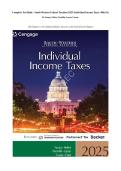
Complete Test Bank - South-Western Federal Taxation 2025: Individual Income Taxes, 48th Ed.
By Young, Nellen, Persellin, Lassar, Cuccia.
(All Chapters 1-20, Updated Edition, Answers at the End of Each Chapter)
C
LE
ST
BE
,TABLE OF CONTENTS
Chapter 1: An Introduction to Taxation and Understanding the Federal Tax Law
Chapter 2: Working with the Tax Law
Chapter 03: Tax Formula and Tax Determination
Chapter 04: Gross Income: Concepts and Inclusions
Chapter 05: Gross Income: Exclusions
Chapter 06: Deductions and Losses: In General
Chapter 07: Deductions and Losses: Certain Business Expenses
Chapter 08: Depreciation, Cost Recovery, Amortization, and Depletion
Chapter 09: Deductions: Employee and Self-Employed-Related Expense
Chapter 10: Deductions and Losses: Certain Itemized Deductions
Chapter 11: Investor Losses
Chapter 12: Alternative Minimum Tax
C
LE
Chapter 13: Tax Credits and Payment Procedures
Chapter 14: Property Transactions: Determination of Gain or Loss and
ST
Chapter 15: Property Transactions: Nontaxable Exchanges
BE
Chapter 16: Property Transactions: Capital Gains and Losses
Chapter 17: Property Transactions: 1231 and Recapture Provisions
Chapter 18: Accounting Periods and Methods
Chapter 19: Deferred Compensation
Chapter 20: Corporations and Partnerships
,Chapter 01 2025 Individuals
Answers provided at the end of each chapter
Indicate whether the statement is true or false.
1. Sales made over the internet are not exempt from the application of a general sales (or use) tax.
a. True
b. False
2. Upon audit by the IRS, Faith is assessed a deficiency of $40,000 of which $25,000 is attributable to
negligence.
The 20% negligence penalty will apply to $25,000.
a. True
b. False
3. Ultimately, most taxes are paid by individuals. C
LE
a. True
ST
b. False
4. Even if property tax rates are not changed, the amount of ad valorem taxes imposed on realty may not
BE
remain the same.
a. True
b. False
5. The principal objective of the FUTA tax is to provide some measure of retirement security.
a. True
b. False
6. If more IRS audits are producing a higher number of no change results, this indicates increased
compliance on the part of taxpayers.
a. True
b. False
7. A safe and easy way for a taxpayer to avoid local and state sales taxes is to make the purchase in a
state that levies no such taxes.
a. True
, b. False
8. A calendar year taxpayer files his 2023 Federal income tax return on March 4, 2024. The return
reflects an overpayment of $6,000, and the taxpayer requests a refund of this amount. The refund is paid on
May 16, 2024. The refund need not include interest.
a. True
b. False
9. A tax cut enacted by Congress that contains a sunset provision will make the tax cut temporary.
a. True
b. False
Name: Class: Date:
Chapter 01 2025 Individuals
C
LE
10. For Federal income tax purposes, there never has been a general amnesty period.
a. True
ST
b. False
BE
11. To lessen or eliminate the effect of multiple taxation, a taxpayer who is subject to both foreign and
U.S. income taxes on the same income is allowed either a deduction or a credit for the foreign tax paid.
a. True
b. False
12. Because it is consistent with the wherewithal to pay concept, the tax law requires a seller to
recognize a gain in the year the installment sale occurs.
a. True
b. False
13. The amount of a taxpayer’s itemized deductions will increase the chance of being audited by the
IRS.
a. True
b. False
14. In 2024, José, a widower, sells land (fair market value of $100,000) to his daughter, Linda, for
$50,000. José has not made a taxable gift.
By Young, Nellen, Persellin, Lassar, Cuccia.
(All Chapters 1-20, Updated Edition, Answers at the End of Each Chapter)
C
LE
ST
BE
,TABLE OF CONTENTS
Chapter 1: An Introduction to Taxation and Understanding the Federal Tax Law
Chapter 2: Working with the Tax Law
Chapter 03: Tax Formula and Tax Determination
Chapter 04: Gross Income: Concepts and Inclusions
Chapter 05: Gross Income: Exclusions
Chapter 06: Deductions and Losses: In General
Chapter 07: Deductions and Losses: Certain Business Expenses
Chapter 08: Depreciation, Cost Recovery, Amortization, and Depletion
Chapter 09: Deductions: Employee and Self-Employed-Related Expense
Chapter 10: Deductions and Losses: Certain Itemized Deductions
Chapter 11: Investor Losses
Chapter 12: Alternative Minimum Tax
C
LE
Chapter 13: Tax Credits and Payment Procedures
Chapter 14: Property Transactions: Determination of Gain or Loss and
ST
Chapter 15: Property Transactions: Nontaxable Exchanges
BE
Chapter 16: Property Transactions: Capital Gains and Losses
Chapter 17: Property Transactions: 1231 and Recapture Provisions
Chapter 18: Accounting Periods and Methods
Chapter 19: Deferred Compensation
Chapter 20: Corporations and Partnerships
,Chapter 01 2025 Individuals
Answers provided at the end of each chapter
Indicate whether the statement is true or false.
1. Sales made over the internet are not exempt from the application of a general sales (or use) tax.
a. True
b. False
2. Upon audit by the IRS, Faith is assessed a deficiency of $40,000 of which $25,000 is attributable to
negligence.
The 20% negligence penalty will apply to $25,000.
a. True
b. False
3. Ultimately, most taxes are paid by individuals. C
LE
a. True
ST
b. False
4. Even if property tax rates are not changed, the amount of ad valorem taxes imposed on realty may not
BE
remain the same.
a. True
b. False
5. The principal objective of the FUTA tax is to provide some measure of retirement security.
a. True
b. False
6. If more IRS audits are producing a higher number of no change results, this indicates increased
compliance on the part of taxpayers.
a. True
b. False
7. A safe and easy way for a taxpayer to avoid local and state sales taxes is to make the purchase in a
state that levies no such taxes.
a. True
, b. False
8. A calendar year taxpayer files his 2023 Federal income tax return on March 4, 2024. The return
reflects an overpayment of $6,000, and the taxpayer requests a refund of this amount. The refund is paid on
May 16, 2024. The refund need not include interest.
a. True
b. False
9. A tax cut enacted by Congress that contains a sunset provision will make the tax cut temporary.
a. True
b. False
Name: Class: Date:
Chapter 01 2025 Individuals
C
LE
10. For Federal income tax purposes, there never has been a general amnesty period.
a. True
ST
b. False
BE
11. To lessen or eliminate the effect of multiple taxation, a taxpayer who is subject to both foreign and
U.S. income taxes on the same income is allowed either a deduction or a credit for the foreign tax paid.
a. True
b. False
12. Because it is consistent with the wherewithal to pay concept, the tax law requires a seller to
recognize a gain in the year the installment sale occurs.
a. True
b. False
13. The amount of a taxpayer’s itemized deductions will increase the chance of being audited by the
IRS.
a. True
b. False
14. In 2024, José, a widower, sells land (fair market value of $100,000) to his daughter, Linda, for
$50,000. José has not made a taxable gift.