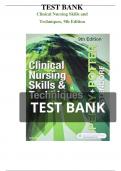
TEST BANK
Clinical Nursing Skills and
Techniques, 9th Edition
,Table Contents
Unit: Supporting the Patient Through the Health Care System
1 Using Evidence in Practice
2 Admitting, Transfer, and Discharge
3 Communication and Collaboration
4 Documentation and Informatics
Unit II: Vital Signs and Physical Assessment
5 Vital Signs
6 Health Assessment
Unit III: Special Procedures
7 Specimen Collection
8 Diagnostic Procedures
Unit IV: Infection Control
9 Medical Asepsis
10 Sterile Technique
Unit V: Activity and Mobility
11 Safe Patient Handling, Transfer and Positioning
12 Exercise and Mobility
13 Support Surfaces and Special Beds
Unit VI: Safety and Comfort
14 Patient Safety
15 Disaster Preparedness
16 Pain Management
17 Palliative Care
Unit VII: Hygiene
18 Personal Hygiene and Bed Making
19 Care of the Eye and Ear
Unit VIII: Medications 20 Safe Medicine Preparation
21 Administration of Nonparenteral Medications
22 Administration of Parenteral Medications
Unit IX: Oxygenation
23 Oxygen Therapy
24 Performing Chest Physiotherapy
25 Airway Management
26 Cardiac Care (NEW CHAPTER)
27 Closed Chest Drainage Systems
28 Emergency Measures for Life Support
Unit X: Fluid Balance
29 Intravenous and Vascular Access Therapy
30 Blood Therapy
Unit XI: Nutrition
31 Oral Nutrition
,32 Enteral Nutrition
33 Parenteral Nutrition
Unit XII: Elimination
34 Urinary Elimination
35 Bowel Elimination and Gastric Intubation
36 Ostomy Care
Unit XIII: Care of the Surgical Patient
37 Preoperative and Postoperative Care
38 Intraoperative Care
Unit XIV: Dressings and Wound Careµ
39 Impaired Skin Integrity Prevention and Care
40 Wound Care and Irrigations
41 Dressings, Bandages, and Binders
42 Warm and Cold Therapy
Unit XV: Home Care
43 Home Care Safety
44 Home Care Teaching
, Chapter 01: Using Evidence in Practice
Perry et al.: Clinical Nursing Skills & Techniques, 9th Edition
M U LT I P L E C H O I C E
1. Evidence-based practice is a problem-solving approach to making decisions about patient
care that is grounded in:
a. the latest information found in textbooks.
b. systematically conducted research studies.
c. tradition in clinical practice.
d. quality improvement and risk-management data.
ANS: B
The best evidence comes from well-designed, systematically conducted research studies
described in scientific journals. Portions of a textbook often become outdated by the time it
is published. Many health care settings do not have a process to help staff adopt new
evidence in practice, and nurses in practice settings lack easy access to risk-management
data, relying instead on tradition or convenience. Some sources of evidence do not originate
from research. These include quality improvement and risk-management data; infection
control data; retrospective or concurrent chart reviews; and clinicians’ expertise. Although
non–research-based evidence is often very valuable, it is important that you learn to rely
more on research-based evidence.
DIF: Cognitive Level: Comprehension REF: Text reference: p. 2
OBJ: Discuss the benefits of evidence-based practice.
TOP: Evidence-Based Practice K E Y: Nursing Process Step: Assessment
MSC: N C L E X : Safe and Effective Care Environment (management of care)
2. When evidence-based practice is used, patient care will be:
a. standardized for all.
b. unhampered by patient culture.
c. variable according to the situation.
d. safe from the hazards of critical thinking.
ANS: C
Using your clinical expertise and considering patients’ cultures, values, and preferences
ensures that you will apply available evidence in practice ethically and appropriately. Even
when you use the best evidence available, application and outcomes will differ; as a nurse,
you will develop critical thinking skills to determine whether evidence is relevant and
appropriate.
DIF: Cognitive Level: Application REF: Text reference: p. 2
OBJ: Discuss the benefits of evidence-based practice.
TOP: Evidence-Based Practice K E Y: Nursing Process Step: Assessment
MSC: N C L E X : Safe and Effective Care Environment (management of care)
3. When a PICOT question is developed, the letter that corresponds with the usual standard of
care is:
a. P.
.
.
.
, .
b. I.
c. C.
d. O.
ANS: C
C = Comparison of interest. What standard of care or current intervention do you usually
use now in practice?
P = Patient population of interest. Identify your patient by age, gender, ethnicity, disease, or
health problem.
I = Intervention of interest. What intervention (e.g., treatment, diagnostic test, and
prognostic factor) do you think is worthwhile to use in practice?
O = Outcome. What result (e.g., change in patient’s behavior, physical finding, and change
in patient’s perception) do you wish to achieve or observe as the result of an intervention?
DIF: Cognitive Level: Knowledge REF: Text reference: p. 3
OBJ: Develop a PICO question. TOP: PICO
K E Y: Nursing Process Step: Implementation
MSC: N C L E X : Safe and Effective Care Environment (management of care)
4. A well-developed PICOT question helps the nurse:
a. search for evidence.
b. include all five elements of the sequence.
c. find as many articles as possible in a literature search.
d. accept standard clinical routines.
ANS: A
The more focused a question that you ask is, the easier it is to search for evidence in the
scientific literature. A well-designed PICOT question does not have to include all five
elements, nor does it have to follow the PICOT sequence. Do not be satisfied with clinical
routines. Always question and use critical thinking to consider better ways to provide patient
care.
DIF: Cognitive Level: Analysis REF: Text reference: p. 3
OBJ: Describe the six steps of evidence-based practice.
TOP: Evidence-Based Practice K E Y: Nursing Process Step: Implementation
MSC: N C L E X : Safe and Effective Care Environment (management of care)
5. The nurse is not sure that the procedure the patient requires is the best possible for the
situation. Utilizing which of the following resources would be the quickest way to review
research on the topic?
a. CINAHL
b. PubMed
c. MEDLINE
d. The Cochrane Database
ANS: D
.
.
.
Clinical Nursing Skills and
Techniques, 9th Edition
,Table Contents
Unit: Supporting the Patient Through the Health Care System
1 Using Evidence in Practice
2 Admitting, Transfer, and Discharge
3 Communication and Collaboration
4 Documentation and Informatics
Unit II: Vital Signs and Physical Assessment
5 Vital Signs
6 Health Assessment
Unit III: Special Procedures
7 Specimen Collection
8 Diagnostic Procedures
Unit IV: Infection Control
9 Medical Asepsis
10 Sterile Technique
Unit V: Activity and Mobility
11 Safe Patient Handling, Transfer and Positioning
12 Exercise and Mobility
13 Support Surfaces and Special Beds
Unit VI: Safety and Comfort
14 Patient Safety
15 Disaster Preparedness
16 Pain Management
17 Palliative Care
Unit VII: Hygiene
18 Personal Hygiene and Bed Making
19 Care of the Eye and Ear
Unit VIII: Medications 20 Safe Medicine Preparation
21 Administration of Nonparenteral Medications
22 Administration of Parenteral Medications
Unit IX: Oxygenation
23 Oxygen Therapy
24 Performing Chest Physiotherapy
25 Airway Management
26 Cardiac Care (NEW CHAPTER)
27 Closed Chest Drainage Systems
28 Emergency Measures for Life Support
Unit X: Fluid Balance
29 Intravenous and Vascular Access Therapy
30 Blood Therapy
Unit XI: Nutrition
31 Oral Nutrition
,32 Enteral Nutrition
33 Parenteral Nutrition
Unit XII: Elimination
34 Urinary Elimination
35 Bowel Elimination and Gastric Intubation
36 Ostomy Care
Unit XIII: Care of the Surgical Patient
37 Preoperative and Postoperative Care
38 Intraoperative Care
Unit XIV: Dressings and Wound Careµ
39 Impaired Skin Integrity Prevention and Care
40 Wound Care and Irrigations
41 Dressings, Bandages, and Binders
42 Warm and Cold Therapy
Unit XV: Home Care
43 Home Care Safety
44 Home Care Teaching
, Chapter 01: Using Evidence in Practice
Perry et al.: Clinical Nursing Skills & Techniques, 9th Edition
M U LT I P L E C H O I C E
1. Evidence-based practice is a problem-solving approach to making decisions about patient
care that is grounded in:
a. the latest information found in textbooks.
b. systematically conducted research studies.
c. tradition in clinical practice.
d. quality improvement and risk-management data.
ANS: B
The best evidence comes from well-designed, systematically conducted research studies
described in scientific journals. Portions of a textbook often become outdated by the time it
is published. Many health care settings do not have a process to help staff adopt new
evidence in practice, and nurses in practice settings lack easy access to risk-management
data, relying instead on tradition or convenience. Some sources of evidence do not originate
from research. These include quality improvement and risk-management data; infection
control data; retrospective or concurrent chart reviews; and clinicians’ expertise. Although
non–research-based evidence is often very valuable, it is important that you learn to rely
more on research-based evidence.
DIF: Cognitive Level: Comprehension REF: Text reference: p. 2
OBJ: Discuss the benefits of evidence-based practice.
TOP: Evidence-Based Practice K E Y: Nursing Process Step: Assessment
MSC: N C L E X : Safe and Effective Care Environment (management of care)
2. When evidence-based practice is used, patient care will be:
a. standardized for all.
b. unhampered by patient culture.
c. variable according to the situation.
d. safe from the hazards of critical thinking.
ANS: C
Using your clinical expertise and considering patients’ cultures, values, and preferences
ensures that you will apply available evidence in practice ethically and appropriately. Even
when you use the best evidence available, application and outcomes will differ; as a nurse,
you will develop critical thinking skills to determine whether evidence is relevant and
appropriate.
DIF: Cognitive Level: Application REF: Text reference: p. 2
OBJ: Discuss the benefits of evidence-based practice.
TOP: Evidence-Based Practice K E Y: Nursing Process Step: Assessment
MSC: N C L E X : Safe and Effective Care Environment (management of care)
3. When a PICOT question is developed, the letter that corresponds with the usual standard of
care is:
a. P.
.
.
.
, .
b. I.
c. C.
d. O.
ANS: C
C = Comparison of interest. What standard of care or current intervention do you usually
use now in practice?
P = Patient population of interest. Identify your patient by age, gender, ethnicity, disease, or
health problem.
I = Intervention of interest. What intervention (e.g., treatment, diagnostic test, and
prognostic factor) do you think is worthwhile to use in practice?
O = Outcome. What result (e.g., change in patient’s behavior, physical finding, and change
in patient’s perception) do you wish to achieve or observe as the result of an intervention?
DIF: Cognitive Level: Knowledge REF: Text reference: p. 3
OBJ: Develop a PICO question. TOP: PICO
K E Y: Nursing Process Step: Implementation
MSC: N C L E X : Safe and Effective Care Environment (management of care)
4. A well-developed PICOT question helps the nurse:
a. search for evidence.
b. include all five elements of the sequence.
c. find as many articles as possible in a literature search.
d. accept standard clinical routines.
ANS: A
The more focused a question that you ask is, the easier it is to search for evidence in the
scientific literature. A well-designed PICOT question does not have to include all five
elements, nor does it have to follow the PICOT sequence. Do not be satisfied with clinical
routines. Always question and use critical thinking to consider better ways to provide patient
care.
DIF: Cognitive Level: Analysis REF: Text reference: p. 3
OBJ: Describe the six steps of evidence-based practice.
TOP: Evidence-Based Practice K E Y: Nursing Process Step: Implementation
MSC: N C L E X : Safe and Effective Care Environment (management of care)
5. The nurse is not sure that the procedure the patient requires is the best possible for the
situation. Utilizing which of the following resources would be the quickest way to review
research on the topic?
a. CINAHL
b. PubMed
c. MEDLINE
d. The Cochrane Database
ANS: D
.
.
.