
Introduction to bioethics
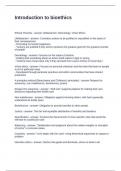
Ethical Theories - answer Utilitarianism, Deontology, Virtue Ethics
Utilitarianism - answer- Considers actions to be justified or unjustified on the basis of
their consequences
- Promoting on human happiness
- "Actions are justified if they tend to produce the greatest good for the greatest number
of people"
Deontology - answer- Focuses on the nature of actions
- Holding that something about an action itself makes it right or wrong
- "Actions have moral value only if they proceed from a pure motive of moral duty."
Virtue ethics - answer- Focuses on personal character and the traits that lead on people
to act in particular ways
- Developed through particular practices and within communities that have shared
purposees
4 principles method (Beauchamp and Childress's principles) - answer Respect for
autonomy, non maleficence, beneficence, justice
Respect for autonomy - answer- "Self-rule" supports patients for making their own
decisions regarding their health care
Non maleficence - answer- Obligation against harming others, with harm generally
understood as bodily injury
Beneficence - answer- Obligation to provide benefits to other people
Justice - answer- The fair and equitable distribution of benefits and burdens
Specification - answer- Involves the discernment of more specific rules that would be
relevant in a particular case
Balancing - answer- "Deliberation and judgment about the relative weights or strengths
of norms" in concrete cases.
Casuistry - answer- "Let's begin with the case" using theoretical arguments to support a
problem
Narrative ethics - answer- Stories that guide and illuminate, show us what to do
Ethical Theories - answer Utilitarianism, Deontology, Virtue Ethics
Utilitarianism - answer- Considers actions to be justified or unjustified on the basis of
their consequences
- Promoting on human happiness
- "Actions are justified if they tend to produce the greatest good for the greatest number
of people"
Deontology - answer- Focuses on the nature of actions
- Holding that something about an action itself makes it right or wrong
- "Actions have moral value only if they proceed from a pure motive of moral duty."
Virtue ethics - answer- Focuses on personal character and the traits that lead on people
to act in particular ways
- Developed through particular practices and within communities that have shared
purposees
4 principles method (Beauchamp and Childress's principles) - answer Respect for
autonomy, non maleficence, beneficence, justice
Respect for autonomy - answer- "Self-rule" supports patients for making their own
decisions regarding their health care
Non maleficence - answer- Obligation against harming others, with harm generally
understood as bodily injury
Beneficence - answer- Obligation to provide benefits to other people
Justice - answer- The fair and equitable distribution of benefits and burdens
Specification - answer- Involves the discernment of more specific rules that would be
relevant in a particular case
Balancing - answer- "Deliberation and judgment about the relative weights or strengths
of norms" in concrete cases.
Casuistry - answer- "Let's begin with the case" using theoretical arguments to support a
problem
Narrative ethics - answer- Stories that guide and illuminate, show us what to do


