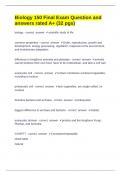
Biology 150 Final Exam Question and
answers rated A+ (32 pgs)
biology - correct answer ✔scientific study of life
common properties - correct answer ✔Order, reproduction, growth and
development, energy processing, regulation, response to the environment,
and evolutionary adaptation
difference in kingdoms animalia and planatae - correct answer ✔animals
cannot produce their own food, have to be multicellular, and lack a cell wall
eukaryotic cell - correct answer ✔contain membrane enclosed organelles,
including a nucleus
prokaryotic cell - correct answer ✔lack organelles, are single-celled, no
nucleus
domains bacteria and archaea - correct answer ✔prokaryotes
biggest difference in archaea and bacteria - correct answer ✔habitat
eukaryotic domain - correct answer ✔protists and the kingdoms Fungi,
Plantae, and Animalia
CONPTT - correct answer ✔Consistent/repeatable
observable
natural
,predictable
tentative
testable
hypothesis - correct answer ✔an informed, tentative statement about the
natural world which generates testable predictions; proposed explanation for
an observation; general statement of affect
predictions - correct answer ✔statement about patterns, trends, or
differences between groups; generated from the hypothesis; measuring a
specific outcome; specifically test hypothesis
theory - correct answer ✔a well-substantiated explanation of some aspect of
the natural world; has a broad explanatory power, is well substantiated and
leads to a hypothesis
law - correct answer ✔a descriptive generalization about how some aspect
of the natural world behaves under stated circumstances; more narrow than
theories
dependent variable - correct answer ✔what is being affected
independent variable - correct answer ✔what is doing the affecting
evolution - correct answer ✔descent with modification; the idea that living
species are descendants of ancestral species that were different from present
day ones; also, the genetic changes in a population from generation to
generation
,natural selection - correct answer ✔the differential survival and reproduction
of individuals due to differences in phenotype; frequency of certain traits in a
population changing from one generation to the next (genetic change)because
of selection; outcome is adaptation
adaption - correct answer ✔an inherited characteristic that enhances an
organism's ability to survive and reproduce in a particular environment; can be
morphological,
physiological, or behavioral
selection pressure - correct answer ✔some factor that results in differential
survival and reproduction of an individual; force that is driving a trait to
increase/decrease in a population
role of environment in NS - correct answer ✔the traits best suited to the
current environment are the traits that will be passed down, because those
individuals will survive and produce viable offspring
tenet of NS- High reproductive potential - correct answer ✔individuals
produce more offspring than can survive
tenet of NS- Heritable variability - correct answer ✔organisms have variable
traits (phenotype) in appearance and function, some of which are heritable
tenet of NS- Limited resources - correct answer ✔resources are not infinite
therefore organisms must compete for access
(food, water, shelter, territory, mates, nest sites)
tenet of NS- Differential reproductive success - correct answer ✔individuals
whose inherited characteristics make them better able to secure resources
, and reproduce in a particular environment will leave more offspring than those
not as well suited
role of limited resources in NS and evolution - correct answer ✔individuals
best suited to obtain resources will survive and produce viable offspring-
passing down their traits
fitness - correct answer ✔the genetic contribution of an individual to the next
generation's gene pool relative to the average for the population, usually
measured by the number of offspring that survive to reproductive age
4 mechanisms of evolution - correct answer ✔mutation
gene flow
genetic drift
natural selection
gene pool - correct answer ✔the stock of different genes in an interbreeding
population
Microevolution - correct answer ✔evolutionary change within a species or
small group of organisms, especially over a short period
Genetic drift - correct answer ✔variation in the relative frequency of different
genotypes in a small population, owing to the chance disappearance of
particular genes as individuals die or do not reproduce
Gene flow - correct answer ✔the transfer of alleles or genes from one
population to another. Migration into or out of a population may be responsible
for a marked change in allele frequencies (the proportion of members carrying
a particular variant of a gene)
answers rated A+ (32 pgs)
biology - correct answer ✔scientific study of life
common properties - correct answer ✔Order, reproduction, growth and
development, energy processing, regulation, response to the environment,
and evolutionary adaptation
difference in kingdoms animalia and planatae - correct answer ✔animals
cannot produce their own food, have to be multicellular, and lack a cell wall
eukaryotic cell - correct answer ✔contain membrane enclosed organelles,
including a nucleus
prokaryotic cell - correct answer ✔lack organelles, are single-celled, no
nucleus
domains bacteria and archaea - correct answer ✔prokaryotes
biggest difference in archaea and bacteria - correct answer ✔habitat
eukaryotic domain - correct answer ✔protists and the kingdoms Fungi,
Plantae, and Animalia
CONPTT - correct answer ✔Consistent/repeatable
observable
natural
,predictable
tentative
testable
hypothesis - correct answer ✔an informed, tentative statement about the
natural world which generates testable predictions; proposed explanation for
an observation; general statement of affect
predictions - correct answer ✔statement about patterns, trends, or
differences between groups; generated from the hypothesis; measuring a
specific outcome; specifically test hypothesis
theory - correct answer ✔a well-substantiated explanation of some aspect of
the natural world; has a broad explanatory power, is well substantiated and
leads to a hypothesis
law - correct answer ✔a descriptive generalization about how some aspect
of the natural world behaves under stated circumstances; more narrow than
theories
dependent variable - correct answer ✔what is being affected
independent variable - correct answer ✔what is doing the affecting
evolution - correct answer ✔descent with modification; the idea that living
species are descendants of ancestral species that were different from present
day ones; also, the genetic changes in a population from generation to
generation
,natural selection - correct answer ✔the differential survival and reproduction
of individuals due to differences in phenotype; frequency of certain traits in a
population changing from one generation to the next (genetic change)because
of selection; outcome is adaptation
adaption - correct answer ✔an inherited characteristic that enhances an
organism's ability to survive and reproduce in a particular environment; can be
morphological,
physiological, or behavioral
selection pressure - correct answer ✔some factor that results in differential
survival and reproduction of an individual; force that is driving a trait to
increase/decrease in a population
role of environment in NS - correct answer ✔the traits best suited to the
current environment are the traits that will be passed down, because those
individuals will survive and produce viable offspring
tenet of NS- High reproductive potential - correct answer ✔individuals
produce more offspring than can survive
tenet of NS- Heritable variability - correct answer ✔organisms have variable
traits (phenotype) in appearance and function, some of which are heritable
tenet of NS- Limited resources - correct answer ✔resources are not infinite
therefore organisms must compete for access
(food, water, shelter, territory, mates, nest sites)
tenet of NS- Differential reproductive success - correct answer ✔individuals
whose inherited characteristics make them better able to secure resources
, and reproduce in a particular environment will leave more offspring than those
not as well suited
role of limited resources in NS and evolution - correct answer ✔individuals
best suited to obtain resources will survive and produce viable offspring-
passing down their traits
fitness - correct answer ✔the genetic contribution of an individual to the next
generation's gene pool relative to the average for the population, usually
measured by the number of offspring that survive to reproductive age
4 mechanisms of evolution - correct answer ✔mutation
gene flow
genetic drift
natural selection
gene pool - correct answer ✔the stock of different genes in an interbreeding
population
Microevolution - correct answer ✔evolutionary change within a species or
small group of organisms, especially over a short period
Genetic drift - correct answer ✔variation in the relative frequency of different
genotypes in a small population, owing to the chance disappearance of
particular genes as individuals die or do not reproduce
Gene flow - correct answer ✔the transfer of alleles or genes from one
population to another. Migration into or out of a population may be responsible
for a marked change in allele frequencies (the proportion of members carrying
a particular variant of a gene)