

Thursday, 10/17
➢ Normal curve is bell-shaped, symmetric about a vertical line through µ
→ Area under curve is 1, curve approaches x-axis but never crosses or touches it
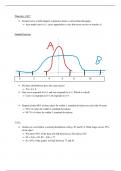
Guided Exercise
0 2 4 6 8 10
12
➢ Do these distributions have the same mean?
→ Yes, it is 6.
➢ One curve responds to δ=1 and one responds to δ=3. Which is which?
→ Curve A responds to δ=1, B responds to δ=3.
➢ Empirical rule-68% of data values lie within 1 standard deviation on each side of mean
→ 95% of values lie within 2 standard deviations
→ 99.7% of values lie within 3 standard deviations
Video
➢ Grades on a test follow a normal distribution with µ=85 and δ=4. What range covers 95%
of the data?
→ We know 95% of the data will fall between (µ-2δ) and (µ+2δ)
→ 85 + 2(4) = 93, 85 – 2(4) = 77
→ So, 95% of the grades will fall between 77 and 93
➢ Normal curve is bell-shaped, symmetric about a vertical line through µ
→ Area under curve is 1, curve approaches x-axis but never crosses or touches it
Guided Exercise
0 2 4 6 8 10
12
➢ Do these distributions have the same mean?
→ Yes, it is 6.
➢ One curve responds to δ=1 and one responds to δ=3. Which is which?
→ Curve A responds to δ=1, B responds to δ=3.
➢ Empirical rule-68% of data values lie within 1 standard deviation on each side of mean
→ 95% of values lie within 2 standard deviations
→ 99.7% of values lie within 3 standard deviations
Video
➢ Grades on a test follow a normal distribution with µ=85 and δ=4. What range covers 95%
of the data?
→ We know 95% of the data will fall between (µ-2δ) and (µ+2δ)
→ 85 + 2(4) = 93, 85 – 2(4) = 77
→ So, 95% of the grades will fall between 77 and 93


