

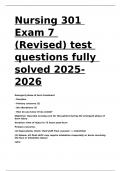
Nursing 301
Exam 7
(Revised) test
questions fully
solved 2025-
2026
Emergent phase of burn treatment
- Duration
- Primary concerns (2)
- lab alterations (3)
- How do you know it has ended?
Objective: Describe nursing care for the patient during the emergent phase of
burn injury
Duration: time of injury to 72 hours post-burn
Primary concerns:
(1) Hypovolemic shock: fluid shift from vascular -> interstitial
(2) Edema: d/t fluid shift; may require intubation (especially w/ burns involving
the face or inhalation injury)
Labs:
,- Elevated Hct: hemoconcentration d/t fluid shift
- Elevated K+: injured cells excrete K+
- Decreased Na+: Na shifts into interstitial space
Ends when...
- onset of diuresis, fluid mobilization (decreased edema)
Objective: Describe nursing care for the patient during the emergent phase of
burn injury: Airway Management
- when would a patient be intubated (reasons? - 2)
- How to care for a patient who is not intubated
Intubated care...
Intubate if... (1) burns to face or neck or (2) development of ARDS
Non-intubated care...
a) 100% humidified oxygen
b) High fowler’s position
c) Deep breathing & cough every hour
d) Reposition every 1 to 2 hours
e) Provide suctioning and chest physiotherapy
Previous
Play
Next
Rewind 10 seconds
Move forward 10 seconds
Unmute
0:00
/
0:15
Full screen
Brainpower
, Read More
Objective: Describe nursing care for the patient during the emergent phase of
burn injury: Fluid therapy
- How do you know how much fluid to give?
- What fluids?
Parkland formula: Formula used to determine how much fluid resuscitation a burn
patient will receive within 24 hours of injury
4 ml x kg x % TBSA = amount of total fluid in ml
- give 1/2 in first 8 hours, 1/4 in second 8 hours, 1/4 in third 8 hours
Fluids: Lactated ringers + albumin
- give colloid (albumin) 12-24 hours after injury - wait for normal vascular
permeability!
Objective: Describe nursing care for the patient during the emergent phase of
burn injury - Wound care
- open vs closed method
- PPE required
Open method of wound care
- burn is covered with topical antimicrobial, no dressings!
- use for facial burns
Closed method of wound care
- Sterile gauze dressing is impregnated w/ or laid over topical antimicrobial
PPE Required...
Exposed wound: disposable hat, masks, gown, gloves
Removal of contaminated dressings or washing: nonsterile & disposable gloves
Applying ointments & sterile dressings: sterile gloves
Exam 7
(Revised) test
questions fully
solved 2025-
2026
Emergent phase of burn treatment
- Duration
- Primary concerns (2)
- lab alterations (3)
- How do you know it has ended?
Objective: Describe nursing care for the patient during the emergent phase of
burn injury
Duration: time of injury to 72 hours post-burn
Primary concerns:
(1) Hypovolemic shock: fluid shift from vascular -> interstitial
(2) Edema: d/t fluid shift; may require intubation (especially w/ burns involving
the face or inhalation injury)
Labs:
,- Elevated Hct: hemoconcentration d/t fluid shift
- Elevated K+: injured cells excrete K+
- Decreased Na+: Na shifts into interstitial space
Ends when...
- onset of diuresis, fluid mobilization (decreased edema)
Objective: Describe nursing care for the patient during the emergent phase of
burn injury: Airway Management
- when would a patient be intubated (reasons? - 2)
- How to care for a patient who is not intubated
Intubated care...
Intubate if... (1) burns to face or neck or (2) development of ARDS
Non-intubated care...
a) 100% humidified oxygen
b) High fowler’s position
c) Deep breathing & cough every hour
d) Reposition every 1 to 2 hours
e) Provide suctioning and chest physiotherapy
Previous
Play
Next
Rewind 10 seconds
Move forward 10 seconds
Unmute
0:00
/
0:15
Full screen
Brainpower
, Read More
Objective: Describe nursing care for the patient during the emergent phase of
burn injury: Fluid therapy
- How do you know how much fluid to give?
- What fluids?
Parkland formula: Formula used to determine how much fluid resuscitation a burn
patient will receive within 24 hours of injury
4 ml x kg x % TBSA = amount of total fluid in ml
- give 1/2 in first 8 hours, 1/4 in second 8 hours, 1/4 in third 8 hours
Fluids: Lactated ringers + albumin
- give colloid (albumin) 12-24 hours after injury - wait for normal vascular
permeability!
Objective: Describe nursing care for the patient during the emergent phase of
burn injury - Wound care
- open vs closed method
- PPE required
Open method of wound care
- burn is covered with topical antimicrobial, no dressings!
- use for facial burns
Closed method of wound care
- Sterile gauze dressing is impregnated w/ or laid over topical antimicrobial
PPE Required...
Exposed wound: disposable hat, masks, gown, gloves
Removal of contaminated dressings or washing: nonsterile & disposable gloves
Applying ointments & sterile dressings: sterile gloves


