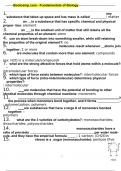
Bootcamp.com - Fundamentals of Biology Exam With
Complete Solutions Latest Update
what are the 3 varieties of carbohydrates?
monosaccharides; disaccharides; polysaccharides
monosaccharides have a ratio of precisely _____ _____ per water molecule, and they
have the empirical formula _____
1 carbon; (CH2O)n
ribose is a _____ sugar (monosaccharide)
pentose (five carbon)
glucose and fructose are _____ sugars (monosaccharides)
hexose (six carbon)
glucose and fructose are _____ of each other
isomers
anything that takes up space and has mass is called _____
matter
an ______ is a form of matter that has identical chemical and physical properties
element
an _____ is the smallest unit of matter that still retains all the chemical properties of an
element
,atom
is it possible for an atom to break down into a smaller particle and still have the
properties of the original element?
no
molecules are formed anytime _____ atoms share bonds
2 or more
_____ are molecules that contain more than one element
compounds
(ex: H2O is a molecule/compound)
what are the strong attractive forces that hold atoms within a molecule?
intramolecular forces
which type of force exists between molecules?
intermolecular forces
which type of force (intra-/intermolecular) determines physical properties?
intermolecular
_____ are molecules that have the potential of bonding to other identical molecules
through chemical reactions
monomers
, _____ is the process when monomers bond together, and it forms _____
polymerization; polymers
_____ are substances that have a large # of monomers bonded together
polymers
what type of sugar is formed when 2 monosaccharide monomers bond/join together?
disaccharide
monosaccharide monomers join together via what type of reaction?
dehydration/condensation reactions
what type of bond is formed and what is released in a dehydration/condensation
reaction?
covalent bond formation; release of H2O
what is the opposite of a condensation/dehydration reaction - why?
A hydrolysis reaction; adds H2O to a covalent bond and splits monomers apart
what is the name of the bond that forms when a carbohydrate attaches to another
molecule?
glycosidic
which disaccharide contains 1 glucose and 1 fructose?
sucrose (table sugar)
Complete Solutions Latest Update
what are the 3 varieties of carbohydrates?
monosaccharides; disaccharides; polysaccharides
monosaccharides have a ratio of precisely _____ _____ per water molecule, and they
have the empirical formula _____
1 carbon; (CH2O)n
ribose is a _____ sugar (monosaccharide)
pentose (five carbon)
glucose and fructose are _____ sugars (monosaccharides)
hexose (six carbon)
glucose and fructose are _____ of each other
isomers
anything that takes up space and has mass is called _____
matter
an ______ is a form of matter that has identical chemical and physical properties
element
an _____ is the smallest unit of matter that still retains all the chemical properties of an
element
,atom
is it possible for an atom to break down into a smaller particle and still have the
properties of the original element?
no
molecules are formed anytime _____ atoms share bonds
2 or more
_____ are molecules that contain more than one element
compounds
(ex: H2O is a molecule/compound)
what are the strong attractive forces that hold atoms within a molecule?
intramolecular forces
which type of force exists between molecules?
intermolecular forces
which type of force (intra-/intermolecular) determines physical properties?
intermolecular
_____ are molecules that have the potential of bonding to other identical molecules
through chemical reactions
monomers
, _____ is the process when monomers bond together, and it forms _____
polymerization; polymers
_____ are substances that have a large # of monomers bonded together
polymers
what type of sugar is formed when 2 monosaccharide monomers bond/join together?
disaccharide
monosaccharide monomers join together via what type of reaction?
dehydration/condensation reactions
what type of bond is formed and what is released in a dehydration/condensation
reaction?
covalent bond formation; release of H2O
what is the opposite of a condensation/dehydration reaction - why?
A hydrolysis reaction; adds H2O to a covalent bond and splits monomers apart
what is the name of the bond that forms when a carbohydrate attaches to another
molecule?
glycosidic
which disaccharide contains 1 glucose and 1 fructose?
sucrose (table sugar)