
,SCHAUM’S SCHAUM’S
outlines outlines
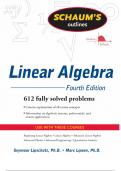
Linear Algebra
Fourth Edition
Seymour Lipschutz, Ph.D.
Temple University
Marc Lars Lipson, Ph.D.
University of Virginia
Schaum’s Outline Series
New York Chicago San Francisco Lisbon London Madrid
Mexico City Milan New Delhi San Juan
Seoul Singapore Sydney Toronto
,Copyright © 2009, 2001, 1991, 1968 by The McGraw-Hill Companies, Inc. All rights reserved. Except as permitted under the United States Copyright Act of
1976, no part of this publication may be reproduced or distributed in any form or by any means, or stored in a database or retrieval system, without the prior writ-
ten permission of the publisher.
ISBN: 978-0-07-154353-8
MHID: 0-07-154353-8
The material in this eBook also appears in the print version of this title: ISBN: 978-0-07-154352-1, MHID: 0-07-154352-X.
All trademarks are trademarks of their respective owners. Rather than put a trademark symbol after every occurrence of a trademarked name, we use names in an
editorial fashion only, and to the benefit of the trademark owner, with no intention of infringement of the trademark. Where such designations appear in this book,
they have been printed with initial caps.
McGraw-Hill eBooks are available at special quantity discounts to use as premiums and sales promotions, or for use in corporate training programs. To contact
a representative please e-mail us at .
TERMS OF USE
This is a copyrighted work and The McGraw-Hill Companies, Inc. (“McGraw-Hill”) and its licensors reserve all rights in and to the work. Use of this work is
subject to these terms. Except as permitted under the Copyright Act of 1976 and the right to store and retrieve one copy of the work, you may not decompile,
disassemble, reverse engineer, reproduce, modify, create derivative works based upon, transmit, distribute, disseminate, sell, publish or sublicense the work or any
part of it without McGraw-Hill’s prior consent. You may use the work for your own noncommercial and personal use; any other use of the work is strictly
prohibited. Your right to use the work may be terminated if you fail to comply with these terms.
THE WORK IS PROVIDED “AS IS.” McGRAW-HILL AND ITS LICENSORS MAKE NO GUARANTEES OR WARRANTIES AS TO THE ACCURACY,
ADEQUACY OR COMPLETENESS OF OR RESULTS TO BE OBTAINED FROM USING THE WORK, INCLUDING ANY INFORMATION THAT CAN
BE ACCESSED THROUGH THE WORK VIA HYPERLINK OR OTHERWISE, AND EXPRESSLY DISCLAIM ANY WARRANTY, EXPRESS OR
IMPLIED, INCLUDING BUT NOT LIMITED TO IMPLIED WARRANTIES OF MERCHANTABILITY OR FITNESS FOR A PARTICULAR PURPOSE.
McGraw-Hill and its licensors do not warrant or guarantee that the functions contained in the work will meet your requirements or that its operation will be
uninterrupted or error free. Neither McGraw-Hill nor its licensors shall be liable to you or anyone else for any inaccuracy, error or omission, regardless of cause,
in the work or for any damages resulting therefrom. McGraw-Hill has no responsibility for the content of any information accessed through the work. Under no
circumstances shall McGraw-Hill and/or its licensors be liable for any indirect, incidental, special, punitive, consequential or similar damages that result from the
use of or inability to use the work, even if any of them has been advised of the possibility of such damages. This limitation of liability shall apply to any claim
or cause whatsoever whether such claim or cause arises in contract, tort or otherwise.
, Preface
Linear algebra has in recent years become an essential part of the mathematical background required by
mathematicians and mathematics teachers, engineers, computer scientists, physicists, economists, and
statisticians, among others. This requirement reflects the importance and wide applications of the subject
matter.
This book is designed for use as a textbook for a formal course in linear algebra or as a supplement to all
current standard texts. It aims to present an introduction to linear algebra which will be found helpful to all
readers regardless of their fields of specification. More material has been included than can be covered in most
first courses. This has been done to make the book more flexible, to provide a useful book of reference, and to
stimulate further interest in the subject.
Each chapter begins with clear statements of pertinent definitions, principles, and theorems together with
illustrative and other descriptive material. This is followed by graded sets of solved and supplementary
problems. The solved problems serve to illustrate and amplify the theory, and to provide the repetition of basic
principles so vital to effective learning. Numerous proofs, especially those of all essential theorems, are
included among the solved problems. The supplementary problems serve as a complete review of the material
of each chapter.
The first three chapters treat vectors in Euclidean space, matrix algebra, and systems of linear equations.
These chapters provide the motivation and basic computational tools for the abstract investigations of vector
spaces and linear mappings which follow. After chapters on inner product spaces and orthogonality and on
determinants, there is a detailed discussion of eigenvalues and eigenvectors giving conditions for representing
a linear operator by a diagonal matrix. This naturally leads to the study of various canonical forms,
specifically, the triangular, Jordan, and rational canonical forms. Later chapters cover linear functions and
the dual space V*, and bilinear, quadratic, and Hermitian forms. The last chapter treats linear operators on
inner product spaces.
The main changes in the fourth edition have been in the appendices. First of all, we have expanded
Appendix A on the tensor and exterior products of vector spaces where we have now included proofs on the
existence and uniqueness of such products. We also added appendices covering algebraic structures, including
modules, and polynomials over a field. Appendix D, ‘‘Odds and Ends,’’ includes the Moore–Penrose
generalized inverse which appears in various applications, such as statistics. There are also many additional
solved and supplementary problems.
Finally, we wish to thank the staff of the McGraw-Hill Schaum’s Outline Series, especially Charles Wall,
for their unfailing cooperation.
SEYMOUR LIPSCHUTZ
MARC LARS LIPSON
iii
outlines outlines
Linear Algebra
Fourth Edition
Seymour Lipschutz, Ph.D.
Temple University
Marc Lars Lipson, Ph.D.
University of Virginia
Schaum’s Outline Series
New York Chicago San Francisco Lisbon London Madrid
Mexico City Milan New Delhi San Juan
Seoul Singapore Sydney Toronto
,Copyright © 2009, 2001, 1991, 1968 by The McGraw-Hill Companies, Inc. All rights reserved. Except as permitted under the United States Copyright Act of
1976, no part of this publication may be reproduced or distributed in any form or by any means, or stored in a database or retrieval system, without the prior writ-
ten permission of the publisher.
ISBN: 978-0-07-154353-8
MHID: 0-07-154353-8
The material in this eBook also appears in the print version of this title: ISBN: 978-0-07-154352-1, MHID: 0-07-154352-X.
All trademarks are trademarks of their respective owners. Rather than put a trademark symbol after every occurrence of a trademarked name, we use names in an
editorial fashion only, and to the benefit of the trademark owner, with no intention of infringement of the trademark. Where such designations appear in this book,
they have been printed with initial caps.
McGraw-Hill eBooks are available at special quantity discounts to use as premiums and sales promotions, or for use in corporate training programs. To contact
a representative please e-mail us at .
TERMS OF USE
This is a copyrighted work and The McGraw-Hill Companies, Inc. (“McGraw-Hill”) and its licensors reserve all rights in and to the work. Use of this work is
subject to these terms. Except as permitted under the Copyright Act of 1976 and the right to store and retrieve one copy of the work, you may not decompile,
disassemble, reverse engineer, reproduce, modify, create derivative works based upon, transmit, distribute, disseminate, sell, publish or sublicense the work or any
part of it without McGraw-Hill’s prior consent. You may use the work for your own noncommercial and personal use; any other use of the work is strictly
prohibited. Your right to use the work may be terminated if you fail to comply with these terms.
THE WORK IS PROVIDED “AS IS.” McGRAW-HILL AND ITS LICENSORS MAKE NO GUARANTEES OR WARRANTIES AS TO THE ACCURACY,
ADEQUACY OR COMPLETENESS OF OR RESULTS TO BE OBTAINED FROM USING THE WORK, INCLUDING ANY INFORMATION THAT CAN
BE ACCESSED THROUGH THE WORK VIA HYPERLINK OR OTHERWISE, AND EXPRESSLY DISCLAIM ANY WARRANTY, EXPRESS OR
IMPLIED, INCLUDING BUT NOT LIMITED TO IMPLIED WARRANTIES OF MERCHANTABILITY OR FITNESS FOR A PARTICULAR PURPOSE.
McGraw-Hill and its licensors do not warrant or guarantee that the functions contained in the work will meet your requirements or that its operation will be
uninterrupted or error free. Neither McGraw-Hill nor its licensors shall be liable to you or anyone else for any inaccuracy, error or omission, regardless of cause,
in the work or for any damages resulting therefrom. McGraw-Hill has no responsibility for the content of any information accessed through the work. Under no
circumstances shall McGraw-Hill and/or its licensors be liable for any indirect, incidental, special, punitive, consequential or similar damages that result from the
use of or inability to use the work, even if any of them has been advised of the possibility of such damages. This limitation of liability shall apply to any claim
or cause whatsoever whether such claim or cause arises in contract, tort or otherwise.
, Preface
Linear algebra has in recent years become an essential part of the mathematical background required by
mathematicians and mathematics teachers, engineers, computer scientists, physicists, economists, and
statisticians, among others. This requirement reflects the importance and wide applications of the subject
matter.
This book is designed for use as a textbook for a formal course in linear algebra or as a supplement to all
current standard texts. It aims to present an introduction to linear algebra which will be found helpful to all
readers regardless of their fields of specification. More material has been included than can be covered in most
first courses. This has been done to make the book more flexible, to provide a useful book of reference, and to
stimulate further interest in the subject.
Each chapter begins with clear statements of pertinent definitions, principles, and theorems together with
illustrative and other descriptive material. This is followed by graded sets of solved and supplementary
problems. The solved problems serve to illustrate and amplify the theory, and to provide the repetition of basic
principles so vital to effective learning. Numerous proofs, especially those of all essential theorems, are
included among the solved problems. The supplementary problems serve as a complete review of the material
of each chapter.
The first three chapters treat vectors in Euclidean space, matrix algebra, and systems of linear equations.
These chapters provide the motivation and basic computational tools for the abstract investigations of vector
spaces and linear mappings which follow. After chapters on inner product spaces and orthogonality and on
determinants, there is a detailed discussion of eigenvalues and eigenvectors giving conditions for representing
a linear operator by a diagonal matrix. This naturally leads to the study of various canonical forms,
specifically, the triangular, Jordan, and rational canonical forms. Later chapters cover linear functions and
the dual space V*, and bilinear, quadratic, and Hermitian forms. The last chapter treats linear operators on
inner product spaces.
The main changes in the fourth edition have been in the appendices. First of all, we have expanded
Appendix A on the tensor and exterior products of vector spaces where we have now included proofs on the
existence and uniqueness of such products. We also added appendices covering algebraic structures, including
modules, and polynomials over a field. Appendix D, ‘‘Odds and Ends,’’ includes the Moore–Penrose
generalized inverse which appears in various applications, such as statistics. There are also many additional
solved and supplementary problems.
Finally, we wish to thank the staff of the McGraw-Hill Schaum’s Outline Series, especially Charles Wall,
for their unfailing cooperation.
SEYMOUR LIPSCHUTZ
MARC LARS LIPSON
iii


