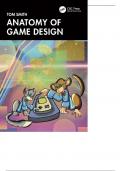
, Anatomy of Game Design
People have played games forever, but it’s only in the past few decades that
people really started thinking about what games are, how they work, and
how to make them better.
Anatomy of Game Design takes some of the most popular and beloved
games of all time and dissects them to see what makes them tick. By break-
ing down the systems and content of each game, the underlying systems of
game design are laid bare.
Eight games are analyzed – including Settlers of Catan; Centipede;
Candy Crush Saga; Papers, Please; Magic: The Gathering; and more – each
representing a different genre or era of game design. Each game is dis-
cussed in detail, using the same methods for each game. What are the
verbs of the game that give the player agency? How do those verbs fit
together to form a core loop that makes the game engaging? What are the
systems that power the gameplay? What is the larger flow that makes the
game interesting over and over again?
Each game is then used as an example to tie back to one or more larger
topics in game design, such as systems design, randomness, monetization,
game theory, and iterative approaches to game development.
Key Features
• Uses well-k nown games to provide specific, discrete examples of
broader game design theory
• Discusses eight popular games using the same methodology to allow
comparison of different types of games
• Includes both high-level theory and academic perspective and p
ractical,
real-world guidance from a working game designer who has created
these games for commercial release
• Provides clear direction for deeper inquiry into game design or
related fields such as psychology, anthropology, game development,
or systems thinking
,
, Anatomy of Game Design
Tom Smith
People have played games forever, but it’s only in the past few decades that
people really started thinking about what games are, how they work, and
how to make them better.
Anatomy of Game Design takes some of the most popular and beloved
games of all time and dissects them to see what makes them tick. By break-
ing down the systems and content of each game, the underlying systems of
game design are laid bare.
Eight games are analyzed – including Settlers of Catan; Centipede;
Candy Crush Saga; Papers, Please; Magic: The Gathering; and more – each
representing a different genre or era of game design. Each game is dis-
cussed in detail, using the same methods for each game. What are the
verbs of the game that give the player agency? How do those verbs fit
together to form a core loop that makes the game engaging? What are the
systems that power the gameplay? What is the larger flow that makes the
game interesting over and over again?
Each game is then used as an example to tie back to one or more larger
topics in game design, such as systems design, randomness, monetization,
game theory, and iterative approaches to game development.
Key Features
• Uses well-k nown games to provide specific, discrete examples of
broader game design theory
• Discusses eight popular games using the same methodology to allow
comparison of different types of games
• Includes both high-level theory and academic perspective and p
ractical,
real-world guidance from a working game designer who has created
these games for commercial release
• Provides clear direction for deeper inquiry into game design or
related fields such as psychology, anthropology, game development,
or systems thinking
,
, Anatomy of Game Design
Tom Smith