

Capitalism in the USA, 1900 to 1940
Nature of capitalism in the USA
In the 1920s, America experienced an economic boom, however the decade ended
with the Great Depression (1929) and the prosperity of the 1920s was replaced
with unemployment and poverty in the 1930s.
The Great depression had a lasting impact on the rest of the world
In Germany, the Depression led to the dictatorship of Hitler and the Nazi Party.
In Japan, a military dictatorship took power which believed aggressive foreign
policy would recover Japan.
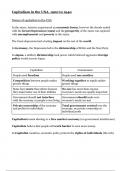
Capitalism Communism
People need freedom People need one another
Competition between people makes Working together as equals makes
greater things greater things
Some have more than others because No one has more than anyone,
they make better use of their abilities everyone's needs are equally important
Government should not interfere Government should make sure
with the economy or people’s own living everyone's needs are met
Private ownership of the economy Total government control over the
and profits for individuals economy, no private ownership or
individual profit
Capitalism’s main ideology is a free market economy (no government interference)
Capitalists believe that people will work harder to earn more money.
In Capitalist countries, economic policy protects the rights of individuals (the rich)
, American Capitalism
Entrepreneurship - taking risks, investing own money, accepting full responsibility for
profits or losses made. Great risk to invest capital in a business in a free market system.
Competition - Capitalist economy is driven by individuals with new ideas.
A company’s new product has a high price (demand>supply).
In competitive markets, poorer or overpriced versions of products won't succeed.
Successful business makes consistent profit against its competitors
Rugged individualism - Belief that all individuals can succeed if they try hard enough.
The Republican Party believed the government should not offer help for people in economic
difficulties. (Herbert Hoover believed in ‘rugged individualism’)
Free Market - Free market economy was based on supply and demand. Price of goods
and services was determined by supply and demand. Prices went up when great demand,
prices went down when there was low demand.
Minimal state control over business - “laissez-faire” Government. Individuals were
responsible for their economic situations.
American Dream
The 1920s was a ‘golden age’ for America. People all around the world came to America to
find the ‘American Dream’. America was portrayed as a land full of prosperity and
opportunity and that anyone could become successful.
The Capitalist boom of the 1920s
The United States emerged as the world’s leading industrial power in the early 1900s.
- Huge country with vast fertile plains for many agricultural food crops.
- Large supply of natural resources (coal, iron, oil, wood) to be used in factories.
- Big population (many immigrants) who worked hard for low wages, which kept
the cost of production down.
During the 1800s, the US developed its resources (factories, oil wells, railways)
New technologies and cheap labour were vital in increasing industrial output.
Nature of capitalism in the USA
In the 1920s, America experienced an economic boom, however the decade ended
with the Great Depression (1929) and the prosperity of the 1920s was replaced
with unemployment and poverty in the 1930s.
The Great depression had a lasting impact on the rest of the world
In Germany, the Depression led to the dictatorship of Hitler and the Nazi Party.
In Japan, a military dictatorship took power which believed aggressive foreign
policy would recover Japan.
Capitalism Communism
People need freedom People need one another
Competition between people makes Working together as equals makes
greater things greater things
Some have more than others because No one has more than anyone,
they make better use of their abilities everyone's needs are equally important
Government should not interfere Government should make sure
with the economy or people’s own living everyone's needs are met
Private ownership of the economy Total government control over the
and profits for individuals economy, no private ownership or
individual profit
Capitalism’s main ideology is a free market economy (no government interference)
Capitalists believe that people will work harder to earn more money.
In Capitalist countries, economic policy protects the rights of individuals (the rich)
, American Capitalism
Entrepreneurship - taking risks, investing own money, accepting full responsibility for
profits or losses made. Great risk to invest capital in a business in a free market system.
Competition - Capitalist economy is driven by individuals with new ideas.
A company’s new product has a high price (demand>supply).
In competitive markets, poorer or overpriced versions of products won't succeed.
Successful business makes consistent profit against its competitors
Rugged individualism - Belief that all individuals can succeed if they try hard enough.
The Republican Party believed the government should not offer help for people in economic
difficulties. (Herbert Hoover believed in ‘rugged individualism’)
Free Market - Free market economy was based on supply and demand. Price of goods
and services was determined by supply and demand. Prices went up when great demand,
prices went down when there was low demand.
Minimal state control over business - “laissez-faire” Government. Individuals were
responsible for their economic situations.
American Dream
The 1920s was a ‘golden age’ for America. People all around the world came to America to
find the ‘American Dream’. America was portrayed as a land full of prosperity and
opportunity and that anyone could become successful.
The Capitalist boom of the 1920s
The United States emerged as the world’s leading industrial power in the early 1900s.
- Huge country with vast fertile plains for many agricultural food crops.
- Large supply of natural resources (coal, iron, oil, wood) to be used in factories.
- Big population (many immigrants) who worked hard for low wages, which kept
the cost of production down.
During the 1800s, the US developed its resources (factories, oil wells, railways)
New technologies and cheap labour were vital in increasing industrial output.


