

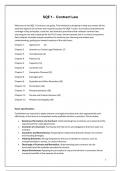
SQE 1 - Contract Law
Welcome to the SQE 1 Contract Law guide. This textbook is designed to help you master all the
essential aspects of contract law required to pass the SQE 1 exam. It provides comprehensive
coverage of key principles, case law, and statutory provisions that underpin contract law,
ensuring you are well-prepared for the FLK1 exam, where contract law is a critical component.
Each chapter includes sample questions to reinforce your learning and assess your
understanding, guiding you toward mastery of this vital topic.
Chapter 1 Agreement (2)
Chapter 2 Intention to Create Legal Relations (7)
Chapter 3 Consideration (9)
Chapter 4 Parties (12)
Chapter 5 Capacity (15)
Chapter 6 Contents (18)
Chapter 7 Exemption Clauses (22)
Chapter 8 Damages (27)
Chapter 9 Equitable and Other Remedies (30)
Chapter 10 Termination (33)
Chapter 11 Misrepresentation (38)
Chapter 12 Duress and Undue Influence (42)
Chapter 13 Mistake and Illegality (46)
Exam specification:
Candidates are required to apply relevant core legal principles and rules appropriately and
effectively, at the level of a competent newly qualified solicitor in practice. This includes:
• Existence/Formation of a Contract: Understanding how contracts are created and the
requirements for valid agreements.
• Contents of a Contract: Familiarity with the terms and obligations that form part of a
contract.
• Causation and Remoteness: Analyzing the relationship between breach of contract
and resulting damages.
• Vitiating Elements: Recognizing factors that can invalidate a contract, such as
misrepresentation, duress, or undue influence.
• Discharge of Contract and Remedies: Understanding how contracts can be
terminated and the available remedies for breach.
• Unjust Enrichment: Applying the principles of unjust enrichment in scenarios where
one party benefits at the expense of another.
1
, 1 - Agreement
Introduction
• Contracts in Business and Consumer Transactions:
o Contracts are essential in business and consumer activities, from buying raw
materials to selling finished products.
o Consumers may not consider legal implications until something goes wrong
(e.g., a disastrous holiday).
o Businesses often employ a contracts manager to handle such matters.
• Importance of a Binding Contract:
o When issues arise (e.g., defective goods), the existence and terms of the
contract are examined.
o The focus of Part 1 is on what constitutes a binding contract.
Offers and Invitations to Treat
• Definition of an Offer:
o An offer is a clear expression of willingness to contract on specified terms,
intended to become binding upon acceptance (Treitel’s definition).
o Offers can be communicated in various forms (e.g., letters, advertisements,
emails, conduct).
• Objective Approach in Law:
o Courts use an objective approach to determine if an agreement exists, focusing
on what a reasonable person would conclude from the parties' actions and
words.
• Example:
o Faheem mistakenly offers to sell a motorcycle for £5,000 instead of £6,000.
Despite his intent, he is legally bound to the £5,000 price because that's what a
reasonable person would interpret as the offer.
• Distinction Between Offer and Invitation to Treat:
o An offer is a definite proposal, whereas an invitation to treat is merely an
invitation to negotiate or make an offer.
o Example: A statement about thinking of selling a car is an invitation to treat, not
an offer.
Situational Examples
• Goods on Display:
2
, o Items on display in stores (e.g., supermarkets) are invitations to treat, not offers.
The contract is concluded at the checkout.
• Advertisements:
o Advertisements generally constitute invitations to treat, not offers.
o Exception: Reward advertisements are considered offers because they promise
a reward for performing a specific act (e.g., providing information).
• Unilateral Contracts:
o A unilateral contract involves one party making a promise in return for the
performance of a specific act.
o Example: The famous Carlill v Carbolic Smoke Ball Co case, where a company
promised £100 to anyone who used their product and contracted the flu.
Auctions and Tenders
• Auctions:
o A sale at an auction is concluded when the auctioneer accepts the highest bid
by bringing down the gavel, which is the acceptance of an offer.
o Reserve prices prevent the sale of items below a certain minimum price.
• Without Reserve Auctions:
o In auctions advertised as "without reserve," the auctioneer must accept the
highest bid, creating a binding unilateral contract (e.g., Barry v Davies case).
• Tenders:
o Inviting tenders is generally an invitation to treat, not an offer. However, a
promise to accept the lowest tender creates a unilateral contract.
Acceptance
• Definition of Acceptance:
o Acceptance is an unqualified expression of assent to the terms of an offer.
• Communication of Acceptance:
o Acceptance must be communicated by the offeree or their agent, either by
words or conduct.
o Silence generally does not constitute acceptance, but conduct implying
acceptance can suffice.
• Counter-Offers:
o A conditional response or counter-offer does not constitute acceptance and can
nullify the original offer.
• Battle of the Forms:
3
, o When parties exchange documents with conflicting terms, the "last shot" often
prevails, meaning the final terms agreed upon become binding.
• Acceptance by Post:
o The postal rule states that acceptance is effective when a properly addressed
and posted letter is sent, not when received.
o Exceptions include specific instructions requiring the acceptance to be received
to be effective.
Termination of Offers
• Methods of Termination:
o Rejection: An offer is terminated if the offeree rejects it or makes a counter-
offer.
o Revocation: The offeror can withdraw an offer anytime before acceptance
unless the offeree has given consideration to keep it open (e.g., Mountford v
Scott case).
o Lapse of Time: Offers can expire after a reasonable period or a specified
timeframe.
• Revocation in Unilateral Contracts:
o Generally, the offeror can revoke an offer anytime before the completion of the
specified act. However, partial performance may prevent revocation.
• Communication of Revocation:
o Revocation must be communicated to be effective, and in electronic
communications, it is effective when it should have been read during normal
business hours (e.g., The Brimnes case).
4
, Sample questions:
Question 1
A client ordered a custom-built computer from a manufacturer on 1 September, agreeing to pay
£2,000. The manufacturer replied on 2 September confirming the order and stating that the
computer would be ready by 20 September. On 15 September, the client emailed the
manufacturer cancelling the order, stating they had found a better deal elsewhere. The
manufacturer responded on 17 September, saying that the cancellation was too late as the
components had already been ordered and some assembly had begun. The client refused to
pay for the computer when it was delivered on 22 September.
If the manufacturer sued the client for breach of contract, which of the following best
describes the most likely outcome?
A. The manufacturer would be entitled to full payment because the client breached the contract
by cancelling after the order was confirmed.
B. The client would not be liable because the cancellation was communicated before the
computer was delivered.
C. The manufacturer would be entitled to damages but not the full amount since the computer
was not yet fully assembled when the cancellation was made.
D. The client would only be liable if the manufacturer could prove that no other buyer could be
found for the custom-built computer.
E. The client would not be liable because the contract was never legally binding.
Answer
The correct answer is A. The contract was binding once the manufacturer confirmed the order.
The cancellation on 15 September was too late, as the manufacturer had already begun fulfilling
the order. Therefore, the client breached the contract by refusing to pay. B is incorrect because
the cancellation did not happen before the contract was binding. C is wrong as the
manufacturer is entitled to the full payment. D is irrelevant since the manufacturer does not
need to prove they couldn't find another buyer. E is wrong because the contract was legally
binding upon confirmation.
Question 2
A client saw an advertisement online for a second-hand boat priced at £10,000. The
advertisement stated that the boat was in excellent condition and would be sold on a "first
come, first served" basis. The client emailed the seller at 9am on 5 July, offering to buy the boat
for the asking price and asking whether the seller could deliver it. The seller replied at 11am,
agreeing to the sale but stating that the boat was "sold as seen" and that the client would need
to arrange for collection. The client did not respond immediately and by 2pm, the seller had sold
the boat to another buyer for £11,000. The client then sued the seller for breach of contract.
Which of the following best describes the most likely outcome?
A. The seller would be liable for breach because a contract was formed when the client emailed
the offer at 9am. B. The client would not succeed because the seller's response at 11am
constituted a counter-offer, which was not accepted. C. The client could claim damages
because the advertisement was an offer, and the client accepted by emailing at 9am. D. The
5
Welcome to the SQE 1 Contract Law guide. This textbook is designed to help you master all the
essential aspects of contract law required to pass the SQE 1 exam. It provides comprehensive
coverage of key principles, case law, and statutory provisions that underpin contract law,
ensuring you are well-prepared for the FLK1 exam, where contract law is a critical component.
Each chapter includes sample questions to reinforce your learning and assess your
understanding, guiding you toward mastery of this vital topic.
Chapter 1 Agreement (2)
Chapter 2 Intention to Create Legal Relations (7)
Chapter 3 Consideration (9)
Chapter 4 Parties (12)
Chapter 5 Capacity (15)
Chapter 6 Contents (18)
Chapter 7 Exemption Clauses (22)
Chapter 8 Damages (27)
Chapter 9 Equitable and Other Remedies (30)
Chapter 10 Termination (33)
Chapter 11 Misrepresentation (38)
Chapter 12 Duress and Undue Influence (42)
Chapter 13 Mistake and Illegality (46)
Exam specification:
Candidates are required to apply relevant core legal principles and rules appropriately and
effectively, at the level of a competent newly qualified solicitor in practice. This includes:
• Existence/Formation of a Contract: Understanding how contracts are created and the
requirements for valid agreements.
• Contents of a Contract: Familiarity with the terms and obligations that form part of a
contract.
• Causation and Remoteness: Analyzing the relationship between breach of contract
and resulting damages.
• Vitiating Elements: Recognizing factors that can invalidate a contract, such as
misrepresentation, duress, or undue influence.
• Discharge of Contract and Remedies: Understanding how contracts can be
terminated and the available remedies for breach.
• Unjust Enrichment: Applying the principles of unjust enrichment in scenarios where
one party benefits at the expense of another.
1
, 1 - Agreement
Introduction
• Contracts in Business and Consumer Transactions:
o Contracts are essential in business and consumer activities, from buying raw
materials to selling finished products.
o Consumers may not consider legal implications until something goes wrong
(e.g., a disastrous holiday).
o Businesses often employ a contracts manager to handle such matters.
• Importance of a Binding Contract:
o When issues arise (e.g., defective goods), the existence and terms of the
contract are examined.
o The focus of Part 1 is on what constitutes a binding contract.
Offers and Invitations to Treat
• Definition of an Offer:
o An offer is a clear expression of willingness to contract on specified terms,
intended to become binding upon acceptance (Treitel’s definition).
o Offers can be communicated in various forms (e.g., letters, advertisements,
emails, conduct).
• Objective Approach in Law:
o Courts use an objective approach to determine if an agreement exists, focusing
on what a reasonable person would conclude from the parties' actions and
words.
• Example:
o Faheem mistakenly offers to sell a motorcycle for £5,000 instead of £6,000.
Despite his intent, he is legally bound to the £5,000 price because that's what a
reasonable person would interpret as the offer.
• Distinction Between Offer and Invitation to Treat:
o An offer is a definite proposal, whereas an invitation to treat is merely an
invitation to negotiate or make an offer.
o Example: A statement about thinking of selling a car is an invitation to treat, not
an offer.
Situational Examples
• Goods on Display:
2
, o Items on display in stores (e.g., supermarkets) are invitations to treat, not offers.
The contract is concluded at the checkout.
• Advertisements:
o Advertisements generally constitute invitations to treat, not offers.
o Exception: Reward advertisements are considered offers because they promise
a reward for performing a specific act (e.g., providing information).
• Unilateral Contracts:
o A unilateral contract involves one party making a promise in return for the
performance of a specific act.
o Example: The famous Carlill v Carbolic Smoke Ball Co case, where a company
promised £100 to anyone who used their product and contracted the flu.
Auctions and Tenders
• Auctions:
o A sale at an auction is concluded when the auctioneer accepts the highest bid
by bringing down the gavel, which is the acceptance of an offer.
o Reserve prices prevent the sale of items below a certain minimum price.
• Without Reserve Auctions:
o In auctions advertised as "without reserve," the auctioneer must accept the
highest bid, creating a binding unilateral contract (e.g., Barry v Davies case).
• Tenders:
o Inviting tenders is generally an invitation to treat, not an offer. However, a
promise to accept the lowest tender creates a unilateral contract.
Acceptance
• Definition of Acceptance:
o Acceptance is an unqualified expression of assent to the terms of an offer.
• Communication of Acceptance:
o Acceptance must be communicated by the offeree or their agent, either by
words or conduct.
o Silence generally does not constitute acceptance, but conduct implying
acceptance can suffice.
• Counter-Offers:
o A conditional response or counter-offer does not constitute acceptance and can
nullify the original offer.
• Battle of the Forms:
3
, o When parties exchange documents with conflicting terms, the "last shot" often
prevails, meaning the final terms agreed upon become binding.
• Acceptance by Post:
o The postal rule states that acceptance is effective when a properly addressed
and posted letter is sent, not when received.
o Exceptions include specific instructions requiring the acceptance to be received
to be effective.
Termination of Offers
• Methods of Termination:
o Rejection: An offer is terminated if the offeree rejects it or makes a counter-
offer.
o Revocation: The offeror can withdraw an offer anytime before acceptance
unless the offeree has given consideration to keep it open (e.g., Mountford v
Scott case).
o Lapse of Time: Offers can expire after a reasonable period or a specified
timeframe.
• Revocation in Unilateral Contracts:
o Generally, the offeror can revoke an offer anytime before the completion of the
specified act. However, partial performance may prevent revocation.
• Communication of Revocation:
o Revocation must be communicated to be effective, and in electronic
communications, it is effective when it should have been read during normal
business hours (e.g., The Brimnes case).
4
, Sample questions:
Question 1
A client ordered a custom-built computer from a manufacturer on 1 September, agreeing to pay
£2,000. The manufacturer replied on 2 September confirming the order and stating that the
computer would be ready by 20 September. On 15 September, the client emailed the
manufacturer cancelling the order, stating they had found a better deal elsewhere. The
manufacturer responded on 17 September, saying that the cancellation was too late as the
components had already been ordered and some assembly had begun. The client refused to
pay for the computer when it was delivered on 22 September.
If the manufacturer sued the client for breach of contract, which of the following best
describes the most likely outcome?
A. The manufacturer would be entitled to full payment because the client breached the contract
by cancelling after the order was confirmed.
B. The client would not be liable because the cancellation was communicated before the
computer was delivered.
C. The manufacturer would be entitled to damages but not the full amount since the computer
was not yet fully assembled when the cancellation was made.
D. The client would only be liable if the manufacturer could prove that no other buyer could be
found for the custom-built computer.
E. The client would not be liable because the contract was never legally binding.
Answer
The correct answer is A. The contract was binding once the manufacturer confirmed the order.
The cancellation on 15 September was too late, as the manufacturer had already begun fulfilling
the order. Therefore, the client breached the contract by refusing to pay. B is incorrect because
the cancellation did not happen before the contract was binding. C is wrong as the
manufacturer is entitled to the full payment. D is irrelevant since the manufacturer does not
need to prove they couldn't find another buyer. E is wrong because the contract was legally
binding upon confirmation.
Question 2
A client saw an advertisement online for a second-hand boat priced at £10,000. The
advertisement stated that the boat was in excellent condition and would be sold on a "first
come, first served" basis. The client emailed the seller at 9am on 5 July, offering to buy the boat
for the asking price and asking whether the seller could deliver it. The seller replied at 11am,
agreeing to the sale but stating that the boat was "sold as seen" and that the client would need
to arrange for collection. The client did not respond immediately and by 2pm, the seller had sold
the boat to another buyer for £11,000. The client then sued the seller for breach of contract.
Which of the following best describes the most likely outcome?
A. The seller would be liable for breach because a contract was formed when the client emailed
the offer at 9am. B. The client would not succeed because the seller's response at 11am
constituted a counter-offer, which was not accepted. C. The client could claim damages
because the advertisement was an offer, and the client accepted by emailing at 9am. D. The
5


