

Sample
Summaries after sample
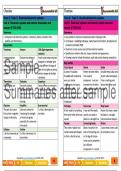
, Component symbols
Ohm’s Law quantitatively Cells in series and in parallel
• Ohm's Law = the electric potential difference (V) • Current in series remains constant at every point.
between two points in a circuit equals the • Parallel-connected cells all produce the same current as
product of the current (I) between those points one cell.
and the total resistance (R) of all the electrical
devices present between those points.
• V = I x R.
• Increased current causes increased voltage.
• Voltage and current aren’t proportion. Lamps in series and in parallel
• Ohmic conductors = transition metals (iron, U1: Electrical
Sample
zinc, nickel, copper, manganese, cobalt, gold
and silver).
• Non-Ohmic conductors = diodes, light bulbs,
LEDs, battery acid and alkaline solutions.
systems and
control:
investigation skills
• Series circuits ensure equal current flow through all
components - results in equal brightness in bulbs.
• Bulbs connected in parallel don't shine as brightly due
to equal branching of current.
Summaries after sample Current in the circuit Switches in series (AND logic)
• Current = the directed flow of electrons through a and parallel (OR logic)
circuit.
• 'AND' configuration - switches connected in series.
• Electrons = negatively charged particles.
• 'OR' configuration - switches connected in parallel.
• Current flows from positive to negative in a
conventional circuit.
• Electrical energy is carried by moving electrons.
• Electrons in DC move in one direction.
• Electrons in AC move in one direction and back in the
opposite direction.
Copyright © www.summariessa.co.za (DO NOT COPY)
GR9 TECH T3-U1 Mind Map Via Afrika
, Sample
Summaries after sample
Summaries after sample
, Component symbols
Ohm’s Law quantitatively Cells in series and in parallel
• Ohm's Law = the electric potential difference (V) • Current in series remains constant at every point.
between two points in a circuit equals the • Parallel-connected cells all produce the same current as
product of the current (I) between those points one cell.
and the total resistance (R) of all the electrical
devices present between those points.
• V = I x R.
• Increased current causes increased voltage.
• Voltage and current aren’t proportion. Lamps in series and in parallel
• Ohmic conductors = transition metals (iron, U1: Electrical
Sample
zinc, nickel, copper, manganese, cobalt, gold
and silver).
• Non-Ohmic conductors = diodes, light bulbs,
LEDs, battery acid and alkaline solutions.
systems and
control:
investigation skills
• Series circuits ensure equal current flow through all
components - results in equal brightness in bulbs.
• Bulbs connected in parallel don't shine as brightly due
to equal branching of current.
Summaries after sample Current in the circuit Switches in series (AND logic)
• Current = the directed flow of electrons through a and parallel (OR logic)
circuit.
• 'AND' configuration - switches connected in series.
• Electrons = negatively charged particles.
• 'OR' configuration - switches connected in parallel.
• Current flows from positive to negative in a
conventional circuit.
• Electrical energy is carried by moving electrons.
• Electrons in DC move in one direction.
• Electrons in AC move in one direction and back in the
opposite direction.
Copyright © www.summariessa.co.za (DO NOT COPY)
GR9 TECH T3-U1 Mind Map Via Afrika
, Sample
Summaries after sample


