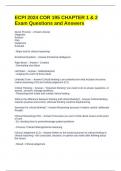
ECPI 2024 COR 195 CHAPTER 1 & 2
Exam Questions and Answers
Nurse Process: - Answer-Assess
Diagnosis
Analyze
Plan
Implement
Evaluate
- Major tool for clinical reasoning
Emotional Quotient: - Answer-Emotional intelligence
Right Brain: - Answer-- Creative
- Generating new ideas
Left Brain: - Answer-- Math/analytical
- Judging the worth of those ideas
Umbrella Term: - Answer-Critical thinking is an umbrella term that includes the terms
critical reasoning (CR) and critical judgement (CJ).
Critical Thinking: - Answer-- "Important thinking" you need to do to answer questions, or
assess , prevent, manage problems.
- Reasoning both inside and outside clinical setting
What is the difference between thinking and critical thinking? - Answer-Critical thinking
requires purpose and control, whereas thinking could be daydreaming.
Synonym for critical thinking? - Answer-Reasoning because it implies careful, deliberate
thought.
Clinical Reasoning (CR): - Answer-Processes you use to think about issues at the point
of care.
- Ex: deciding how to prevent/manage patient problems
- Process: Critical thinking/clinical reasoning
Clinical Judgement (CJ): - Answer-Refers to the result (outcome) of critical thinking or
clinical reasoning - the conclusion, decision, or opinion you make after thinking about
the issues.
- Result - Clinical judgement
, Critical Thinking In Nursing: - Answer-- Includes clinical reasoning and clinical
judgement - is purposeful, informed, outcome - focused thinking that:
- Guided by standards, policies, ethic codes, laws
- Driven by patient, family, community needs as well as nurses needs to give
efficient/competent care
- Based on principles of nursing process, problem-solving, and scientific method
- Focuses on safety and quality, constantly re-evaluating, self-correcting, striving to
improve
- Carefully identifies key problems, issues, risks, involved, including patients, families,
key stakeholders in decision-making early in the process. Stakeholders will be most
affected (patients/families) or from whom requirements will be drawn
- Uses logic, intuition, creativity and is grounded in specific knowledge, skills,
experience.
- Calls for strategies that make most of human potential and compensate for problems
created by human nature
Common Sense: - Answer-- Usually learned from experiences
- Everyone's common sense is different
Ideal Critical Thinker: - Answer-- Is habitually inquisitive
- Self-informed
- Trustful of reason
- Open-minded
- Flexible
- Fair-minded in evaluation
- Honest in facing personal biases
- Prudent in making judgements
- Willing to reconsider
- Clear about issues
- Orderly in complex matters
- Diligent in seeking relevant information
- Reasonable in selecting criteria
- Focused in inquiry and present in seeking results that are as precise as the subject
and the circumstances of inquiry permit
Personal Critical Thinking Indicators: - Answer-- Self aware
- Genuine/authentic
- Effective communication
- Curious and inquisitive
- Alert to context
- Reflective and self-corrective
- Analytical and insightful
- Logical and intuitive
- Confident and resilient
- Honest and upright
Exam Questions and Answers
Nurse Process: - Answer-Assess
Diagnosis
Analyze
Plan
Implement
Evaluate
- Major tool for clinical reasoning
Emotional Quotient: - Answer-Emotional intelligence
Right Brain: - Answer-- Creative
- Generating new ideas
Left Brain: - Answer-- Math/analytical
- Judging the worth of those ideas
Umbrella Term: - Answer-Critical thinking is an umbrella term that includes the terms
critical reasoning (CR) and critical judgement (CJ).
Critical Thinking: - Answer-- "Important thinking" you need to do to answer questions, or
assess , prevent, manage problems.
- Reasoning both inside and outside clinical setting
What is the difference between thinking and critical thinking? - Answer-Critical thinking
requires purpose and control, whereas thinking could be daydreaming.
Synonym for critical thinking? - Answer-Reasoning because it implies careful, deliberate
thought.
Clinical Reasoning (CR): - Answer-Processes you use to think about issues at the point
of care.
- Ex: deciding how to prevent/manage patient problems
- Process: Critical thinking/clinical reasoning
Clinical Judgement (CJ): - Answer-Refers to the result (outcome) of critical thinking or
clinical reasoning - the conclusion, decision, or opinion you make after thinking about
the issues.
- Result - Clinical judgement
, Critical Thinking In Nursing: - Answer-- Includes clinical reasoning and clinical
judgement - is purposeful, informed, outcome - focused thinking that:
- Guided by standards, policies, ethic codes, laws
- Driven by patient, family, community needs as well as nurses needs to give
efficient/competent care
- Based on principles of nursing process, problem-solving, and scientific method
- Focuses on safety and quality, constantly re-evaluating, self-correcting, striving to
improve
- Carefully identifies key problems, issues, risks, involved, including patients, families,
key stakeholders in decision-making early in the process. Stakeholders will be most
affected (patients/families) or from whom requirements will be drawn
- Uses logic, intuition, creativity and is grounded in specific knowledge, skills,
experience.
- Calls for strategies that make most of human potential and compensate for problems
created by human nature
Common Sense: - Answer-- Usually learned from experiences
- Everyone's common sense is different
Ideal Critical Thinker: - Answer-- Is habitually inquisitive
- Self-informed
- Trustful of reason
- Open-minded
- Flexible
- Fair-minded in evaluation
- Honest in facing personal biases
- Prudent in making judgements
- Willing to reconsider
- Clear about issues
- Orderly in complex matters
- Diligent in seeking relevant information
- Reasonable in selecting criteria
- Focused in inquiry and present in seeking results that are as precise as the subject
and the circumstances of inquiry permit
Personal Critical Thinking Indicators: - Answer-- Self aware
- Genuine/authentic
- Effective communication
- Curious and inquisitive
- Alert to context
- Reflective and self-corrective
- Analytical and insightful
- Logical and intuitive
- Confident and resilient
- Honest and upright