

The French Revolution
Feudal System
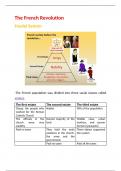
-The French population was divided into three social classes called
estates.
The first estate The second estate The third estate
Clergy: the people who Nobles 98% of the population
worked for the Roman
Catholic Church
The officials in the Owned majority of the Middle class, urban
church were very land workers, and poorer
wealthy farmers (peasants)
Paid no taxes They held the main There labour supported
positions in the church, the system
the army and the
government.
Paid no taxes Paid all the taxes
, -The middle class (bourgeoisie) were shopkeepers, doctors, and
lawyers who lived in the towns.
-They were well-educated and wealthy
-However even though many of them were qualified to play leading
roles in the state, positions of power always went to the nobles.
-The middle class was frustrated by their lack of opportunity and lack
of political power.
-They wanted the system to be based on merit.
-Criticism of the king or of the Church was not permitted.
-Members of the third estate could be sentenced to more cruel
forms of punishment than the other two estates, even if the same
crime was committed.
Feudal System
-The French population was divided into three social classes called
estates.
The first estate The second estate The third estate
Clergy: the people who Nobles 98% of the population
worked for the Roman
Catholic Church
The officials in the Owned majority of the Middle class, urban
church were very land workers, and poorer
wealthy farmers (peasants)
Paid no taxes They held the main There labour supported
positions in the church, the system
the army and the
government.
Paid no taxes Paid all the taxes
, -The middle class (bourgeoisie) were shopkeepers, doctors, and
lawyers who lived in the towns.
-They were well-educated and wealthy
-However even though many of them were qualified to play leading
roles in the state, positions of power always went to the nobles.
-The middle class was frustrated by their lack of opportunity and lack
of political power.
-They wanted the system to be based on merit.
-Criticism of the king or of the Church was not permitted.
-Members of the third estate could be sentenced to more cruel
forms of punishment than the other two estates, even if the same
crime was committed.


