

Chap 13+14+15+16+17+18 ECPI Nur 166
Questions And Answers
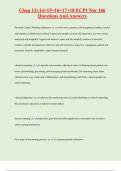
Personal Critical Thinking Indicators self-aware, genuine, self-disciplined, healthy, careful
and prudent, confident and resilient, honest and upright, curious and inquisitive, alert to context,
analytical and insightful, logical and intuitive, open and fair-minded, sensitive to diversity,
creative, realistic and practical, reflective and self-corrective, proactive, courageous, patient and
persistent, flexible, empathetic, improvement-oriented
clinical reasoning a specific term usually referring to ways of thinking about patient care
issues (determining, preventing, and managing patient problems); for reasoning about other
clinical issues (e.g., teamwork, collaboration, and streamlining work flow); nurses usually use
critical thinking
clinical judgement refers to the result (outcome) of critical thinking or clinical reasoning;
the conclusion, decision, or opinion a nurse makes
decison making purposeful, goal-directed effort applied in a systematic way to make a
choice among alternatives
Five steps of the nursing process 1) Assessment/data collection
, Chap 13+14+15+16+17+18 ECPI Nur 166
Questions And Answers
2) Diagnosis - Analysis/data collection
3) Outcome - planning
4) Implementation - intervention
5) Evaluation
Nursing Process Systematic: part of an ordered sequence
Dynamic: great interaction and overlapping among the five steps
•Interpersonal: human being is always at the heart of nursing
•Outcome oriented: nurses and patients work together to identify outcomes
•Universally applicable: a framework for all nursing activities
Steps in Concept Mapping 1. Collect patient problems and concerns
2. Collect and analyze, categorize data.
3. create diagram
, Chap 13+14+15+16+17+18 ECPI Nur 166
Questions And Answers
5. Keep in mind, key concepts,safety, and advocacy
Gibbs Reflective Model Description - What happened
Feelings - what were your reactions/feelings
Evaluation - what was bad or good about the experience
Analysis - what sense can you make of the situation
Conclusion - what can be concluded, general and specific
Action plan - what are you going to do differently in this type of situation next time?
Five types of nursing assessments •Comprehensive initial - performed shortly after the
patient is admitted to a health care facility or service
•Focused - data about a specific problem that has already been identified
•Emergency - identify life-threatening problems
•Time-lapsed - scheduled to compare a patient's current status to the baseline data obtained
earlier
Questions And Answers
Personal Critical Thinking Indicators self-aware, genuine, self-disciplined, healthy, careful
and prudent, confident and resilient, honest and upright, curious and inquisitive, alert to context,
analytical and insightful, logical and intuitive, open and fair-minded, sensitive to diversity,
creative, realistic and practical, reflective and self-corrective, proactive, courageous, patient and
persistent, flexible, empathetic, improvement-oriented
clinical reasoning a specific term usually referring to ways of thinking about patient care
issues (determining, preventing, and managing patient problems); for reasoning about other
clinical issues (e.g., teamwork, collaboration, and streamlining work flow); nurses usually use
critical thinking
clinical judgement refers to the result (outcome) of critical thinking or clinical reasoning;
the conclusion, decision, or opinion a nurse makes
decison making purposeful, goal-directed effort applied in a systematic way to make a
choice among alternatives
Five steps of the nursing process 1) Assessment/data collection
, Chap 13+14+15+16+17+18 ECPI Nur 166
Questions And Answers
2) Diagnosis - Analysis/data collection
3) Outcome - planning
4) Implementation - intervention
5) Evaluation
Nursing Process Systematic: part of an ordered sequence
Dynamic: great interaction and overlapping among the five steps
•Interpersonal: human being is always at the heart of nursing
•Outcome oriented: nurses and patients work together to identify outcomes
•Universally applicable: a framework for all nursing activities
Steps in Concept Mapping 1. Collect patient problems and concerns
2. Collect and analyze, categorize data.
3. create diagram
, Chap 13+14+15+16+17+18 ECPI Nur 166
Questions And Answers
5. Keep in mind, key concepts,safety, and advocacy
Gibbs Reflective Model Description - What happened
Feelings - what were your reactions/feelings
Evaluation - what was bad or good about the experience
Analysis - what sense can you make of the situation
Conclusion - what can be concluded, general and specific
Action plan - what are you going to do differently in this type of situation next time?
Five types of nursing assessments •Comprehensive initial - performed shortly after the
patient is admitted to a health care facility or service
•Focused - data about a specific problem that has already been identified
•Emergency - identify life-threatening problems
•Time-lapsed - scheduled to compare a patient's current status to the baseline data obtained
earlier


