

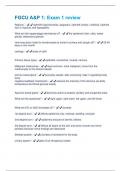
FGCU A&P 1: Exam 1 review
Regions: - ✔️✔️right/left hypochondriac, epigastric, right/left lumbar, umbilical, right/left
iliac or inguinal, and hypogastric
What are skin appendages derivatives of? - ✔️✔️the epidermis (hair, nails, sweat
glands, sebaceous glands)
How long does it take for keratinocytes to travel to surface and slough off? - ✔️✔️25-45
days or one month
cytology - ✔️✔️study of cells
Primary tissue types - ✔️✔️epithelial, connective, muscle, nervous
Malignant melanomas - ✔️✔️least common, most malignant, come from the
melanocytes in the stratum basale
eccrine sweat gland - ✔️✔️everyday sweats, after exercising, help in regulating body
temp
negative feedback mechanism - ✔️✔️reduces the intensity of the stimulus (ex:body
temperature and blood glucose levels)
Apocrine sweat gland - ✔️✔️becomes active at puberty (axillary and anogenital area)
What are the quadrants? - ✔️✔️right upper, right lower, left upper, and left lower
What are KCI or NaCI examples of? - ✔️✔️symbols
1st degree burn - ✔️✔️affects epidermis only, redness, swelling, and pain
2nd degree burn - ✔️✔️epidermis and part of dermis, blisters
3rd degree burn - ✔️✔️affects all layers of the skin and some muscle and nerve
painless because nerve endings are destroyed
Skeletal system - ✔️✔️provides a framework for the body
urinary system - ✔️✔️gets rid of nitrogenous waste
, Depolarization - ✔️✔️reduction of membrane potential towards zero
Hyperpolarization - ✔️✔️when membrane potential goes past RMP
Gated channels - ✔️✔️can be open or closed
Leakage channels - ✔️✔️always open
Types of connective tissue - ✔️✔️connective tissue proper, cartilage, bone, and blood
Rule of nines - ✔️✔️used to estimate fluid loss from 2nd and 3rd degree burns only
What is melanin responsible for? - ✔️✔️skin color (ranges from yellow-black)
Cranial cavity - ✔️✔️holds the brain
Serous membranes - ✔️✔️lines closed body cavities
parietal serosa - ✔️✔️lines the walls (farthest from organ)
visceral serosa - ✔️✔️lines organs (closest to the organ)
Heart is located in what cavity? - ✔️✔️thoracic cavity
Pipillary layer of the dermis - ✔️✔️makes up 20% of the dermis
Reticular layer of the dermis - ✔️✔️makes up 80% of dermis
What is the dermis made of? - ✔️✔️connective tissue
Where is vitamin D produced? - ✔️✔️the dermis
Gap junctions - ✔️✔️cell to cell communication
Desmosomes - ✔️✔️anchors cells
Tight junctions - ✔️✔️prevents fluids from leaking through
Mitochondria - ✔️✔️site of ATP production
Exocrine glands - ✔️✔️secrete into ducts that are open to surface
Endocrine glands - ✔️✔️(ductless) secrete straight into blood stream
Regions: - ✔️✔️right/left hypochondriac, epigastric, right/left lumbar, umbilical, right/left
iliac or inguinal, and hypogastric
What are skin appendages derivatives of? - ✔️✔️the epidermis (hair, nails, sweat
glands, sebaceous glands)
How long does it take for keratinocytes to travel to surface and slough off? - ✔️✔️25-45
days or one month
cytology - ✔️✔️study of cells
Primary tissue types - ✔️✔️epithelial, connective, muscle, nervous
Malignant melanomas - ✔️✔️least common, most malignant, come from the
melanocytes in the stratum basale
eccrine sweat gland - ✔️✔️everyday sweats, after exercising, help in regulating body
temp
negative feedback mechanism - ✔️✔️reduces the intensity of the stimulus (ex:body
temperature and blood glucose levels)
Apocrine sweat gland - ✔️✔️becomes active at puberty (axillary and anogenital area)
What are the quadrants? - ✔️✔️right upper, right lower, left upper, and left lower
What are KCI or NaCI examples of? - ✔️✔️symbols
1st degree burn - ✔️✔️affects epidermis only, redness, swelling, and pain
2nd degree burn - ✔️✔️epidermis and part of dermis, blisters
3rd degree burn - ✔️✔️affects all layers of the skin and some muscle and nerve
painless because nerve endings are destroyed
Skeletal system - ✔️✔️provides a framework for the body
urinary system - ✔️✔️gets rid of nitrogenous waste
, Depolarization - ✔️✔️reduction of membrane potential towards zero
Hyperpolarization - ✔️✔️when membrane potential goes past RMP
Gated channels - ✔️✔️can be open or closed
Leakage channels - ✔️✔️always open
Types of connective tissue - ✔️✔️connective tissue proper, cartilage, bone, and blood
Rule of nines - ✔️✔️used to estimate fluid loss from 2nd and 3rd degree burns only
What is melanin responsible for? - ✔️✔️skin color (ranges from yellow-black)
Cranial cavity - ✔️✔️holds the brain
Serous membranes - ✔️✔️lines closed body cavities
parietal serosa - ✔️✔️lines the walls (farthest from organ)
visceral serosa - ✔️✔️lines organs (closest to the organ)
Heart is located in what cavity? - ✔️✔️thoracic cavity
Pipillary layer of the dermis - ✔️✔️makes up 20% of the dermis
Reticular layer of the dermis - ✔️✔️makes up 80% of dermis
What is the dermis made of? - ✔️✔️connective tissue
Where is vitamin D produced? - ✔️✔️the dermis
Gap junctions - ✔️✔️cell to cell communication
Desmosomes - ✔️✔️anchors cells
Tight junctions - ✔️✔️prevents fluids from leaking through
Mitochondria - ✔️✔️site of ATP production
Exocrine glands - ✔️✔️secrete into ducts that are open to surface
Endocrine glands - ✔️✔️(ductless) secrete straight into blood stream


