

Written by students who passed Immediately available after payment Read online or as PDF Wrong document? Swap it for free 4.6 TrustPilot
logo-home
Document preview thumbnail
Preview 3 out of 16 pages
Exam (elaborations)

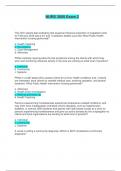
NURS 3600 Exam 2 | Questions and Answers (Complete Solutions)

Document preview thumbnail
Preview 3 out of 16 pages

NURS 3600 Exam 2 | Questions and Answers (Complete Solutions) The CDC reports data indicating that seasonal influenza proportion of outpatient visits for February 2018 was 6.4% and 13 pediatric deaths occurred. What Public Health Intervention is being performed? a. Health Teaching b. Surveillance c. Case Management d. Advocacy PHNs routinely inquiring about flu-like symptoms among the clients with whom they work and monitoring influenza activity in the area are working at what level of practice? a. Individual b. Community c. Systems PHNs in a faith-based clinic assess clients for chronic health conditions and, if clients are interested, send clients for needed medical care, smoking cessation, and alcohol treatment. What Public Health Intervention is being performed? a. Advocacy b. Health Event Investigation c. Referral and follow up d. Health Teaching Persons experiencing homelessness experience temperature-related conditions, and may often have inadequately controlled chronic diseases, such as hypertension, diabetes, or anemia. BSN students that partner with faith-based nurses at a clinic for persons experiencing homelessness and give out socks donated by the congregation to clients and local organizations are working at what level of practice? a. Individual b. Community c. Systems A nurse is writing a community diagnosis. Which is NOT considered a community diagnosis? a. Deficient knowledge related to support and resources b. Impaired social interactions related to inadequate transportation for senior citizens c. Risk for infection related to immunosuppression A nurse is collecting primary and secondary data in the community. Which of the following is an example of primary data? a. Community informant interviews b. Crime statistics c. Morbidity and Mortality Weekly statistics d. Data set analysis Who might be considered a key informant to interview if you want to find out more about community member experiences with Spanish-language interpreters at clinic appointments? a. Spanish-language interpreter b. A Spanish-speaking patient c. Hospital administrator d. Nurse Practitioner at a clinic A nurse refers a new parent to a community parenting class. The nurse is implementing what level of prevention to prevent child abuse? a. Primary b. Secondary c. Tertiary A nurse is collecting the medical history of a 10-year-old client. The nurse notes that the child avoids eye contact and appears withdrawn. What is the nurse observing? a. Normal child behavior b. A nonverbal sign of abuse c. A physical sign of abuse d. Uncooperative behavior If a caregiver is withholding food or medications from their elderly client, they are committing what type of elder abuse? a. Abandonment b. Neglect c. Emotional abuse d. Physical abuse What factor most contributes to violence in the community? a. High education b. Social conditions and economic stressors c. Large population of children and elderly Which is NOT a protective factor that can reduce the risk of child abuse and neglect? a. Stable employment b. Nurturing parenting skills c. Stable housing, quality childcare and preschool in communities d. Emphasis on individual parenting responsibility When a child is known to have been emotionally neglected, what have they been deprived of? a. Basic nurturing b. Sexual safety c. Bodily safety d. appropriate food Public Health Intervention Wheel - The purple, green, and blue wedges are mostly used by nurses focused on individuals, families, classes, and groups - The orange and yellow wedges are mostly used by nurses focused on effecting systems and communities. PHN Practice Uses a Common Set of Interventions Regardless of Practice Setting Individual/family level of practice- PH intervention wheel example: children at risk for lead poisoning PHNs use lead screening questionnaire to determine risk status and need for referral (case-finding) Community level of practice- PH intervention wheel example: children at risk for lead poisoning Providing program that tests for lead and hazard control services to qualifying families through grants Systems level of practice- PH intervention wheel example: children at risk for lead poisoning Enacting a state law that mandates screening children under 5 years old insured by Medicaid, and children enrolled in WIC, for blood lead levels Primary prevention - prevention of problems before they occur - vaccinations Infants are given a hepatitis B vaccine at birth. This is an example of what level of prevention? a. Primary b. Secondary c. Tertiary Secondary prevention - early detection and intervention - screenings Pregnant mothers are tested for HIV, STIs, and Group B Strep before delivery. This is an example of what level of prevention? a. Primary b. Secondary c. Tertiary Tertiary prevention - correction and prevention and deterioration of a disease state - medical treatments, pharms, therapy PHIW: Surveillance Describes and monitors health events through ongoing and systematic collection, analysis, and interpretation of health data for the purpose of planning, implementing, and evaluating public health interventions PHIW: Disease and other health investigation Systematically gathers and analyzes data regarding threats to the health of populations, ascertains the source of the threat, identifies cases and others at risk, and determines control measures PHIW: Outreach Locates populations-of- interest or populations-at-risk and provides information about the nature of the concern, what can be done about it, and how services can be obtained PHIW: Screening Identifies individuals with unrecognized health risk factors or asymptomatic disease conditions in populations PHIW: Case-finding Locates individuals and families with identified risk factors and connects them with resources PHIW: Referral and follow-up Assists individuals, families, groups, organizations, and/or communities to identify and access necessary resources in to prevent or resolve problems or concerns PHIW: Case management Optimizes self-care capabilities of individuals and families and the capacity of systems and communities to coordinate and provide services PHIW: Delegated functions Direct care tasks a registered professional nurse carries out under the authority of a health care practitioner as allowed by law. Delegated functions also include any direct care tasks a registered professional nurse entrusts to other appropriate personnel to perform PHIW: Health teaching Communicates facts, ideas and skills that change knowledge, attitudes, values, beliefs, behaviors, and practices of individuals, families, systems, and/or communities PHIW: Consultation Seeks information and generates optional solutions to perceived problems or issues through interactive problem solving with a community, system, family or individual. The community, system, family or individual selects and acts on the option best meeting the circumstances PHIW: Counseling Establishes an interpersonal relationship with a community, a system, family or individual intended to increase or enhance their capacity for self-care and coping. Engages the community, a system, family or individual at an emotional level PHIW: Collaboration Commits two or more persons or organizations to achieve a common goal through enhancing the capacity of one or more of the members to promote and protect health PHIW: Coalition building Promotes and develops alliances among organizations or constituencies for a common purpose. It builds linkages, solves problems, and/or enhances local leadership to address health concerns PHIW: Community organizing Helps community groups to identify common problems or goals, mobilize resources, and develop and implement strategies for reaching the goals they collectively have set PHIW: Advocacy Pleads someone's cause or act on someone's behalf, with a focus on developing the community, system, individual or family's capacity to plead their own cause or act on their own behalf PHIW: Social marketing Utilizes commercial marketing principles and technologies for programs designed to influence the knowledge, attitudes, values, beliefs, behaviors, and practices of the population-of-interest PHIW: Policy development Places health issues on decision-makers' agendas, acquires a plan of resolution, and determines needed resources. Policy development results in laws, rules and regulation, ordinances, and policies PHIW: Policy enforcement Compels others to comply with the laws, rules, regulations, ordinances and policies created in conjunction with policy development. Population of interest generally healthy population but focus of intervention or research Population at risk risk factors present in population primary data in healthcare Data that has been generated by the researcher themselves, surveys, interviews, experiments, specially designed for understanding and solving the research problem at hand. examples of primary data in healthcare key informant interviews, focus groups, photovoice, participant observation, windshield surveys Key informant interviews conducted with individuals who have knowledge of and the ability to report on the needs of a corporation, hospital or organization Focus groups 6-12 community members who engage in a discussion about atopic of interest to group Photovoice the technique of asking participants to take photographs themselves and then interpret them Participant observation a research method in which investigators systematically observe people while joining them in their routine activities: PTO, church groups, etc. Windshield survey A method of simple observation- quick overview of the community. Things to observe: Common characteristics of people, neighborhood gathering places, rhythm of community life, housing quality, geographic boundaries secondary data in healthcare Using existing data generated by large government institutions, healthcare facilities etc. as part of organizational record keeping. The data is then extracted from more varied data files. examples of secondary data in healthcare Raynor Library, CDC, Milwaukee Health Report, US Census Data, WI Department of Health Services, Behavioral Risk Factor Surveillance System (BRFSS) What are the parts of the community diagnostic statement? - Target group or aggregate - Response/overall goal (May be actual or potential; at risk for) - Related factors (etiologies = causes) ---- Aggregate (community or population) _____ at risk for (disease or disability) _____ related to (etiology) ______, as evidenced by (health indicators) __________. Community diagnosis should: - Relate to the community or group as a total - Be generated from the assessment data - Amenable to community or aggregate interventions - Benefit the total community or aggregate as much as possible Example of a community diagnostic statement Increased risk of infant malnutrition among families in Iron County related to: lack of regular developmental screening, lack of an outreach program to identify at-risk infants, and knowledge deficit among families about infant-related nutrition and about WIC. As evidenced by: documented developmental delay so Infant below ideal weight for age What are the differences between needs-based and asset-based assessment? The purpose of the needs-based is to provide services to a community while the purpose of the asset-based is to engage community interests and skills. --- it's basically like a glass half empty/half full difference on type of approach taken to assess communities Needs-based assessment Focus on learning about the needs of a community so that services can be provided for them or goods can be given to them. Asset-Based assessment Focus on learning from a community so that initiatives can be built by the community and with the community. What are the risk factors for violence? Poverty, unemployment, economic dependency; polydrug and alcohol abuse; dysfunctional family and/or social environment; differing lifestyles/culture; lack of emotional support; media influence; access to firearms; political and/or religious ideology; education (low education increases violence); population: either crowding or isolation; community facilities (availability of pools, playgrounds, sports, entertainment) emotional neglect Involves a failure to meet a child's emotional needs or to provide psychological care, or to allow a child to use alcohol or drugs. physical neglect refers to a failure to provide such basic needs as food, clothing, shelter, or appropriate supervision. physical abuse intentionally causing physical harm to another person emotional abuse a pattern of attacking another person's emotional development and sense of worth sexual abuse any sexual act without consent child abuse Any act or failure to act which results in death, serious physical or emotional harm, sexual abuse, exploitation, or risk of serious harm Types of child abuse Neglect (78%), physical (18%), sexual (10%), emotional (8%), medical neglect (2%) child abuse risk factors family stress, lack of social support, children under the age of 4, child with disability, community turning a blind eye, presence of IPV, poverty Types of elder abuse and neglect physical abuse, psychological-emotional abuse, sexual abuse, neglect, abandonment, financial exploitation, health care fraud and abuse risk factors for IPV Adolescent or young adult, unplanned pregnancy, low income and unemployment, low education, exposure to violence in childhood, experience poor parenting, conflict,

Content preview

NURS 3600 Exam 2


The CDC reports data indicating that seasonal influenza proportion of outpatient visits
for February 2018 was 6.4% and 13 pediatric deaths occurred. What Public Health
Intervention is being performed?

a. Health Teaching
b. Surveillance
c. Case Management
d. Advocacy

PHNs routinely inquiring about flu-like symptoms among the clients with whom they
work and monitoring influenza activity in the area are working at what level of practice?

a. Individual
b. Community
c. Systems

PHNs in a faith-based clinic assess clients for chronic health conditions and, if clients
are interested, send clients for needed medical care, smoking cessation, and alcohol
treatment. What Public Health Intervention is being performed?

a. Advocacy
b. Health Event Investigation
c. Referral and follow up
d. Health Teaching

Persons experiencing homelessness experience temperature-related conditions, and
may often have inadequately controlled chronic diseases, such as hypertension,
diabetes, or anemia. BSN students that partner with faith-based nurses at a clinic for
persons experiencing homelessness and give out socks donated by the congregation to
clients and local organizations are working at what level of practice?

a. Individual
b. Community
c. Systems

A nurse is writing a community diagnosis. Which is NOT considered a community
diagnosis?

,a. Deficient knowledge related to support and resources
b. Impaired social interactions related to inadequate transportation for senior citizens
c. Risk for infection related to immunosuppression

A nurse is collecting primary and secondary data in the community. Which of the
following is an example of primary data?

a. Community informant interviews
b. Crime statistics
c. Morbidity and Mortality Weekly statistics
d. Data set analysis

Who might be considered a key informant to interview if you want to find out more about
community member experiences with Spanish-language interpreters at clinic
appointments?

a. Spanish-language interpreter
b. A Spanish-speaking patient
c. Hospital administrator
d. Nurse Practitioner at a clinic

A nurse refers a new parent to a community parenting class. The nurse is implementing
what level of prevention to prevent child abuse?

a. Primary
b. Secondary
c. Tertiary

A nurse is collecting the medical history of a 10-year-old client. The nurse notes that the
child avoids eye contact and appears withdrawn. What is the nurse observing?

a. Normal child behavior
b. A nonverbal sign of abuse
c. A physical sign of abuse
d. Uncooperative behavior

If a caregiver is withholding food or medications from their elderly client, they are
committing what type of elder abuse?

a. Abandonment
b. Neglect
c. Emotional abuse
d. Physical abuse

What factor most contributes to violence in the community?

, a. High education
b. Social conditions and economic stressors
c. Large population of children and elderly

Which is NOT a protective factor that can reduce the risk of child abuse and neglect?

a. Stable employment
b. Nurturing parenting skills
c. Stable housing, quality childcare and preschool in communities
d. Emphasis on individual parenting responsibility

When a child is known to have been emotionally neglected, what have they been
deprived of?

a. Basic nurturing
b. Sexual safety
c. Bodily safety
d. appropriate food

Public Health Intervention Wheel
- The purple, green, and blue wedges are mostly used by nurses focused on individuals,
families, classes, and groups
- The orange and yellow wedges are mostly used by nurses focused on effecting
systems and communities. PHN Practice Uses a Common Set of Interventions
Regardless of Practice Setting


Individual/family level of practice- PH intervention wheel
example: children at risk for lead poisoning
PHNs use lead screening questionnaire to determine risk status and need for referral
(case-finding)

Community level of practice- PH intervention wheel
example: children at risk for lead poisoning
Providing program that tests for lead and hazard control services to qualifying families
through grants

Systems level of practice- PH intervention wheel
example: children at risk for lead poisoning
Enacting a state law that mandates screening children under 5 years old insured by
Medicaid, and children enrolled in WIC, for blood lead levels

Document information

Uploaded on
October 16, 2024
Number of pages
16
Written in
2024/2025
Type
Exam (elaborations)
Contains
Questions & answers
$18.99

Wrong document? Swap it for free Within 14 days of purchase and before downloading, you can choose a different document. You can simply spend the amount again.
Written by students who passed
Immediately available after payment
Read online or as PDF

Seller avatar
Reputation scores are based on the amount of documents a seller has sold for a fee and the reviews they have received for those documents. There are three levels: Bronze, Silver and Gold. The better the reputation, the more your can rely on the quality of the sellers work.
Jumuja
3.9
(121)
Sold
589
Followers
417
Items
2856
Last sold
4 days ago


Why students choose Stuvia

Created by fellow students, verified by reviews

Quality you can trust: written by students who passed their tests and reviewed by others who've used these notes.

Didn't get what you expected? Choose another document

No worries! You can instantly pick a different document that better fits what you're looking for.

Pay as you like, start learning right away

No subscription, no commitments. Pay the way you're used to via credit card and download your PDF document instantly.

Student with book image

“Bought, downloaded, and aced it. It really can be that simple.”

Alisha Student

Working on your references?

Create accurate citations in APA, MLA and Harvard with our free citation generator.

Working on your references?

Frequently asked questions
