

Organization and Power
Hoorcollege 1 Introduction: Studying power in organizations
Organization 1: Organizations are social entities that are goal oriented are designed as deliberately
structured and coordinated activity systems, and are linked to the external environment (Daft, 2004)
Organization 2: Organizations are arenas of power where discursive struggles take place (Maguire &
hardy)
Theory 1: (Kerlinger, 1986:9) a set of interrelated constructs (concepts), Definitions, and propositions that
present a systematic view of phenomena by specifying relations among variables, with the purpose of
explaining and predicting the phenomena.
Social identity is a person's sense of who they are based on their group
membership(s). Tajfel (1979) proposed that the groups (e.g. social class, family,
soccer team etc.) which people belonged to were an important source of pride
and self-esteem.
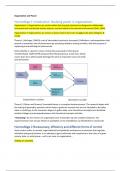
Theory 2: (Glaser and Strauss): Grounded theory is a complex iterative process. The research begins with
the raising of generative questions which help to guide the research but are not intended to be either
static or confining. As the researcher begins to gather data, core theoretical concept(s) are identified.
entative linkages are developed between the theoretical concepts and data.
"rehearsing" als een manier om organisaties voor te bereiden op een onzekere toekomst: het
experimenteren met nieuwe ideeën en praktijken en het ontwikkelen van flexibiliteit en veerkracht.
Hoorcollege 2 Bureaucracy, efficiency and different forms of control
Social control refers to societal, organizational (and political) mechanisms or processes that regulate
individual and group behavior in an attempt to gain conformity and compliance to the rules of a given
society, state, or social group - and in our case: an organization...
FORMS OF CONTROL
, - Hard coercion (formal control): regulation, sanctions
- Soft coercion (informal control): socialization, norms, values
Definition of Power: capacity of A to influence the behavior of B so that B does things he/she would
not otherwise do.
Max Weber (1864-1920): The sociology of organizations begins with the work of the German Sociologist
Max Weber. “The fate of our times is characterized by rationalization and intellectualization and, above
all, by the disenchantment of the world.”
➢ Rationalisation
• Weber’s theory is a wider theory of rationalisation (legal systems, capitalism)
• Weber's typology of three authority-based organisations:
- traditional forms based on social precedent, ritual, rights (external arbitrariness and internal
loyalty)
- those based on charismatic elements, the power of the person (trait theory, domination,
narcissism)
- modern rational-legal systems and 'formal rationality’ (bureaucracy)
Modern rational-legal systems and 'formal rationality’
Bureaucracy is the exercise of control on the basis of knowledge. It is about rational legal hierarchical
power: not the leader is important but the bureau. A bureaucratic official is personally free and
appointed to the position on the basis of conduct. The official exercises the authority delegated to them
in accordance with impersonal rules.
The legacy of Max Weber for Organizational Theory
• Not efficiency but rationality is central
• He was interested in social theory and the ideal type: (thoughtful) construct of a hypothetical
concept
• Organizational forms, intended and unintended consequences
Henri Fayol Span of control: (hierarchy)
• What is the Span of Control
o The number of people who report to one manager in a hierarchy
o The more people under the control of the manager – the wider the span of control
o Less means a narrower span of control
• Example below shows how a span of control of 4 for the marketing manager
,Frederick Taylor (1856-1915) The scientific management perspective (time and motion studies) – Hard
control
It is a theoretical approach to organizations that emphasizes organizational design, worker training for
efficiency, chains of command, and division of labor. The perspective rests on the assumption that work
and organizations can be rationally or “scientifically” designed and developed.
Hawthorne studies: measuring the production groups. The organization can be seen as a natural, human
system (Soft control, tegenreactie op de studie van Max Weber)
Douglas McGregor: Theory X ervan uitgaan dat de medewerkers niet willen werken, lui zijn, geen
verantwoordelijkheid willen en moeten worden gestuurd om doelen te behalen.
Theory Y: Ervan uitgaan dat de medewerkers het leuk vinden om te werken, creatief zijn,
verantwoordelijkheden zoeken en zichzelf kan redden.
Normative control:
1. Mechanism: internalization of norms
2. Using the cultural dimension of organizations
De normen en waarden van een organisatie dat zijn geïmplementeerd bij individuen
Soft controls is still visible, normative control is a form of soft control, bur it is going deeper, the broader
culture of an organization.
Normative control: Governs behavior through accepted patterns of action rather than written policies an
procedures. Uses values beliefs called norms, which are established standards
Internalization: Y
ou make the social norms on your own
Continue Verbetering (Kaizen)
Definitie: Kaizen is een Japans concept dat "verandering ten goede" betekent. Het verwijst naar een
continue, stapsgewijze verbetering van productieprocessen, operationele systemen en werkmethoden
binnen een organisatie.
Belangrijke Kenmerken:
• Kleine Stappen: Focus op het maken van kleine, geleidelijke veranderingen in plaats van grote,
ingrijpende aanpassingen.
• Betrokkenheid van Iedereen: Kaizen moedigt alle medewerkers aan om deel te nemen aan het
verbeteringsproces, van de werkvloer tot het management.
• Cultuur van Verbeteren: Het is een continue proces dat is ingebed in de bedrijfscultuur, gericht
op het verhogen van efficiëntie, kwaliteit en productiviteit.
Voordelen:
• Verhoogde efficiëntie en productiviteit.
, • Vermindering van verspilling en kosten.
• Betere kwaliteit van producten en diensten.
• Verbeterde werkplek tevredenheid en betrokkenheid van medewerkers.
Total Quality Management (TQM)
Definitie: Total Quality Management is een organisatiebrede benadering die gericht is op het
voortdurend verbeteren van de kwaliteit van producten, diensten en processen. Het streeft naar
klanttevredenheid door integratie van kwaliteitsbevordering in alle aspecten van de organisatie.
Belangrijke Kenmerken:
• Klantgerichtheid: De behoeften en verwachtingen van klanten staan centraal in alle activiteiten
en processen.
• Integrale Benadering: Kwaliteit wordt niet alleen gezien als de verantwoordelijkheid van een
specifieke afdeling, maar als een collectieve verantwoordelijkheid van de hele organisatie.
• Continue Verbetering: Net als bij Kaizen is voortdurende verbetering een kernprincipe, maar
TQM heeft een bredere focus op zowel processen als eindproducten.
Voordelen:
• Verhoogde klanttevredenheid door levering van hogere kwaliteit producten en diensten.
• Verbeterde efficiëntie en effectiviteit van processen.
• Versterking van de concurrentiepositie.
• Cultuur van samenwerking en betrokkenheid binnen de organisatie.
Beide concepten benadrukken het belang van kwaliteitsverbetering en medewerkersbetrokkenheid,
maar TQM heeft een bredere strategische focus op het hele kwaliteitsbeheerproces binnen een
organisatie, terwijl Kaizen zich meer richt op incrementele verbeteringen op operationeel niveau.
How to study organizational culture:
- Edgar Schein: layers of levels
Hoorcollege 1 Introduction: Studying power in organizations
Organization 1: Organizations are social entities that are goal oriented are designed as deliberately
structured and coordinated activity systems, and are linked to the external environment (Daft, 2004)
Organization 2: Organizations are arenas of power where discursive struggles take place (Maguire &
hardy)
Theory 1: (Kerlinger, 1986:9) a set of interrelated constructs (concepts), Definitions, and propositions that
present a systematic view of phenomena by specifying relations among variables, with the purpose of
explaining and predicting the phenomena.
Social identity is a person's sense of who they are based on their group
membership(s). Tajfel (1979) proposed that the groups (e.g. social class, family,
soccer team etc.) which people belonged to were an important source of pride
and self-esteem.
Theory 2: (Glaser and Strauss): Grounded theory is a complex iterative process. The research begins with
the raising of generative questions which help to guide the research but are not intended to be either
static or confining. As the researcher begins to gather data, core theoretical concept(s) are identified.
entative linkages are developed between the theoretical concepts and data.
"rehearsing" als een manier om organisaties voor te bereiden op een onzekere toekomst: het
experimenteren met nieuwe ideeën en praktijken en het ontwikkelen van flexibiliteit en veerkracht.
Hoorcollege 2 Bureaucracy, efficiency and different forms of control
Social control refers to societal, organizational (and political) mechanisms or processes that regulate
individual and group behavior in an attempt to gain conformity and compliance to the rules of a given
society, state, or social group - and in our case: an organization...
FORMS OF CONTROL
, - Hard coercion (formal control): regulation, sanctions
- Soft coercion (informal control): socialization, norms, values
Definition of Power: capacity of A to influence the behavior of B so that B does things he/she would
not otherwise do.
Max Weber (1864-1920): The sociology of organizations begins with the work of the German Sociologist
Max Weber. “The fate of our times is characterized by rationalization and intellectualization and, above
all, by the disenchantment of the world.”
➢ Rationalisation
• Weber’s theory is a wider theory of rationalisation (legal systems, capitalism)
• Weber's typology of three authority-based organisations:
- traditional forms based on social precedent, ritual, rights (external arbitrariness and internal
loyalty)
- those based on charismatic elements, the power of the person (trait theory, domination,
narcissism)
- modern rational-legal systems and 'formal rationality’ (bureaucracy)
Modern rational-legal systems and 'formal rationality’
Bureaucracy is the exercise of control on the basis of knowledge. It is about rational legal hierarchical
power: not the leader is important but the bureau. A bureaucratic official is personally free and
appointed to the position on the basis of conduct. The official exercises the authority delegated to them
in accordance with impersonal rules.
The legacy of Max Weber for Organizational Theory
• Not efficiency but rationality is central
• He was interested in social theory and the ideal type: (thoughtful) construct of a hypothetical
concept
• Organizational forms, intended and unintended consequences
Henri Fayol Span of control: (hierarchy)
• What is the Span of Control
o The number of people who report to one manager in a hierarchy
o The more people under the control of the manager – the wider the span of control
o Less means a narrower span of control
• Example below shows how a span of control of 4 for the marketing manager
,Frederick Taylor (1856-1915) The scientific management perspective (time and motion studies) – Hard
control
It is a theoretical approach to organizations that emphasizes organizational design, worker training for
efficiency, chains of command, and division of labor. The perspective rests on the assumption that work
and organizations can be rationally or “scientifically” designed and developed.
Hawthorne studies: measuring the production groups. The organization can be seen as a natural, human
system (Soft control, tegenreactie op de studie van Max Weber)
Douglas McGregor: Theory X ervan uitgaan dat de medewerkers niet willen werken, lui zijn, geen
verantwoordelijkheid willen en moeten worden gestuurd om doelen te behalen.
Theory Y: Ervan uitgaan dat de medewerkers het leuk vinden om te werken, creatief zijn,
verantwoordelijkheden zoeken en zichzelf kan redden.
Normative control:
1. Mechanism: internalization of norms
2. Using the cultural dimension of organizations
De normen en waarden van een organisatie dat zijn geïmplementeerd bij individuen
Soft controls is still visible, normative control is a form of soft control, bur it is going deeper, the broader
culture of an organization.
Normative control: Governs behavior through accepted patterns of action rather than written policies an
procedures. Uses values beliefs called norms, which are established standards
Internalization: Y
ou make the social norms on your own
Continue Verbetering (Kaizen)
Definitie: Kaizen is een Japans concept dat "verandering ten goede" betekent. Het verwijst naar een
continue, stapsgewijze verbetering van productieprocessen, operationele systemen en werkmethoden
binnen een organisatie.
Belangrijke Kenmerken:
• Kleine Stappen: Focus op het maken van kleine, geleidelijke veranderingen in plaats van grote,
ingrijpende aanpassingen.
• Betrokkenheid van Iedereen: Kaizen moedigt alle medewerkers aan om deel te nemen aan het
verbeteringsproces, van de werkvloer tot het management.
• Cultuur van Verbeteren: Het is een continue proces dat is ingebed in de bedrijfscultuur, gericht
op het verhogen van efficiëntie, kwaliteit en productiviteit.
Voordelen:
• Verhoogde efficiëntie en productiviteit.
, • Vermindering van verspilling en kosten.
• Betere kwaliteit van producten en diensten.
• Verbeterde werkplek tevredenheid en betrokkenheid van medewerkers.
Total Quality Management (TQM)
Definitie: Total Quality Management is een organisatiebrede benadering die gericht is op het
voortdurend verbeteren van de kwaliteit van producten, diensten en processen. Het streeft naar
klanttevredenheid door integratie van kwaliteitsbevordering in alle aspecten van de organisatie.
Belangrijke Kenmerken:
• Klantgerichtheid: De behoeften en verwachtingen van klanten staan centraal in alle activiteiten
en processen.
• Integrale Benadering: Kwaliteit wordt niet alleen gezien als de verantwoordelijkheid van een
specifieke afdeling, maar als een collectieve verantwoordelijkheid van de hele organisatie.
• Continue Verbetering: Net als bij Kaizen is voortdurende verbetering een kernprincipe, maar
TQM heeft een bredere focus op zowel processen als eindproducten.
Voordelen:
• Verhoogde klanttevredenheid door levering van hogere kwaliteit producten en diensten.
• Verbeterde efficiëntie en effectiviteit van processen.
• Versterking van de concurrentiepositie.
• Cultuur van samenwerking en betrokkenheid binnen de organisatie.
Beide concepten benadrukken het belang van kwaliteitsverbetering en medewerkersbetrokkenheid,
maar TQM heeft een bredere strategische focus op het hele kwaliteitsbeheerproces binnen een
organisatie, terwijl Kaizen zich meer richt op incrementele verbeteringen op operationeel niveau.
How to study organizational culture:
- Edgar Schein: layers of levels



