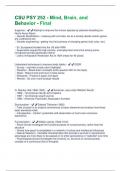
CSU PSY 252 - Mind, Brain, and
Behavior - Final
Eugenics - ✔️✔️Attempt to improve the human species by selective breeding (ex:
Nazi's Aryan Race)
- Genetic Stratification - messing with out traits, we as a society decide certain genes
are unattractive etc.
- Genetic engineering - getting into the business of changing genes (hair color, etc.)
- Ex: Europeans flooded into the US after WWI
- Eugenicists argued the high poverty, unemployment and crime among some
immigrants proved genetically inferior
- Led to immigration Restriction Act of 1924 (intact for 40 years)
Understand techniques to improve study habits - ✔️✔️SQ3R:
- Survey - read like a book (don't highlight)
- Question - Break down concepts (write question MC for the topic)
- Read - Read at end and have it make sense
- Rehearse - Practice it again and again
- Review - Go over it and analyse results
G. Stanley Hall (1846-1924) - ✔️✔️American, was under Wilhelm Wundt
- 1883 - 1st American lab @ John Hopkins
- 1887 - 1st American psych journal
- 1892 - American Psychiatric Association founded
Structuralism - ✔️✔️Edward Titchener (1892)
- Task of psych is to analyze consciences to basic elements and analyze how those
basic elements relate
- Introspection - Careful, systematic self-observation of one's own conscious
experience
Functionalism - ✔️✔️William James (1842-1910)
- Psych should investigate the function/purpose of consciousness, rather than the
structure
- Shows how psych is embedded in a network of culture and intellectual influences
- Natural Selection - Heritable characteristics that provide a survival or reproductive
advantage are more likely to be passed on to other generations or "selected" over time
- Psychologists should investigate the functions vs. structure of consciousness,
consists of a continuous flow of thoughts
, - Stream of consciousness vs lab (how people adapt their behavior to the demands of
the world
Sigmund Freud (1856-1939) - ✔️✔️Austrian psychologist came up with psychoanalysis
- Psychoanalysis - explains personality, motivation, and mental disorders by focusing
on the unconscious
- The unconscious - Contains thoughts, memories, and desires that are well below the
surface of conscious awareness, but are a great influence on behavior
Behaviorism - ✔️✔️John B. Watson (1878-1958)
- Theoretical orientation based on the premise that scientific psychology should study
observable behavior
- Behavior reflects to any observable response or activity by an organism
- S-R Psych (Simultaneous-response psych), using animals to study
- Science of behavior
B.F. Skinner (1904-1990) - ✔️✔️Psych should only study observable behavior
- working w/ lab rats and pigeons, organisms tend to repeat responses that lead to
neutral or neg. consequences
- Behavior is governed by external stimuli, Beyond Freedom & Dignity that free will is
an illusion (controversial ideas, misunderstood)
- Humanism became influential in the 1950's after behaviorism and psychoanalysis
became unsatisfactory
- Led by Abraham Maslow and Carl Rogers - emphasis on qualities of human behavior
and humans
Wilhelm Wundt (1832-1920) - ✔️✔️Made Psychology as independent discipline away
from physiology
- 1879 - 1st Successful formal psych lab
- 1881 - 1st journal devoted to psych labs
- 1883-1889 - 23 new psych labs
Carl Rogers (1902-1987) - ✔️✔️Humanistic psychologist - agreed with the main
assumptions of Abraham Maslow,
- For a person to "grow", they need:
- an environment that provides them with genuineness (openness and self-disclosure)
- acceptance (being seen with unconditional positive regard)
- empathy (being listened to and understood)
Scientific Approach - ✔️✔️Assumes there are laws of behavior that can be discovered
through empirical research
- Goals of Scientific Psychology:
- 1: Measurement/description of behavior
- 2: Understanding/prediction of behavior
- 3: Application of this knowledge to task of controlling behavior
Behavior - Final
Eugenics - ✔️✔️Attempt to improve the human species by selective breeding (ex:
Nazi's Aryan Race)
- Genetic Stratification - messing with out traits, we as a society decide certain genes
are unattractive etc.
- Genetic engineering - getting into the business of changing genes (hair color, etc.)
- Ex: Europeans flooded into the US after WWI
- Eugenicists argued the high poverty, unemployment and crime among some
immigrants proved genetically inferior
- Led to immigration Restriction Act of 1924 (intact for 40 years)
Understand techniques to improve study habits - ✔️✔️SQ3R:
- Survey - read like a book (don't highlight)
- Question - Break down concepts (write question MC for the topic)
- Read - Read at end and have it make sense
- Rehearse - Practice it again and again
- Review - Go over it and analyse results
G. Stanley Hall (1846-1924) - ✔️✔️American, was under Wilhelm Wundt
- 1883 - 1st American lab @ John Hopkins
- 1887 - 1st American psych journal
- 1892 - American Psychiatric Association founded
Structuralism - ✔️✔️Edward Titchener (1892)
- Task of psych is to analyze consciences to basic elements and analyze how those
basic elements relate
- Introspection - Careful, systematic self-observation of one's own conscious
experience
Functionalism - ✔️✔️William James (1842-1910)
- Psych should investigate the function/purpose of consciousness, rather than the
structure
- Shows how psych is embedded in a network of culture and intellectual influences
- Natural Selection - Heritable characteristics that provide a survival or reproductive
advantage are more likely to be passed on to other generations or "selected" over time
- Psychologists should investigate the functions vs. structure of consciousness,
consists of a continuous flow of thoughts
, - Stream of consciousness vs lab (how people adapt their behavior to the demands of
the world
Sigmund Freud (1856-1939) - ✔️✔️Austrian psychologist came up with psychoanalysis
- Psychoanalysis - explains personality, motivation, and mental disorders by focusing
on the unconscious
- The unconscious - Contains thoughts, memories, and desires that are well below the
surface of conscious awareness, but are a great influence on behavior
Behaviorism - ✔️✔️John B. Watson (1878-1958)
- Theoretical orientation based on the premise that scientific psychology should study
observable behavior
- Behavior reflects to any observable response or activity by an organism
- S-R Psych (Simultaneous-response psych), using animals to study
- Science of behavior
B.F. Skinner (1904-1990) - ✔️✔️Psych should only study observable behavior
- working w/ lab rats and pigeons, organisms tend to repeat responses that lead to
neutral or neg. consequences
- Behavior is governed by external stimuli, Beyond Freedom & Dignity that free will is
an illusion (controversial ideas, misunderstood)
- Humanism became influential in the 1950's after behaviorism and psychoanalysis
became unsatisfactory
- Led by Abraham Maslow and Carl Rogers - emphasis on qualities of human behavior
and humans
Wilhelm Wundt (1832-1920) - ✔️✔️Made Psychology as independent discipline away
from physiology
- 1879 - 1st Successful formal psych lab
- 1881 - 1st journal devoted to psych labs
- 1883-1889 - 23 new psych labs
Carl Rogers (1902-1987) - ✔️✔️Humanistic psychologist - agreed with the main
assumptions of Abraham Maslow,
- For a person to "grow", they need:
- an environment that provides them with genuineness (openness and self-disclosure)
- acceptance (being seen with unconditional positive regard)
- empathy (being listened to and understood)
Scientific Approach - ✔️✔️Assumes there are laws of behavior that can be discovered
through empirical research
- Goals of Scientific Psychology:
- 1: Measurement/description of behavior
- 2: Understanding/prediction of behavior
- 3: Application of this knowledge to task of controlling behavior