

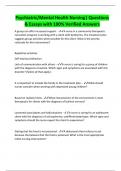
Psychiatric/Mental Health Nursing| Questions
& Essays with 100% Verified Answers
A group can offer increased support. - ✔️✔️A nurse in a community therapeutic
recreation program is working with a client with dysthymia. The treatment plan
suggests group activities when possible for this client. What is the priority
rationale for this intervention?
Repetitive activities
Self-injurious behaviors
Lack of communication with others - ✔️✔️A nurse is caring for a group of children
with the diagnosis of autism. Which signs and symptoms are associated with this
disorder? (Select all that apply.)
It is important to include the family in the treatment plan. - ✔️✔️What should
nurses consider when working with depressed young children?
Based on realistic limits - ✔️✔️What characteristic of the environment is most
therapeutic for clients with the diagnosis of bulimia nervosa?
Loosened associations and hallucinations - ✔️✔️A nurse is caring for an adolescent
client with the diagnosis of schizophrenia, undifferentiated type. Which signs and
symptoms should the nurse expect the client to experience?
Stating that the food is not poisoned - ✔️✔️A delusional client refuses to eat
because she believes that the food is poisoned. What is the most appropriate
initial nursing intervention?
,The client arrives on time for meals without being told - ✔️✔️An adolescent with
anorexia nervosa frequently telephones home just before mealtimes. The client
uses the phone calls to avoid eating. What client behavior supports the nurse's
conclusion that the nursing plan to set limits on this avoidance behavior has been
effective?
Responsiveness to the parents - ✔️✔️A 3-year-old child is found to have a
pervasive developmental disorder not otherwise specified (autistic disorder).
What should the nurse consider most unusual for the child to demonstrate?
"I didn't hear anyone talking; come with me to your room." - ✔️✔️The nurse finds a
client with schizophrenia lying under a bench in the hall. The client says, "God told
me to lie here." What is the best response by the nurse?
Perform a relaxation exercise - ✔️✔️A nurse concludes that a client has successfully
achieved the long-term goal of mobilizing effective coping responses when the
client states that when he feels himself getting anxious he will:
Encouraging the client to tear pictures out of magazines for a scrapbook -
✔️✔️What therapeutic nursing intervention may redirect a hyperactive, manic
client?
"How will you manage the next time your problems start piling up?" - ✔️✔️A nurse
moves into the working phase of a therapeutic relationship with a depressed
client who has a history of suicide attempts. What question should the nurse ask
the client when exploring alternative coping strategies?
,Denial - ✔️✔️An older adult who lives alone tells a nurse at the community health
center, "I really don't need anyone to talk to. The TV is my best friend." The nurse
identifies the defense mechanism known as:
Offering high-calorie snacks frequently that the client can hold - ✔️✔️How should
the nursing staff fulfill the nutritional needs of a client experiencing periods of
extreme mania and hyperactivity?
Antisocial personality - ✔️✔️A nurse works with school-age children who have
conduct disorder, childhood-onset type. The nurse knows that these children are
at risk for progression to another disorder during adolescence. For signs of which
disorder should the nurse evaluate their current behavior?
"Have you ever felt bad or guilty about your drinking?" - ✔️✔️A nurse uses the
CAGE screening test for alcoholism to determine an individual's potential for a
drinking problem. What is one of the four questions included on this test?
Shorten the rest of the story - ✔️✔️A mother of a 6-year-old boy with the diagnosis
of attention deficit-hyperactivity disorder (ADHD) tells the nurse that when she is
reading storybooks to her son, about halfway through the story he becomes
distracted, fidgets, and stops paying attention. The nurse suggests that the
mother:
Angry - ✔️✔️A client with bipolar disorder, manic episode, has a superior,
authoritative manner and constantly instructs other clients in how to dress, what
to eat, and where to sit. The nurse should intervene because these behaviors
eventually will cause the other clients to feel:
Verbalizes difficulty identifying personal strengths
, Acknowledges the effects of the addiction on the family
Addresses how the addiction has contributed to family distress - ✔️✔️A nurse is in
the process of developing a therapeutic relationship with a client who has an
addiction problem. What client communication permits the nurse to conclude
that they are making progress in the working stage of the relationship? (Select all
that apply.)
Confusion immediately after the treatment - ✔️✔️A nurse is assisting with the
administration of electroconvulsive therapy (ECT) to a severely depressed client.
What side effect of the therapy should the nurse anticipate?
Is too busy to take the time to eat - ✔️✔️A nurse is caring for a hyperactive, manic
client who exhibits flight of ideas and is not eating. What may be the reason why
the client is not eating?
Low self-esteem - ✔️✔️A client is found to have an adjustment disorder with mixed
anxiety and depression. What should the nurse anticipate as the client's primary
problem?
Leaving a dim light on in the client's room at night - ✔️✔️At night an older client
with dementia sleeps very little and becomes more disoriented. How can the
nurse best limit this confusion resulting from sleep deprivation?
Offer to accompany the client to the dining room - ✔️✔️On the fifth day of
hospitalization the nurse notes that a depressed client remains lying on her bed
when the clients are called to the dining room for lunch. What should the nurse
do to encourage the client to eat?
& Essays with 100% Verified Answers
A group can offer increased support. - ✔️✔️A nurse in a community therapeutic
recreation program is working with a client with dysthymia. The treatment plan
suggests group activities when possible for this client. What is the priority
rationale for this intervention?
Repetitive activities
Self-injurious behaviors
Lack of communication with others - ✔️✔️A nurse is caring for a group of children
with the diagnosis of autism. Which signs and symptoms are associated with this
disorder? (Select all that apply.)
It is important to include the family in the treatment plan. - ✔️✔️What should
nurses consider when working with depressed young children?
Based on realistic limits - ✔️✔️What characteristic of the environment is most
therapeutic for clients with the diagnosis of bulimia nervosa?
Loosened associations and hallucinations - ✔️✔️A nurse is caring for an adolescent
client with the diagnosis of schizophrenia, undifferentiated type. Which signs and
symptoms should the nurse expect the client to experience?
Stating that the food is not poisoned - ✔️✔️A delusional client refuses to eat
because she believes that the food is poisoned. What is the most appropriate
initial nursing intervention?
,The client arrives on time for meals without being told - ✔️✔️An adolescent with
anorexia nervosa frequently telephones home just before mealtimes. The client
uses the phone calls to avoid eating. What client behavior supports the nurse's
conclusion that the nursing plan to set limits on this avoidance behavior has been
effective?
Responsiveness to the parents - ✔️✔️A 3-year-old child is found to have a
pervasive developmental disorder not otherwise specified (autistic disorder).
What should the nurse consider most unusual for the child to demonstrate?
"I didn't hear anyone talking; come with me to your room." - ✔️✔️The nurse finds a
client with schizophrenia lying under a bench in the hall. The client says, "God told
me to lie here." What is the best response by the nurse?
Perform a relaxation exercise - ✔️✔️A nurse concludes that a client has successfully
achieved the long-term goal of mobilizing effective coping responses when the
client states that when he feels himself getting anxious he will:
Encouraging the client to tear pictures out of magazines for a scrapbook -
✔️✔️What therapeutic nursing intervention may redirect a hyperactive, manic
client?
"How will you manage the next time your problems start piling up?" - ✔️✔️A nurse
moves into the working phase of a therapeutic relationship with a depressed
client who has a history of suicide attempts. What question should the nurse ask
the client when exploring alternative coping strategies?
,Denial - ✔️✔️An older adult who lives alone tells a nurse at the community health
center, "I really don't need anyone to talk to. The TV is my best friend." The nurse
identifies the defense mechanism known as:
Offering high-calorie snacks frequently that the client can hold - ✔️✔️How should
the nursing staff fulfill the nutritional needs of a client experiencing periods of
extreme mania and hyperactivity?
Antisocial personality - ✔️✔️A nurse works with school-age children who have
conduct disorder, childhood-onset type. The nurse knows that these children are
at risk for progression to another disorder during adolescence. For signs of which
disorder should the nurse evaluate their current behavior?
"Have you ever felt bad or guilty about your drinking?" - ✔️✔️A nurse uses the
CAGE screening test for alcoholism to determine an individual's potential for a
drinking problem. What is one of the four questions included on this test?
Shorten the rest of the story - ✔️✔️A mother of a 6-year-old boy with the diagnosis
of attention deficit-hyperactivity disorder (ADHD) tells the nurse that when she is
reading storybooks to her son, about halfway through the story he becomes
distracted, fidgets, and stops paying attention. The nurse suggests that the
mother:
Angry - ✔️✔️A client with bipolar disorder, manic episode, has a superior,
authoritative manner and constantly instructs other clients in how to dress, what
to eat, and where to sit. The nurse should intervene because these behaviors
eventually will cause the other clients to feel:
Verbalizes difficulty identifying personal strengths
, Acknowledges the effects of the addiction on the family
Addresses how the addiction has contributed to family distress - ✔️✔️A nurse is in
the process of developing a therapeutic relationship with a client who has an
addiction problem. What client communication permits the nurse to conclude
that they are making progress in the working stage of the relationship? (Select all
that apply.)
Confusion immediately after the treatment - ✔️✔️A nurse is assisting with the
administration of electroconvulsive therapy (ECT) to a severely depressed client.
What side effect of the therapy should the nurse anticipate?
Is too busy to take the time to eat - ✔️✔️A nurse is caring for a hyperactive, manic
client who exhibits flight of ideas and is not eating. What may be the reason why
the client is not eating?
Low self-esteem - ✔️✔️A client is found to have an adjustment disorder with mixed
anxiety and depression. What should the nurse anticipate as the client's primary
problem?
Leaving a dim light on in the client's room at night - ✔️✔️At night an older client
with dementia sleeps very little and becomes more disoriented. How can the
nurse best limit this confusion resulting from sleep deprivation?
Offer to accompany the client to the dining room - ✔️✔️On the fifth day of
hospitalization the nurse notes that a depressed client remains lying on her bed
when the clients are called to the dining room for lunch. What should the nurse
do to encourage the client to eat?


