
Organic chemistry
The chemistry of carbon:
Carbon always has 4 unpaired valence electrons
Therefore, can form 4 strong covalent bonds
Bonds form a tetrahedral shape
Molecular formula:
(a chemical formula that indicates the element and number of each of the atoms in a molecule)
E.g. C4H10
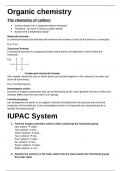
Structural formula:
(a structural formula of a compound shows which atoms are attached to which within the
molecule)
E.g.
Condensed structural formula:
(the notation shows the way in which atoms are bonded together in the molecule, but does not
show all bond lines)
E.g. CH3CH(CH3)CH3
Homologous series:
(a series of organic compounds that can be described by the same general formula in which one
member differs from the next with a CH2 group)
Functional group:
(an arrangement of atoms in an organic molecule that determine the physical and chemical
properties of that molecule. Every homologous series of compounds are characterised by a
specific functional group)
IUPAC System
1. Find the longest unbroken carbon chain containing the functional group
One carbon meth…
Two carbons eth…
Three carbons prop…
Four carbons but…
Five carbons pent…
Six carbons hex…
Seven carbons hept…
Eight carbons oct…
2. Number the carbons in the main chain from the side nearest the functional group/
first side chain
, 3. Side chains are named first in alphabetical order
Single carbon side chain methyl
Two carbon side chain ethyl
4. Any part of the molecule appearing more than once must be named with a prefix
(indicate the carbon number it appears on)
Di, tri, tetra, pent…
5. Main chain is named last based on the number of carbon atoms in longest chain,
containing the functional group (NO SPACE)
Hydrocarbons
(organic compounds consisting of only hydrogen and carbon atoms)
Non-polar molecules
Held together by weak London dispersion forces
Relatively low melting and boiling point
Insoluble in water (cannot form permanent dipole dipole forces with water molecules)
Saturated- higher MP and BP due to lower electron density than unsaturated
Strength of IMFs increase as molecular mass increases (due to increase in surface area
and electron density of the molecule)
Increase in surface area allows for more of the same type of forces to form
Branched chains have lower MP and BP than straight chains, as they have smaller surface
area, therefore reduces amount of IMFs that can form
Saturated hydrocarbons:
(compounds in which there are no multiple bonds between C atoms in their hydrocarbon chains)
Alkanes:
Molecular Structural Condensed IUPAC name General Characteristics
formula formula formula formula
CH4 CH4 Methane CnH2n+2 Physical:
-Non polar
-Weak London
dispersion
C2H6 CH3CH3 Ethane forces
-Higher MP and
BP
C3H8 CH3CH2CH3 Propane Chemical:
-Saturated
-React slowly
with most
C4H10 CH3CH(CH3)CH3 2-
substances
methylpropane
-Good source of
fuel as react
well with O2
, Unsaturated hydrocarbons:
(compounds with one or more multiple bonds between C atoms in their hydrocarbon chains)
Alkenes:
Molecular Structural Condensed IUPAC name General Characteristics
formula formula formula formula
C2H4 CH2CH2 Eth-1-ene CnH2n Physical:
-Non polar
-Weak London
dispersion
C3H6 CH2CHCH3 Prop-1-ene forces
-Less H, smaller
molecules
-Lower MP and
C4H8 CH2CHCH2CH3 But-1-ene BP
Chemical:
-Unsaturated
-React quickly
with most
substances
Alkynes:
Molecular Structural Condensed formula IUPAC name General Characteristics
formula formula formula
C2H2 CHCH Ethyne CnH2n-2 Physical:
-Non polar
-Weak London
dispersion
C3H4 CHCCH3 Propyne forces
-Less H, smaller
molecules
-Lower MP and
C7H12 CH3C(CH3)2CHCCCH3 4,4-dimethyl BP
pent-2-yne
Chemical:
-Unsaturated
-React quickly
with most
substances
Tests to distinguish between saturated/ unsaturated:
1. Add a few drops of brown liquid bromine/ purple potassium permanganate solution (KMnO 4)
to the colourless organic compound
2. If colour vanishes immediately original compound was unsaturated
3. If colour does not vanish immediately (will vanish in sun) original compound was
saturated
Combustion of hydrocarbons:
Burning of hydrocarbons in the presence of sufficient oxygen to undergo complete
combustion: Alkane+O 2 →CO 2 + H 2 O
The chemistry of carbon:
Carbon always has 4 unpaired valence electrons
Therefore, can form 4 strong covalent bonds
Bonds form a tetrahedral shape
Molecular formula:
(a chemical formula that indicates the element and number of each of the atoms in a molecule)
E.g. C4H10
Structural formula:
(a structural formula of a compound shows which atoms are attached to which within the
molecule)
E.g.
Condensed structural formula:
(the notation shows the way in which atoms are bonded together in the molecule, but does not
show all bond lines)
E.g. CH3CH(CH3)CH3
Homologous series:
(a series of organic compounds that can be described by the same general formula in which one
member differs from the next with a CH2 group)
Functional group:
(an arrangement of atoms in an organic molecule that determine the physical and chemical
properties of that molecule. Every homologous series of compounds are characterised by a
specific functional group)
IUPAC System
1. Find the longest unbroken carbon chain containing the functional group
One carbon meth…
Two carbons eth…
Three carbons prop…
Four carbons but…
Five carbons pent…
Six carbons hex…
Seven carbons hept…
Eight carbons oct…
2. Number the carbons in the main chain from the side nearest the functional group/
first side chain
, 3. Side chains are named first in alphabetical order
Single carbon side chain methyl
Two carbon side chain ethyl
4. Any part of the molecule appearing more than once must be named with a prefix
(indicate the carbon number it appears on)
Di, tri, tetra, pent…
5. Main chain is named last based on the number of carbon atoms in longest chain,
containing the functional group (NO SPACE)
Hydrocarbons
(organic compounds consisting of only hydrogen and carbon atoms)
Non-polar molecules
Held together by weak London dispersion forces
Relatively low melting and boiling point
Insoluble in water (cannot form permanent dipole dipole forces with water molecules)
Saturated- higher MP and BP due to lower electron density than unsaturated
Strength of IMFs increase as molecular mass increases (due to increase in surface area
and electron density of the molecule)
Increase in surface area allows for more of the same type of forces to form
Branched chains have lower MP and BP than straight chains, as they have smaller surface
area, therefore reduces amount of IMFs that can form
Saturated hydrocarbons:
(compounds in which there are no multiple bonds between C atoms in their hydrocarbon chains)
Alkanes:
Molecular Structural Condensed IUPAC name General Characteristics
formula formula formula formula
CH4 CH4 Methane CnH2n+2 Physical:
-Non polar
-Weak London
dispersion
C2H6 CH3CH3 Ethane forces
-Higher MP and
BP
C3H8 CH3CH2CH3 Propane Chemical:
-Saturated
-React slowly
with most
C4H10 CH3CH(CH3)CH3 2-
substances
methylpropane
-Good source of
fuel as react
well with O2
, Unsaturated hydrocarbons:
(compounds with one or more multiple bonds between C atoms in their hydrocarbon chains)
Alkenes:
Molecular Structural Condensed IUPAC name General Characteristics
formula formula formula formula
C2H4 CH2CH2 Eth-1-ene CnH2n Physical:
-Non polar
-Weak London
dispersion
C3H6 CH2CHCH3 Prop-1-ene forces
-Less H, smaller
molecules
-Lower MP and
C4H8 CH2CHCH2CH3 But-1-ene BP
Chemical:
-Unsaturated
-React quickly
with most
substances
Alkynes:
Molecular Structural Condensed formula IUPAC name General Characteristics
formula formula formula
C2H2 CHCH Ethyne CnH2n-2 Physical:
-Non polar
-Weak London
dispersion
C3H4 CHCCH3 Propyne forces
-Less H, smaller
molecules
-Lower MP and
C7H12 CH3C(CH3)2CHCCCH3 4,4-dimethyl BP
pent-2-yne
Chemical:
-Unsaturated
-React quickly
with most
substances
Tests to distinguish between saturated/ unsaturated:
1. Add a few drops of brown liquid bromine/ purple potassium permanganate solution (KMnO 4)
to the colourless organic compound
2. If colour vanishes immediately original compound was unsaturated
3. If colour does not vanish immediately (will vanish in sun) original compound was
saturated
Combustion of hydrocarbons:
Burning of hydrocarbons in the presence of sufficient oxygen to undergo complete
combustion: Alkane+O 2 →CO 2 + H 2 O


