
• Wrong document? Swap it for free
  • Written by students who passed
  • Immediately available after payment
  • Read online or as PDF
Sell
Where do you study
Your language
Document preview thumbnail
Preview 2 out of 5 pages
Summary

Summary AP Chemistry chapter 1 study guide

Document preview thumbnail
Preview 2 out of 5 pages

These are the notes that I wrote last year for the AP Chemistry exam. This chapter covers moles and molar mass, mass spectroscopy of elements, elemental composition of pure substances, composition of mixtures, atomic structure and electron configuration, photoelectron spectroscopy, periodic trends, valence elections and ionic compounds.

Content preview

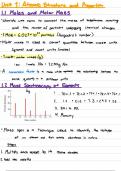
Unit 1 Atomic Structure and Properties
1 Moles and Molar Mass
chemists use moles to connect the mass of substances reacting

and the number of particles undergoing chemical changes

1Mole 6 022 1023particles Avigadro's number
Molar mass is used to convert quantities between mass units

grams and count units moles

1 mole molar mass g
ex Imole Na 22.9dg Na
A conversion factor is a ratio which represents the relationship between the

same quantity in to different units
2 Mass Spectroscopy of Elements
9 1 70 2 72 3 73 74 4 76 1

2 11 21.6 7 3 29.2 7.6
3 80.1 80
4 Mercury


Mass spec is a technique used to identify the isotopes
of an element and their relative abundance in nature

steps
Multiply each isotope by its relative abundance


Add the results

, Round to two sigfigs
Identify the element

Mass number protons neutrons Protons are the isotopes
3 Elemental Composition of Pure Substances
All pure substances elements and compounds have a fixed composition

This means the elements present and the ratio of the element's
atom is the same for every sample of the compound

Ex Sodium Chloride NaCl is a 1 1 ratio
4 Composition of Mixtures
A mixture contains more than one pure substance
Mixtures have variable compositions depending on the pure substanc

they contain and the relative amount of those substances

Solutions are an example of mixtures
The elemental composition of a mixture can be used to determ
the relative amounts of pure substances that compose it

Elemental analysis finding the relative mass of one or more

elements in the mixture 7 is often used by chemists to

determine how pure a substance is
Ex: A 2.4g sample of a mixture of CaCl2, and NaCl is found to contain 0.12g Na. What percent of

this sample is NaCl

1 Determine moles of Na
0.12.9 Na Imo Na 23.0gmol 5.22.10 mol Na

Document information

School year
3
Uploaded on
October 8, 2024
Number of pages
5
Written in
2023/2024
Type
Summary
$9.49

Wrong document? Swap it for free Within 14 days of purchase and before downloading, you can choose a different document. You can simply spend the amount again.
Written by students who passed
Immediately available after payment
Read online or as PDF

Sold
0
Followers
0
Items
2
Last sold
-


Why students choose Stuvia

Created by fellow students, verified by reviews

Quality you can trust: written by students who passed their tests and reviewed by others who've used these notes.

Didn't get what you expected? Choose another document

No worries! You can instantly pick a different document that better fits what you're looking for.

Pay as you like, start learning right away

No subscription, no commitments. Pay the way you're used to via credit card and download your PDF document instantly.

Student with book image

“Bought, downloaded, and aced it. It really can be that simple.”

Alisha Student

Working on your references?

Create accurate citations in APA, MLA and Harvard with our free citation generator.

Working on your references?

Frequently asked questions

