

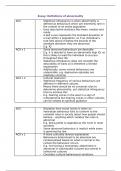
Essay: Definitions of abnormality
AO1 - Statistical infrequency is when abnormality is
defined as behaviours which are extremely rare in
the context of an entire population
- Uses descriptive statistics like mean, median and
mode
- A bell curve represents the standard deviation of
a trait within a population, so if an individual’s
trait falls above of below the bounds of the
standard deviation they are abnormal
- E.g. IQ
AO3 x 1 - Some abnormal behaviours are desirable
- E.g. it is desired to have an abnormally high IQ, as
this is likely to lead the individual to success
throughout their life
- Statistical infrequency does not consider the
desirability of traits so is therefore a limited
explanation
- Additionally, some normal behaviours are
undesirable, e.g. depressive episodes are
relatively common
AO3 x 2 - Cultural relativism
- Statistical frequency of various behaviours are
different in different cultures
- Means there should be no universal rules to
determine abnormality, yet statistical infrequency
tries to achieve this
- E.g. hearing voices in the west is a sign of
schizophrenia but hearing voices in other cultures
can be viewed as spiritual guidance
AO1 - Deviation from social norms is when an
individuals behaviour fails to conform to the
unstated rules in society about how people should
behave – anything which violates the rules is
abnormal
- E.g. being polite is regarded as the norm in most
societies
- Some abnormal behaviour is implicit while some
is governed by law
AO3 x 1 - A more culturally diverse explanation
- Behaviours determined to be abnormal are
contextualised based on what is normal in the
culture the behaviour occurs
- E.g. not having a monotropic attachment is
abnormal in individualist cultures but normal in
collectivist cultures
- Considers cultural behavioural variations
, AO3 x 2 - Context of the behaviour is vital before it can be
determined as normal or abnormal
- E.g. shouting is abnormal behaviour in a
classroom, but would be regarded as highly
normal at a football match
- A strong understanding of context is needed
Essay: Definitions of abnormality
AO1 - Failure to function adequately is when people are
judged as abnormal when people are unable to
go about their daily lives without experiencing
distress or displaying behaviour which distresses
other people
- E.g. eating regularly, washing clothes, adequate
communication, control over your life etc.
AO3 x 1 - Subjective experiences need to be considered
- For example, while not having a job or washing
clothes regularly can be considered to be
abnormal to some, some people may be content
with living like this
- Therefore personal distress levels need to be
considered before defining someone as abnormal
AO3 x 2 - Being defined as failure to function adequately is
likely to be highly subjective
- Different people will have different opinions about
what justifies an inability to function adequately,
and there is unlikely to be objective evidence to
support this
- Therefore there is likely to be vast inconsistency
in diagnosis due to the subjectivity of the process
AO1 - Deviation from ideal mental health is defined as
an inability to engage in behaviours which are
associated with competence and happiness –
includes accurate perceptions of reality and
positive self-attitudes
- 6 traits need to be met proposed by Jahoda:
positive self attitudes, personal growth/self-
actualisation, integration, autonomy, having an
accurate perception of reality and mastery of the
environment
AO3 x 1 - Major limitation is that the criteria is very difficult
to simultaneously meet
- Jahoda says to be mentally healthy, individuals
have to fulfil all 6 criteria simultaneously
- Most people in society wouldn’t be able to meet
all 6 criteria at one time, meaning entire
populations could be over-defined as abnormal
AO3 x 2 - Definition considers personal and cultural desires
AO1 - Statistical infrequency is when abnormality is
defined as behaviours which are extremely rare in
the context of an entire population
- Uses descriptive statistics like mean, median and
mode
- A bell curve represents the standard deviation of
a trait within a population, so if an individual’s
trait falls above of below the bounds of the
standard deviation they are abnormal
- E.g. IQ
AO3 x 1 - Some abnormal behaviours are desirable
- E.g. it is desired to have an abnormally high IQ, as
this is likely to lead the individual to success
throughout their life
- Statistical infrequency does not consider the
desirability of traits so is therefore a limited
explanation
- Additionally, some normal behaviours are
undesirable, e.g. depressive episodes are
relatively common
AO3 x 2 - Cultural relativism
- Statistical frequency of various behaviours are
different in different cultures
- Means there should be no universal rules to
determine abnormality, yet statistical infrequency
tries to achieve this
- E.g. hearing voices in the west is a sign of
schizophrenia but hearing voices in other cultures
can be viewed as spiritual guidance
AO1 - Deviation from social norms is when an
individuals behaviour fails to conform to the
unstated rules in society about how people should
behave – anything which violates the rules is
abnormal
- E.g. being polite is regarded as the norm in most
societies
- Some abnormal behaviour is implicit while some
is governed by law
AO3 x 1 - A more culturally diverse explanation
- Behaviours determined to be abnormal are
contextualised based on what is normal in the
culture the behaviour occurs
- E.g. not having a monotropic attachment is
abnormal in individualist cultures but normal in
collectivist cultures
- Considers cultural behavioural variations
, AO3 x 2 - Context of the behaviour is vital before it can be
determined as normal or abnormal
- E.g. shouting is abnormal behaviour in a
classroom, but would be regarded as highly
normal at a football match
- A strong understanding of context is needed
Essay: Definitions of abnormality
AO1 - Failure to function adequately is when people are
judged as abnormal when people are unable to
go about their daily lives without experiencing
distress or displaying behaviour which distresses
other people
- E.g. eating regularly, washing clothes, adequate
communication, control over your life etc.
AO3 x 1 - Subjective experiences need to be considered
- For example, while not having a job or washing
clothes regularly can be considered to be
abnormal to some, some people may be content
with living like this
- Therefore personal distress levels need to be
considered before defining someone as abnormal
AO3 x 2 - Being defined as failure to function adequately is
likely to be highly subjective
- Different people will have different opinions about
what justifies an inability to function adequately,
and there is unlikely to be objective evidence to
support this
- Therefore there is likely to be vast inconsistency
in diagnosis due to the subjectivity of the process
AO1 - Deviation from ideal mental health is defined as
an inability to engage in behaviours which are
associated with competence and happiness –
includes accurate perceptions of reality and
positive self-attitudes
- 6 traits need to be met proposed by Jahoda:
positive self attitudes, personal growth/self-
actualisation, integration, autonomy, having an
accurate perception of reality and mastery of the
environment
AO3 x 1 - Major limitation is that the criteria is very difficult
to simultaneously meet
- Jahoda says to be mentally healthy, individuals
have to fulfil all 6 criteria simultaneously
- Most people in society wouldn’t be able to meet
all 6 criteria at one time, meaning entire
populations could be over-defined as abnormal
AO3 x 2 - Definition considers personal and cultural desires


