
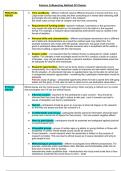
Factors Influencing Method Of Choice:
PRACTICAL ● Time and Money - different methods require different amounts of money and time. E.g
ISSUES Large scale surveys may be costly and time consuming as it needs data extracting staff
and people who are willing to take part in the research.
But small scale surveys may be cheaper and less time consuming
● Requirement of funding bodies- research institutes, businesses or the government
may require the data and results so it is important it is in the data is in the required
format. For example, a research about educational achievement may be needed in the
format of statistics
● Personal skills and characteristics - different sociologists researchers have a different
set of skills and characteristics as a result the method used may reflect this. For
example someone who mixes well with people, observant, has good recall would be
good in participant observations. Whereas someone who is empathetic will be useful in
interviews building a rapport with the interviewees
● Subject matter - it is important that the method chosen is adequate for certain subject
matters. For example a male sociologist would not be fit to conduct a study on a group
of females - may not get desired results or genuine reactions. Questionnaires would not
be adequate for deaf or blind individuals.
● Research opportunities - there can be times where a research opportunity occurs
unexpectedly. As a result the researcher needs to improvise and see which method best
fits the situation. An structured interview or questionnaire may not be able to carried out
in unexpected research opportunities - something like a participant observation would be
adequate
Patricks study of gangs - unexpected opportunity where he had to spend time with gang
leader and the gang. In that case he had no option but to use participant observation.
ETHICAL Ethical issues are the moral issues of right and wrong. When carrying a method out it is crucial
ISSUES that sociologists see if it has any ethical issues.
● Informed consent- important for the participants to give consent - they should be
informed that they have the right to refuse to take part. Lack of consent can lead to
issues of deception and harm to participants.
● Debrief - participants should be given an overview of what will happen in the research
so that they are aware and then can consent to it.
● Confidentiality and privacy - participants identity personal information should be kept
private and a secret out of respect for their privacy . this can present negative effects.
● Harm to participants - participants should be protected and safeguard against physical
or psychological harm.
● Vulnerable groups - groups of certain ages e.g elderly or young children or those with
disabilities or certain mental health issues should be cared for.
● Covert research - covert research when the researcher is hidden or the purpose of
research is hidden. This can lead to ethical issues as it causes deception and lying to
gain people's trust.
● Methodological perspectives - different sociologists have different perspectives. For
example, positivists prefer quantitative data. Marxists and functionalists prefer this as
they have a macro view on society.
Interpretivists prefer qualitative data - interactionists who study small scale face to face
interactions would like this as the focus is micro - small
PRACTICAL ● Time and Money - different methods require different amounts of money and time. E.g
ISSUES Large scale surveys may be costly and time consuming as it needs data extracting staff
and people who are willing to take part in the research.
But small scale surveys may be cheaper and less time consuming
● Requirement of funding bodies- research institutes, businesses or the government
may require the data and results so it is important it is in the data is in the required
format. For example, a research about educational achievement may be needed in the
format of statistics
● Personal skills and characteristics - different sociologists researchers have a different
set of skills and characteristics as a result the method used may reflect this. For
example someone who mixes well with people, observant, has good recall would be
good in participant observations. Whereas someone who is empathetic will be useful in
interviews building a rapport with the interviewees
● Subject matter - it is important that the method chosen is adequate for certain subject
matters. For example a male sociologist would not be fit to conduct a study on a group
of females - may not get desired results or genuine reactions. Questionnaires would not
be adequate for deaf or blind individuals.
● Research opportunities - there can be times where a research opportunity occurs
unexpectedly. As a result the researcher needs to improvise and see which method best
fits the situation. An structured interview or questionnaire may not be able to carried out
in unexpected research opportunities - something like a participant observation would be
adequate
Patricks study of gangs - unexpected opportunity where he had to spend time with gang
leader and the gang. In that case he had no option but to use participant observation.
ETHICAL Ethical issues are the moral issues of right and wrong. When carrying a method out it is crucial
ISSUES that sociologists see if it has any ethical issues.
● Informed consent- important for the participants to give consent - they should be
informed that they have the right to refuse to take part. Lack of consent can lead to
issues of deception and harm to participants.
● Debrief - participants should be given an overview of what will happen in the research
so that they are aware and then can consent to it.
● Confidentiality and privacy - participants identity personal information should be kept
private and a secret out of respect for their privacy . this can present negative effects.
● Harm to participants - participants should be protected and safeguard against physical
or psychological harm.
● Vulnerable groups - groups of certain ages e.g elderly or young children or those with
disabilities or certain mental health issues should be cared for.
● Covert research - covert research when the researcher is hidden or the purpose of
research is hidden. This can lead to ethical issues as it causes deception and lying to
gain people's trust.
● Methodological perspectives - different sociologists have different perspectives. For
example, positivists prefer quantitative data. Marxists and functionalists prefer this as
they have a macro view on society.
Interpretivists prefer qualitative data - interactionists who study small scale face to face
interactions would like this as the focus is micro - small


