Summary: Climate System Dynamics and Modelling
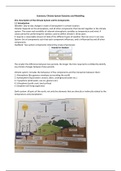
Ch1. Description of the Climate System and Its Components
1.1 Introduction
Weather: Day-to-day changes in state of atmosphere in certain location.
Climate: Depends on the atmosphere, and all other components that interact together in the climate
system. The mean and variability of relevant atmospheric variables as temperature and wind. A
classic period for performing the statistics used to define climate is thirty years.
It requires a reasonable amount of data of the different types of weather that can occur in an area.
System: Set of components such that each component influences, and is influenced by and all other
components.
Feedback: Two system components interact by a loop of processes:
The smaller the difference between two periods, the longer the time required to confidently identify
any climate changes between those periods.
Climate system: Includes the behaviour of five components and the interaction between them:
1. Atmosphere (the gaseous envelope surrounding the earth)
2. Hydrosphere (liquid water; oceans, lakes, underground water etc.)
3. Cryosphere (solid water; sea ice, glaciers etc.)
4. Lithosphere (earth crust; land surface)
5. biosphere (all living organisms)
Earth system: all parts of the earth, not only the elements that are directly or indirectly related to the
temperature and precipitation.
,1.2 The atmosphere
1.2.1. Composition and Temperature
Dry air: mainly composed of nitrogen (78% by volume), oxygen (21% by volume), argon (1% by
volume) and to a lesser extent carbon dioxide (395 ppm, 0,04% by volume). The remaining fraction is
made up of constituents such as neon, helium, methane and krypton.
Specific humidity q: The ratio between the mass of vapour and the mass of air (including water
vapour)
Clausius-Clapeyron equation: Shows that the amount of water vapour in the air at saturation strongly
depends on temperature.
The dry air and water vapour can be considered as ideal gases (perfect gases). The density,
temperature and pressure thus are related through the equation of state of perfect gases, the ideal
gas law:
𝑝 = 𝜌 ∗ 𝑅𝑔 ∗ 𝑇
p: Pressure
ρ: Density
𝑅𝑔 : Gas constant (which is equal to 287.0 J K-1 kg-1 for dry air)
T: Temperature
Hydrostatic equilibrium: The atmosphere is very close to this; at height z, the force due to the
pressure p on a 1-m2 horizontal surface balances the force due to the weight of the air above z. The
atmospheric pressure thus is at its maximum at the Earth’s surface, and the surface pressure ps is
directly related the mass of the whole air column at a particular location. Pressure then decreases
with height, following an exponential law:
𝑧
𝑝 = 𝑝𝑠 ∗ 𝑒 −𝐻
ps: surface pressure
e: partial pressure of the water vapour
z: height
H: scale height (generally 7-8 km for the lowest 100 km of the atmosphere)
Lapse rate Γ: The rate of this decrease (the temperature generally decrease with height in the
troposphere). Varies with location and season. Depends mainly on the radiative processes in the
atmosphere and in the vertical exchanges in the air column but also the horizontal heat transport.
𝜕𝑇
Γ=−
𝜕𝑧
T: Temperature
z: Height
The lapse rate determines the vertical stability of the atmosphere. If an parcel moves upward
because of a perturbation, its temperature does not remain constant: as pressure decreases with
height, the parcel expands and thus cools.
,Left: If the air parcel following an adiabatic uplift becomes colder than the environment and thus
denser than the surrounding air. It will tend to move back to its original position, inhibiting vertical
movements and leading to a stable atmosphere.
Right: If an air parcel becomes warmer than the environment and thus lighter than the surrounding
air, it will continue to move upward, and the atmosphere will be unstable.
An atmosphere in radiative equilibrium is unstable because of the warming at the surface. The air
close to the surface is generally less dense than above and tends to rise. The convection processes
thus are very important for the vertical structure of the atmosphere. The lapse rate is also involved in
feedbacks, in the response of the climate system to a perturbation.
Vertical structure atmosphere:
Troposphere (0-10 km): The temperature generally decrease with height.
- Contains 80% of the total air mass
- Positive lapse rate; temperature goes down as height increases
- Strong mixing, vertical transport of air
- Influenced by land surface processes
- All circulations and weather systems are active
Tropopause (10 km): Separates the troposphere from the stratosphere. This is the zone where the
laps rate changes from positive to negative.
Stratosphere (10-48 km): Temperature increases with height until the stratopause. Tropo- and
Stratosphere contain together 99% of the mass of the atmosphere. Negative lapse rate > stable layer
> very little mixing. Includes ozone layer, important for the absorption of UV radiation.
Stratopause (48 km): Separates the stratosphere from the mesosphere.
Mesosphere (48-80 km): Temperature decreases strongly as height increases.
, 1.2.2 General Circulation of the atmosphere
The convection is also responsible for the horizontal movements. The higher temperatures at the
equator make the air there less dense. It tends to rise before being transported poleward at high
altitudes in the troposphere. This is compensated for at the surface by an equator-ward transport of
air.
Hadley cell: Two cells driven by the ascendance at the equator, close with a downward flow around
30⁰ latitude.
Tropospheric jet streams: The poleward boundaries of the Hadley cells are marked by strongly
westerly winds in the upper troposphere. Direct cell, because its driven by convection and
ascendance in the warmest regions near the equator.
Ferrel cell: Weaker than the Hadley cell. Characterised by rising motion in its poleward branch and
downward motion in the equator-ward branch. Indirect cell
1.2.3 Precipitation
Precipitation and temperature are the most important variables in defining the climate of a region.
Precipitation is strongly influenced by the large-scale atmospheric circulation that transports water
vapour horizontally and vertically.
Vertical water vapour movements are responsible for large temperature variations that play an
important role in the condensation processes and therefore in precipitation.
Upward branch of Hadley cell > Heavy precipitation
Downward branch of Hadley cell > relatively dry air and thus very low precipitation rates > Most of
the large deserts are located in the subtropical belt
1.3 The Ocean
1.3.1 Composition and Properties
The ocean covers 71% of the Earth surface and has an average depth of 3700 m. The salinity
influences many properties of seawater; the density or the freezing-point temperature. The salinity
will be expressed in practical salinity units (psu).
Ch1. Description of the Climate System and Its Components
1.1 Introduction
Weather: Day-to-day changes in state of atmosphere in certain location.
Climate: Depends on the atmosphere, and all other components that interact together in the climate
system. The mean and variability of relevant atmospheric variables as temperature and wind. A
classic period for performing the statistics used to define climate is thirty years.
It requires a reasonable amount of data of the different types of weather that can occur in an area.
System: Set of components such that each component influences, and is influenced by and all other
components.
Feedback: Two system components interact by a loop of processes:
The smaller the difference between two periods, the longer the time required to confidently identify
any climate changes between those periods.
Climate system: Includes the behaviour of five components and the interaction between them:
1. Atmosphere (the gaseous envelope surrounding the earth)
2. Hydrosphere (liquid water; oceans, lakes, underground water etc.)
3. Cryosphere (solid water; sea ice, glaciers etc.)
4. Lithosphere (earth crust; land surface)
5. biosphere (all living organisms)
Earth system: all parts of the earth, not only the elements that are directly or indirectly related to the
temperature and precipitation.
,1.2 The atmosphere
1.2.1. Composition and Temperature
Dry air: mainly composed of nitrogen (78% by volume), oxygen (21% by volume), argon (1% by
volume) and to a lesser extent carbon dioxide (395 ppm, 0,04% by volume). The remaining fraction is
made up of constituents such as neon, helium, methane and krypton.
Specific humidity q: The ratio between the mass of vapour and the mass of air (including water
vapour)
Clausius-Clapeyron equation: Shows that the amount of water vapour in the air at saturation strongly
depends on temperature.
The dry air and water vapour can be considered as ideal gases (perfect gases). The density,
temperature and pressure thus are related through the equation of state of perfect gases, the ideal
gas law:
𝑝 = 𝜌 ∗ 𝑅𝑔 ∗ 𝑇
p: Pressure
ρ: Density
𝑅𝑔 : Gas constant (which is equal to 287.0 J K-1 kg-1 for dry air)
T: Temperature
Hydrostatic equilibrium: The atmosphere is very close to this; at height z, the force due to the
pressure p on a 1-m2 horizontal surface balances the force due to the weight of the air above z. The
atmospheric pressure thus is at its maximum at the Earth’s surface, and the surface pressure ps is
directly related the mass of the whole air column at a particular location. Pressure then decreases
with height, following an exponential law:
𝑧
𝑝 = 𝑝𝑠 ∗ 𝑒 −𝐻
ps: surface pressure
e: partial pressure of the water vapour
z: height
H: scale height (generally 7-8 km for the lowest 100 km of the atmosphere)
Lapse rate Γ: The rate of this decrease (the temperature generally decrease with height in the
troposphere). Varies with location and season. Depends mainly on the radiative processes in the
atmosphere and in the vertical exchanges in the air column but also the horizontal heat transport.
𝜕𝑇
Γ=−
𝜕𝑧
T: Temperature
z: Height
The lapse rate determines the vertical stability of the atmosphere. If an parcel moves upward
because of a perturbation, its temperature does not remain constant: as pressure decreases with
height, the parcel expands and thus cools.
,Left: If the air parcel following an adiabatic uplift becomes colder than the environment and thus
denser than the surrounding air. It will tend to move back to its original position, inhibiting vertical
movements and leading to a stable atmosphere.
Right: If an air parcel becomes warmer than the environment and thus lighter than the surrounding
air, it will continue to move upward, and the atmosphere will be unstable.
An atmosphere in radiative equilibrium is unstable because of the warming at the surface. The air
close to the surface is generally less dense than above and tends to rise. The convection processes
thus are very important for the vertical structure of the atmosphere. The lapse rate is also involved in
feedbacks, in the response of the climate system to a perturbation.
Vertical structure atmosphere:
Troposphere (0-10 km): The temperature generally decrease with height.
- Contains 80% of the total air mass
- Positive lapse rate; temperature goes down as height increases
- Strong mixing, vertical transport of air
- Influenced by land surface processes
- All circulations and weather systems are active
Tropopause (10 km): Separates the troposphere from the stratosphere. This is the zone where the
laps rate changes from positive to negative.
Stratosphere (10-48 km): Temperature increases with height until the stratopause. Tropo- and
Stratosphere contain together 99% of the mass of the atmosphere. Negative lapse rate > stable layer
> very little mixing. Includes ozone layer, important for the absorption of UV radiation.
Stratopause (48 km): Separates the stratosphere from the mesosphere.
Mesosphere (48-80 km): Temperature decreases strongly as height increases.
, 1.2.2 General Circulation of the atmosphere
The convection is also responsible for the horizontal movements. The higher temperatures at the
equator make the air there less dense. It tends to rise before being transported poleward at high
altitudes in the troposphere. This is compensated for at the surface by an equator-ward transport of
air.
Hadley cell: Two cells driven by the ascendance at the equator, close with a downward flow around
30⁰ latitude.
Tropospheric jet streams: The poleward boundaries of the Hadley cells are marked by strongly
westerly winds in the upper troposphere. Direct cell, because its driven by convection and
ascendance in the warmest regions near the equator.
Ferrel cell: Weaker than the Hadley cell. Characterised by rising motion in its poleward branch and
downward motion in the equator-ward branch. Indirect cell
1.2.3 Precipitation
Precipitation and temperature are the most important variables in defining the climate of a region.
Precipitation is strongly influenced by the large-scale atmospheric circulation that transports water
vapour horizontally and vertically.
Vertical water vapour movements are responsible for large temperature variations that play an
important role in the condensation processes and therefore in precipitation.
Upward branch of Hadley cell > Heavy precipitation
Downward branch of Hadley cell > relatively dry air and thus very low precipitation rates > Most of
the large deserts are located in the subtropical belt
1.3 The Ocean
1.3.1 Composition and Properties
The ocean covers 71% of the Earth surface and has an average depth of 3700 m. The salinity
influences many properties of seawater; the density or the freezing-point temperature. The salinity
will be expressed in practical salinity units (psu).