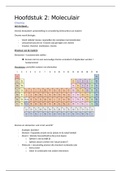
Hoofdstuk 2: Moleculair
Chemie
Het startpunt…
Chemie bestudeert samenstelling en verandering (interacties) van materie
Chemie wordt biologie:
- Vanaf cellulair niveau: organellen zijn complexe macromoleculen
- Lichaamsstructuren en -functies zijn gevolgen van chemie
- Voedsel, vloeistof, medicijnen: chemie
Structuur van de materie
Elementen = fundamentele stoffen
Kunnen niet via een eenvoudige chemie veranderd of afgebroken worden =
fundamenteel
Mendelejev: periodiek systeem van elementen
Atomen en elementen: wat is het verschil?
- Analogie: ijswinkel
- Element = bepaalde smaak van ijs (plaats in de tabel/winkel)
- Atoom = kleinste hoeveelheid ijs die je kan kopen
o Splitsen 1 bol ijs blijft ijs
o Splitsen atoom creëert iets ‘totaal anders’!!
- Molecule = verzameling atomen die chemisch verbonden zijn
o Soms zuiver
o Vaker in combinatie met andere elementen
, - Levende organismen: + 20 elementen:
Atoom = kleinste stabiele eenheid van materie
Subatomair = combinatie protonen, neutronen, elektronen
Atoomstructuur:
- Kern – positief geladen
o Protonen (p+)
o Neutronen (n0)
- Elektronen (e-) – negatief geladen
- Globaal: atoom is ongeladen: p+ = e-
- Atoomgetal:
o Hh. P+ in kern (H: 1; C: 6)
- Atoomgewicht:
o Hh. P+ + n0 in kern (H: 1; C: 12)
o (e- zijn quasi gewichtsloos)
Isotopen van een element:
- Zelfde atoomgetal (dus idem p+)
- Verschillend atoomgewicht
o Door variërend aantal neutronen
o Bv: O: 8 p+ maar 8,9,10 n0 O16-17-18
- Idem chemische interactie want bepaald door hh. e-
- Instabiele isotopen = instabiel kern radioactief
o Uitstoot energetische delen = straling = radiatie
o Alfa, bèta, gamma – straling medische toepassingen
o (uitstoten van een neutron = instabiel)
o Klinische link: radioactieve isotopen
Vb. jodium, instabiel jodium = radioactief jodium (inspuiting met dat product
prentjes maken die weergeven hoe de schildklier werkt)
Chemisch gedrag geladen atomen = interactie tussen e- = basis fysiologie op celniveau
- Elektronenmantels
Chemie
Het startpunt…
Chemie bestudeert samenstelling en verandering (interacties) van materie
Chemie wordt biologie:
- Vanaf cellulair niveau: organellen zijn complexe macromoleculen
- Lichaamsstructuren en -functies zijn gevolgen van chemie
- Voedsel, vloeistof, medicijnen: chemie
Structuur van de materie
Elementen = fundamentele stoffen
Kunnen niet via een eenvoudige chemie veranderd of afgebroken worden =
fundamenteel
Mendelejev: periodiek systeem van elementen
Atomen en elementen: wat is het verschil?
- Analogie: ijswinkel
- Element = bepaalde smaak van ijs (plaats in de tabel/winkel)
- Atoom = kleinste hoeveelheid ijs die je kan kopen
o Splitsen 1 bol ijs blijft ijs
o Splitsen atoom creëert iets ‘totaal anders’!!
- Molecule = verzameling atomen die chemisch verbonden zijn
o Soms zuiver
o Vaker in combinatie met andere elementen
, - Levende organismen: + 20 elementen:
Atoom = kleinste stabiele eenheid van materie
Subatomair = combinatie protonen, neutronen, elektronen
Atoomstructuur:
- Kern – positief geladen
o Protonen (p+)
o Neutronen (n0)
- Elektronen (e-) – negatief geladen
- Globaal: atoom is ongeladen: p+ = e-
- Atoomgetal:
o Hh. P+ in kern (H: 1; C: 6)
- Atoomgewicht:
o Hh. P+ + n0 in kern (H: 1; C: 12)
o (e- zijn quasi gewichtsloos)
Isotopen van een element:
- Zelfde atoomgetal (dus idem p+)
- Verschillend atoomgewicht
o Door variërend aantal neutronen
o Bv: O: 8 p+ maar 8,9,10 n0 O16-17-18
- Idem chemische interactie want bepaald door hh. e-
- Instabiele isotopen = instabiel kern radioactief
o Uitstoot energetische delen = straling = radiatie
o Alfa, bèta, gamma – straling medische toepassingen
o (uitstoten van een neutron = instabiel)
o Klinische link: radioactieve isotopen
Vb. jodium, instabiel jodium = radioactief jodium (inspuiting met dat product
prentjes maken die weergeven hoe de schildklier werkt)
Chemisch gedrag geladen atomen = interactie tussen e- = basis fysiologie op celniveau
- Elektronenmantels