Themba solutions
Question 1
1.1 Utilitarian View on Business Ethics
If Liberating Incorporated follows the utilitarian view on business ethics, it will focus on
making decisions that provide the greatest good for the greatest number of people. This
approach could benefit the company in the following ways:
Increased profitability: Outsourcing could lead to reduced production costs,
allowing the company to offer more competitive prices and increase profits.
Job creation: The move to a developing country could stimulate job opportunities in
that region, potentially improving local livelihoods.
Stakeholder satisfaction: The shareholders of Liberating Incorporated could benefit
from increased returns on investment due to cost savings.
However, the utilitarian view may also weigh the negative consequences:
Poor working conditions: The potential exploitation of cheap labor may harm the
company’s reputation and lead to public backlash.
Employee morale: Outsourcing could lead to job losses for existing employees,
negatively impacting morale.
Example: A factory in a developed country could be shut down due to high labor costs, and
jobs are relocated to a country with lower wages. Although this benefits the shareholders and
customers (lower prices), it could harm the displaced workers and damage the company’s
reputation.
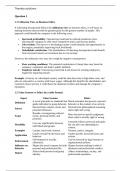
1.2 Value Systems vs Ethics (in a table format)
Aspect Value Systems Ethics
A set of principles or standards that Moral principles that govern a person's
Definition
guide individual or group behavior. behavior or the conduct of an activity.
Derived from cultural, social, and Derived from philosophical reasoning
Source
personal influences. about right and wrong.
Broader, encompassing cultural
More focused on specific judgments
Scope norms, personal beliefs, and
about what is morally right or wrong.
priorities.
Generally follows universal principles
Can vary significantly between
Flexibility but can also vary depending on
individuals and groups.
context.
Examples Loyalty, hard work, honesty. Fairness, justice, integrity.
Guides overall life decisions and Guides specific moral decisions and
Application
behavior. actions.
Self-imposed or socially Can be enforced by legal systems or
Enforcement
influenced. organizational policies.
Influence on Shapes the moral compass for both Shapes decision-making in ethical
behavior personal and professional life. dilemmas and professional conduct.
Affects both personal and group Affects relationships, society, and
Impact
identity. professional reputation.
Question 1
1.1 Utilitarian View on Business Ethics
If Liberating Incorporated follows the utilitarian view on business ethics, it will focus on
making decisions that provide the greatest good for the greatest number of people. This
approach could benefit the company in the following ways:
Increased profitability: Outsourcing could lead to reduced production costs,
allowing the company to offer more competitive prices and increase profits.
Job creation: The move to a developing country could stimulate job opportunities in
that region, potentially improving local livelihoods.
Stakeholder satisfaction: The shareholders of Liberating Incorporated could benefit
from increased returns on investment due to cost savings.
However, the utilitarian view may also weigh the negative consequences:
Poor working conditions: The potential exploitation of cheap labor may harm the
company’s reputation and lead to public backlash.
Employee morale: Outsourcing could lead to job losses for existing employees,
negatively impacting morale.
Example: A factory in a developed country could be shut down due to high labor costs, and
jobs are relocated to a country with lower wages. Although this benefits the shareholders and
customers (lower prices), it could harm the displaced workers and damage the company’s
reputation.
1.2 Value Systems vs Ethics (in a table format)
Aspect Value Systems Ethics
A set of principles or standards that Moral principles that govern a person's
Definition
guide individual or group behavior. behavior or the conduct of an activity.
Derived from cultural, social, and Derived from philosophical reasoning
Source
personal influences. about right and wrong.
Broader, encompassing cultural
More focused on specific judgments
Scope norms, personal beliefs, and
about what is morally right or wrong.
priorities.
Generally follows universal principles
Can vary significantly between
Flexibility but can also vary depending on
individuals and groups.
context.
Examples Loyalty, hard work, honesty. Fairness, justice, integrity.
Guides overall life decisions and Guides specific moral decisions and
Application
behavior. actions.
Self-imposed or socially Can be enforced by legal systems or
Enforcement
influenced. organizational policies.
Influence on Shapes the moral compass for both Shapes decision-making in ethical
behavior personal and professional life. dilemmas and professional conduct.
Affects both personal and group Affects relationships, society, and
Impact
identity. professional reputation.