

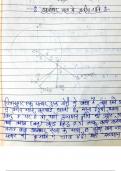
Class 11 motion in horizontal circular handwritten notes
**Motion in Horizontal Circular State (Class 11)** In horizontal circular motion, an object moves in a circular path with its plane parallel to the horizontal. The motion is governed by centripetal force, which acts towards the center of the circle, maintaining the object's circular path. This force is provided by various means, such as tension in a string, friction between tires and the road, or gravitational pull in cases like planetary orbits. Key aspects include: 1. **Centripetal Acceleration**: The acceleration directed towards the center of the circle, given by ( a_c = frac{v^2}{r} ), where ( v ) is the velocity and ( r ) is the radius of the circle. 2. **Centripetal Force**: The force that keeps the object in circular motion, calculated by ( F_c = frac{mv^2}{r} ), where ( m ) is the object's mass. 3. **Uniform Circular Motion**: The object moves with constant speed, but its velocity direction continuously changes, leading to acceleration. The velocity and force directions constantly change, but their magnitudes remain the same in uniform motion.
Infos sur le Document
- Cours
- High school
- Année scolaire
- 1
- Publié le
- 25 septembre 2024
- Nombre de pages
- 3
- Écrit en
- 2024/2025
- Type
- Notes de cours
- Professeur(s)
- Aditya
- Contenu
- Toutes les classes


