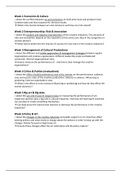
Week 1 Economics & Culture
= about the conflicts between art and commerce on both artist level and producer level.
Combine both and find a balance for the best results.
→ What is the tension between art and commerce and how can it be solved?
Week 2 Entrepreneurship: Risk & Innovation
= about the positive and negative characteristics of the creative industries. The amounts of
risks and innovations depend on the reputation of the artists (are they in the recognition or
renown-phase?).
→ What factors determine the chances of success for new entry in the creative industries?
Week 3 Management of Cultural Productions
= about the different and similar approaches of management strategies between regular
organizations and creative organizations. Different leadership styles and balanced
scorecards. Internal-organizational view.
→ How to measure the performances of - and how to best manage the creative
organizations?
Week 4 Critics & Publics (evaluations)
= about the effect of public preferences and critics reviews on the performance, audience
sizes and success rates of the creative productions. Salience vs valence. Influencing vs
predicting. External-stakeholders view.
→ What is the effect of critic reviews (influencing or predicting) and how do they affect the
market dynamics?
Week 5 Big art & Big data
= about the use and misuse of (organic) data on measuring the performances of art.
Subjective opinions play a big role in cultural industries. And how self-learning AI machines
can use data to create something themselves.
→ Can data prove the reasons that improve or decrease the performance in the creative
industries?
Week 6 Policy & Art
= about the changes in the creative industries and public support on art. How they affect
existing policies and what needs to change about the policies in order to keep up with the
changes. Mainly focused on high-brow art.
→ How do these changes affect the art institutions and the policy makers?
, WEEK 1 Economics & Culture
Article 1 Bradshaw & Holbrook
= they try to find a balance between art and commerce on the artist level of Chet Baker. By
using self-destructive behavior artists can be famous (commerce) and stay true to
themselves (creative integrity, art) at the same time. Try to avoid pandering as an artist.
Article 2 Dubois
= about French poetry publishers on artist level. Poets (art) move to the bigger publishers
(commerce) due to the better reputation (recognition and renown) it will give them. This
shapes the structure of the market.
Article 3 Velthuis
= about how to handle the pricing problem of the arts on producer level. They come up with
two options: nothing but (commerce) vs hostile worlds (art). They state that it is best to
combine both options and find a balance between the artistic and economic value.
LINK ON ART VS COMMERCE:
- Bradshaw & Holbrook: stay true to yourself with creative integrity (art) or make
money and ignore your own values with pandering (commerce). Artistic level: Chet
- Dubois: be recognized by your own art world and stay true to yourself as a poet (art).
Or move to the bigger publishers and be renown to have a better overall reputation
(commerce). They link the tension to the reputation.
- Velthuis: believe in the hostile world perspective where the artistic value is
separated from the economic value (art). Or believe in the nothing but perspective
where the price deicides the economic value (commerce).
- Menger week 2: creatives also look at the commercial labour market (commerce).
- Mol, Chiu & Wijnberg week 2: in the music industry: if you are in there for the
money (commerce) you have a more sober view on the situation and are less likely to
overestimate yourself, which will increase your chances of success. So an economic
motivation will lead to more success.
LINK OVERCONFIDENCE vs SELF-DESTRUCTION (EXAM):
- Bradshaw & Holbrook: they discuss self-destructive behaviour of entrepreneurs. It
signals authenticity, especially in the highbrow environment, it can be an marketing
strategy (+). By self-destructive behaviour, you show that your behaviour is not due
to a marketing strategy. Self-destructive behaviour can lead to positive reassessment.
- Hayward, Stephard & Griffin week 2: they discuss overconfidence of entrepreneurs.
You overestimate yourself, or underestimate the resources you need. You need to be
confident in order to start at first (+), but you are not aware of all the risks (-).
Overconfidence can lead to failure in the start.
- Boundary condition: this overconfidence should not lead to failure in the present: if
you as a firm have failed in the past (due to over confidence), in the present this
could be reevaluated as a positive thing if the reassessment is positive (and the
failure was not publicly visible). You learned from this failure. If others perceive your
process as failure, they look at you as a genius. For example Van Gogh. How he was
perceived in the past, and now. Van Gogh is a perfect example for this question.
= about the conflicts between art and commerce on both artist level and producer level.
Combine both and find a balance for the best results.
→ What is the tension between art and commerce and how can it be solved?
Week 2 Entrepreneurship: Risk & Innovation
= about the positive and negative characteristics of the creative industries. The amounts of
risks and innovations depend on the reputation of the artists (are they in the recognition or
renown-phase?).
→ What factors determine the chances of success for new entry in the creative industries?
Week 3 Management of Cultural Productions
= about the different and similar approaches of management strategies between regular
organizations and creative organizations. Different leadership styles and balanced
scorecards. Internal-organizational view.
→ How to measure the performances of - and how to best manage the creative
organizations?
Week 4 Critics & Publics (evaluations)
= about the effect of public preferences and critics reviews on the performance, audience
sizes and success rates of the creative productions. Salience vs valence. Influencing vs
predicting. External-stakeholders view.
→ What is the effect of critic reviews (influencing or predicting) and how do they affect the
market dynamics?
Week 5 Big art & Big data
= about the use and misuse of (organic) data on measuring the performances of art.
Subjective opinions play a big role in cultural industries. And how self-learning AI machines
can use data to create something themselves.
→ Can data prove the reasons that improve or decrease the performance in the creative
industries?
Week 6 Policy & Art
= about the changes in the creative industries and public support on art. How they affect
existing policies and what needs to change about the policies in order to keep up with the
changes. Mainly focused on high-brow art.
→ How do these changes affect the art institutions and the policy makers?
, WEEK 1 Economics & Culture
Article 1 Bradshaw & Holbrook
= they try to find a balance between art and commerce on the artist level of Chet Baker. By
using self-destructive behavior artists can be famous (commerce) and stay true to
themselves (creative integrity, art) at the same time. Try to avoid pandering as an artist.
Article 2 Dubois
= about French poetry publishers on artist level. Poets (art) move to the bigger publishers
(commerce) due to the better reputation (recognition and renown) it will give them. This
shapes the structure of the market.
Article 3 Velthuis
= about how to handle the pricing problem of the arts on producer level. They come up with
two options: nothing but (commerce) vs hostile worlds (art). They state that it is best to
combine both options and find a balance between the artistic and economic value.
LINK ON ART VS COMMERCE:
- Bradshaw & Holbrook: stay true to yourself with creative integrity (art) or make
money and ignore your own values with pandering (commerce). Artistic level: Chet
- Dubois: be recognized by your own art world and stay true to yourself as a poet (art).
Or move to the bigger publishers and be renown to have a better overall reputation
(commerce). They link the tension to the reputation.
- Velthuis: believe in the hostile world perspective where the artistic value is
separated from the economic value (art). Or believe in the nothing but perspective
where the price deicides the economic value (commerce).
- Menger week 2: creatives also look at the commercial labour market (commerce).
- Mol, Chiu & Wijnberg week 2: in the music industry: if you are in there for the
money (commerce) you have a more sober view on the situation and are less likely to
overestimate yourself, which will increase your chances of success. So an economic
motivation will lead to more success.
LINK OVERCONFIDENCE vs SELF-DESTRUCTION (EXAM):
- Bradshaw & Holbrook: they discuss self-destructive behaviour of entrepreneurs. It
signals authenticity, especially in the highbrow environment, it can be an marketing
strategy (+). By self-destructive behaviour, you show that your behaviour is not due
to a marketing strategy. Self-destructive behaviour can lead to positive reassessment.
- Hayward, Stephard & Griffin week 2: they discuss overconfidence of entrepreneurs.
You overestimate yourself, or underestimate the resources you need. You need to be
confident in order to start at first (+), but you are not aware of all the risks (-).
Overconfidence can lead to failure in the start.
- Boundary condition: this overconfidence should not lead to failure in the present: if
you as a firm have failed in the past (due to over confidence), in the present this
could be reevaluated as a positive thing if the reassessment is positive (and the
failure was not publicly visible). You learned from this failure. If others perceive your
process as failure, they look at you as a genius. For example Van Gogh. How he was
perceived in the past, and now. Van Gogh is a perfect example for this question.