100% satisfaction guarantee Immediately available after payment Both online and in PDF No strings attached 4.2 TrustPilot
logo-home
Other

PHIL-447N Week 6 Discussion Question 1 – Inductive Reasoning – Download To Score An A+

Rating
-
Sold
-
Pages
3
Uploaded on
22-09-2024
Written in
2024/2025

PHIL-447N Week 6 Discussion Question 1 – Inductive Reasoning – Download To Score An A+ In what way are the two situations comparable? The two situations mentioned are similar. The issues that came to mind was the fact that each of the two industry are “money driven”. I say that because it is apparent that they do not care about the well-being of the customer. Both companies push their products to make money, nevertheless without caring that they are harming people. Another reason the two are comparable is because they both were endorsed by physicians. Doctors were not warning patients about the serious complications accompanied with both tobacco and opiates. In what way are they different? One difference between the two is that one is easily obtainable and the other is not. Tobacco is legal and can be easily purchased over the counter at the age of 18. Opiates are a bit harder to get, as it must be prescribed by a physician. It is very easy to get hooked on both. However, with tobacco, since it is so accessible, people have no trouble getting it. With opiates people unfortunately put themselves in unpredictable positions to get prescription refilled. Physicians should definability be careful when prescribing this medication class. Apply the concept of moral equivalence. Is the conduct of doctors in relation to smoking and the tobacco industry morally equivalent to the conduct of doctors in the opioid crisis? Explain your position and be very specific. In my opinion, these issues are comparable, but I see the tobacco companies being worse. It is well known how terrible tobacco is for the body, yet tobacco companies still push their products onto people and make obtaining them incredibly easy. “Tobacco use leads to long term health problems” (CDC, 2020). According to the CDC some of the health complications related to tobacco use include asthma, lung disease/cancer, COPD, gum disease, tooth loss/decay, heart disease, stroke, miscarriage, etc (CDC, 2020). Smoking tobacco is the leading cause of preventable death. It is a serious addiction was well as opiates that should be treated more seriously. Center of disease control and prevention [CDC], 2020, Part 2 Myopia is a common onset of nearsightedness that is believed due to a combination of genetic and environmental factors. Results from animal experiments indicate that light cycles may affect the development of myopia (Quinn et al, 2019). The report provides an association between childhood myopia and night-time lighting before the age of two. The issue can involve causation of a natural sciences kind or causation of the social. Causal thinking includes figuring out which of a few potential clarifications is the best record for a given event. Developing causation is important for a couple of reasons, it enables us to set up explanations. Second, it engages us to make assumptions, and in this way review the various plans and methodologies about things. The degree of acceptability and relevance affects the degree of strength. Often, additional information may increase our certainty about the conclusion. “It demands the application of all of our critical thinking skills: analysis, interpretation, inference, explanation, evaluation, and reflective self- correction” (Facione & Gittens, 2016). References: Facione, P. A., & Gittens, C. A. (2016). Think critically (3rd ed.). Boston: Pearson. Quinn, G (1999). Myopia and ambient lighting at night. Nature, 399(6732), 113-114. Zadnik, K. (2000). Myopia and ambient night-time lighting. CLEERE study group. Collaborative longitudinal evaluation of ethnicity and refractive error. Nature, 404(6774), 143-144. Ethics: Option 2: What moral guidelines should we use when it comes to recently introduced healthcare technologies of any kind (you will note and engage with your own examples) and social technologies of any kind (you will note and engage with your own examples)? “Care as a normative value is indeed related to the ideal of not inflicting harm, but it must also include a reasonably limited commitment to actively working for the prevention of harm.” (Pettersen, 2011). These are aspects that pose moral and ethical issues in technology today which will outline and control the consideration of all the parties involved. Ethical concerns with health issues, job displacement, and gender are the situations that require ethical thinking when it comes to designing the technical applications. A relevant issue now is social-media based applications. The patient-physician relationship can suffer from the new information gain on both sides since private information of both the healthcare provider and patient may be hindered by way of internet. Not having the ability to maintain a person’s behavior and thoughts should motivate healthcare professionals to cultivate kindness and enhance the benefits of foresight with the change of technology. Many patients have unique health status and personal views with health platforms. It is certain that these measures involves certain risks, but the overall benefit is to exceed the risk. Recognition of human dignity requires fair and equal treatment for all people. When developing products and technical solutions, we must be aware of the moral issues of the technology being used, and take these factors into practice in order to realize how the software and products will have an impact on human health. Reference: Pettersen T. (2011). The ethics of care: normative structures and empirical implications. Health care analysis : HCA : journal of health philosophy and policy, 19(1), 51–64. Rachels, S., & Rachels, J. (2019). The elements of moral philosophy (9th ed.). Mcgraw-Hill Education. Schuchter, P., & Heller, A. (2018). The Care Dialog: the "ethics of care" approach and its importance for clinical ethics consultation. Medicine, health care, and philosophy, 21(1), 51–62.

Show more Read less


Whoops! We can’t load your doc right now. Try again or contact support.

Document information

Uploaded on
September 22, 2024
Number of pages
3
Written in
2024/2025
Type
Other
Person
Unknown

Subjects

Content preview

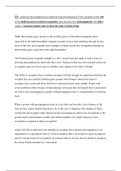
In what way are the two situations comparable?

The two situations mentioned are similar. The issues that came to mind was the fact that each of
the two industry are “money driven”. I say that because it is apparent that they do not care about
the well-being of the customer. Both companies push their products to make money, nevertheless
without caring that they are harming people. Another reason the two are comparable is because
they both were endorsed by physicians. Doctors were not warning patients about the serious
complications accompanied with both tobacco and opiates.

In what way are they different?

One difference between the two is that one is easily obtainable and the other is not. Tobacco is
legal and can be easily purchased over the counter at the age of 18. Opiates are a bit harder to
get, as it must be prescribed by a physician. It is very easy to get hooked on both. However, with
tobacco, since it is so accessible, people have no trouble getting it. With opiates people
unfortunately put themselves in unpredictable positions to get prescription refilled. Physicians
should definability be careful when prescribing this medication class.

Apply the concept of moral equivalence. Is the conduct of doctors in relation to smoking and the
tobacco industry morally equivalent to the conduct of doctors in the opioid crisis? Explain your
position and be very specific.


In my opinion, these issues are comparable, but I see the tobacco companies being worse. It is
well known how terrible tobacco is for the body, yet tobacco companies still push their products
onto people and make obtaining them incredibly easy. “Tobacco use leads to long term health
problems” (CDC, 2020). According to the CDC some of the health complications related to
tobacco use include asthma, lung disease/cancer, COPD, gum disease, tooth loss/decay, heart
disease, stroke, miscarriage, etc (CDC, 2020). Smoking tobacco is the leading cause of
preventable death. It is a serious addiction was well as opiates that should be treated more
seriously.


Center of disease control and prevention [CDC], 2020, https://www.cdc.gov/tobacco/about/osh/


This study source was downloaded by 100000883055406 from CourseHero.com on 09-19-2024 14:02:39 GMT -05:00


https://www.coursehero.com/file/154589972/Week-6-discussion-part-1docx/

Get to know the seller

Seller avatar
Reputation scores are based on the amount of documents a seller has sold for a fee and the reviews they have received for those documents. There are three levels: Bronze, Silver and Gold. The better the reputation, the more your can rely on the quality of the sellers work.
DocEdyth Teachme2-tutor
View profile
Follow You need to be logged in order to follow users or courses
Sold
26
Member since
2 year
Number of followers
12
Documents
520
Last sold
1 month ago

4.0

2 reviews

5
1
4
0
3
1
2
0
1
0

Recently viewed by you

Why students choose Stuvia

Created by fellow students, verified by reviews

Quality you can trust: written by students who passed their exams and reviewed by others who've used these revision notes.

Didn't get what you expected? Choose another document

No problem! You can straightaway pick a different document that better suits what you're after.

Pay as you like, start learning straight away

No subscription, no commitments. Pay the way you're used to via credit card and download your PDF document instantly.

Student with book image

“Bought, downloaded, and smashed it. It really can be that simple.”

Alisha Student

Frequently asked questions